
Most lists of the world's oldest games are lists of dead games. Senet, Mehen, the Royal Game of Ur — magnificent, ancient, and nobody has played any of them without a gap of two thousand years or more.
This is the other list. Every game here has been played continuously, handed from one generation to the next, with no point at which somebody had to reconstruct it from a tomb painting. The winner is not close.
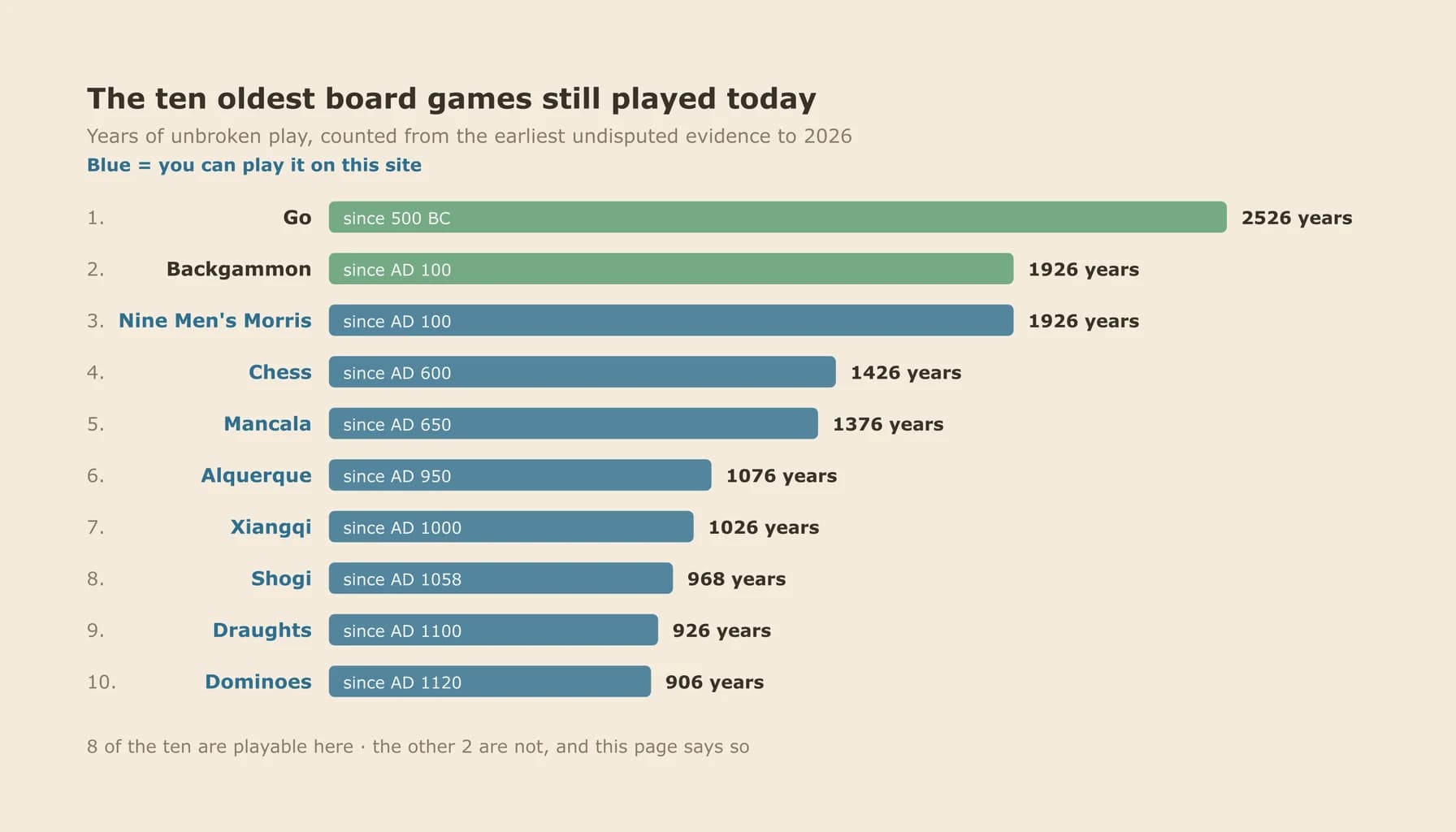
- 2,526 years of unbroken play — Go, the oldest surviving game
- 600 years of clear water between Go and second place
- 8 of 10 on this list are playable free on this site
- 2,600 years between the oldest board and the oldest living game
What is the oldest game in the world still played today?
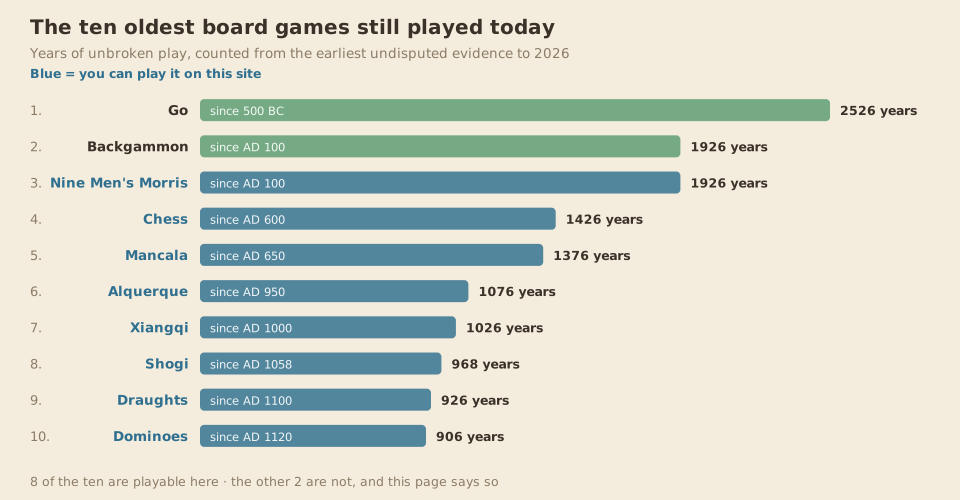
Go, at roughly 2,526 years. Chinese texts describe it by the fifth century BC — the Zuo Zhuan discusses events of 548 BC in terms a player would recognise — and it has been played every century since without interruption.
It is not that Go never changed. The board grew from 17×17 to 19×19, and the old Chinese game began with stones already placed on the corner points. But nobody ever had to work out how it went from archaeology. The rules travelled by people teaching people, unbroken, from the Zhou dynasty to the phone in your pocket.
The ten oldest board games still played today
| # | Game | Playing since | Unbroken years | Earliest solid evidence |
|---|---|---|---|---|
| 1 | Go | c. 500 BC | 2,526 | Zuo Zhuan, on events of 548 BC |
| 2 | Backgammon | c. AD 100 | 1,926 | Roman tabula, then Persian nard |
| 3 | Nine Men's Morris | c. AD 100 | 1,926 | Roman boards cut into pavements |
| 4 | Chess | c. AD 600 | 1,426 | chaturanga in Indian sources |
| 5 | Mancala | c. AD 650 | 1,376 | Aksumite boards, Ethiopia and Eritrea |
| 6 | Alquerque | c. AD 950 | 1,076 | quirkat, described in Arabic sources |
| 7 | Xiangqi | c. AD 1000 | 1,026 | settled form under the Song |
| 8 | Shogi | c. AD 1058 | 968 | dated pieces excavated at Nara |
| 9 | Draughts | c. AD 1100 | 926 | alquerque moved onto a chess board |
| 10 | Dominoes | c. AD 1120 | 906 | Song-dynasty references |
Two of them are missing from this site — Go and backgammon — and that is worth saying plainly rather than quietly leaving them off the list. The other eight are one click away, at the bottom of this page.
Why Senet and the Royal Game of Ur are not on this list
Because nobody plays them. That sounds blunt, but it is the entire distinction between "oldest game" and "oldest game still played", and it is where almost every list on the internet goes wrong.
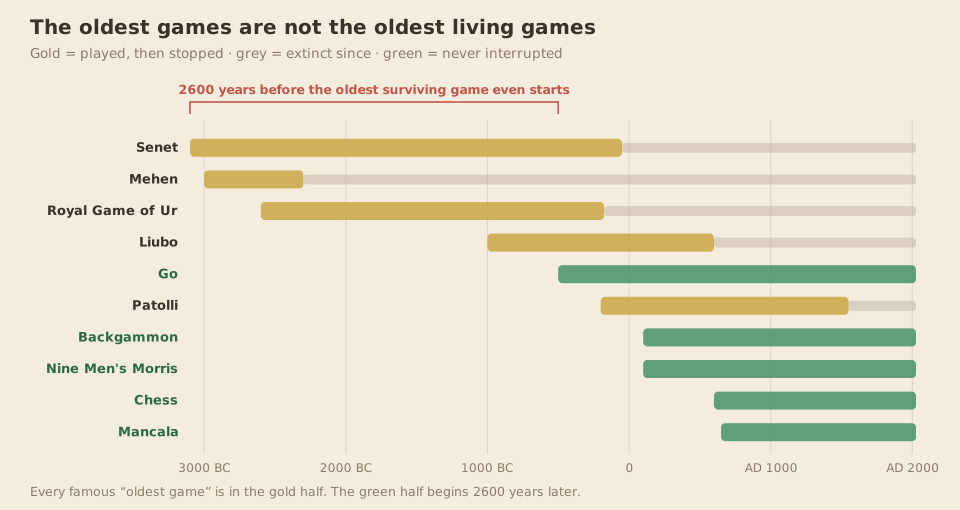
Senet was played for about 3,050 years — longer than anything in the table above — and has been extinct for roughly two thousand. The Royal Game of Ur is the oldest game whose rules we actually know, thanks to a Babylonian tablet, and it too died out; what is played today is a reconstruction, however good.
The full argument about which game deserves the title, and why the answer depends on whether you mean the board, the rules or the playing, is set out in what is the oldest board game in the world.
What counts as "still played"?
Every entry in the table had to clear the same three bars. They are strict on purpose — loosen any one of them and the list fills up with games that are really modern reconstructions wearing old names.
- Continuity of play, not of objects. A board found in the ground proves somebody owned it, not that anybody has played it since. Boards are cheap evidence; an unbroken chain of players is expensive evidence.
- Dated from the earliest undisputed evidence. Where a game has an exciting early claim and a defensible later one, this list takes the later one. Mancala is the clearest case: you will see 5000 BC quoted from rows of holes in Jordan and Egypt, while the earliest finds scholars agree are game boards are Aksumite, around the sixth or seventh century AD.
- The game, not the family. Draughts descends from alquerque, and both are listed, because they are played as separate games today with separate rules. Ludo descends from pachisi — but Ludo is a Victorian patent, so its date is 1896, not 1500.
Which games nearly made the list?
Four came close and failed on one of the three bars. They are worth naming, because each fails differently — and between them they show what "still played" is actually asking.
| Game | Why it looks old enough | Why it is not on the list |
|---|---|---|
| Hnefatafl | Viking boards from the ninth century, and a family reaching back to Roman ludus latrunculorum | The chain broke. Tablut survived in Lapland until Linnaeus wrote it down in 1732; everything played today is reconstructed from that one account |
| Pachisi | Played at Akbar's court in the sixteenth century, on a family of cross-and-circle boards far older | The game is continuous, but its documented history starts around AD 1500 — recent enough to fall well outside the top ten |
| Liubo | The great board game of Han China, on tomb walls and in poetry for over a thousand years | Died out around the sixth century AD. The rules are lost, exactly like Senet's |
| Patolli | Played across Mesoamerica for well over a thousand years before contact | Suppressed after the Spanish conquest. What is played now was revived, not inherited |
Hnefatafl is the instructive one. It is genuinely old, genuinely well documented, and genuinely playable — and it still fails, because the version on this site and everywhere else descends from a single eighteenth-century description of a Sámi game. That is the same predicament as Senet, only eight hundred years less severe. Tafl variants traces what survived and what did not.
Where do the surviving old games come from?
Five regions, and they are not evenly matched. East Asia alone holds four of the ten — Go, xiangqi, shogi and dominoes — which is more than Europe and West Asia put together.
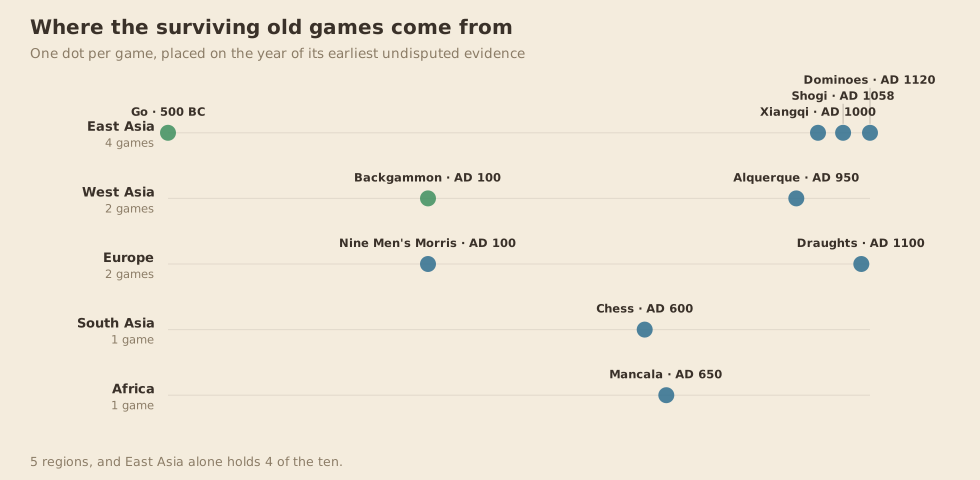
There is a second pattern in that picture. Look at the right-hand end: xiangqi, alquerque, shogi, draughts and dominoes all appear within about 170 years of each other, between AD 950 and AD 1120, on three separate continents. That is not coincidence so much as evidence — it is the period from which enough written material survives, across enough of the world, to date a game confidently.
Which of these can you play right now?
Eight of the ten, free and in the browser, no account:
- Nine Men's Morris — third on the list, the Roman one, cut into pavements from Britain to Syria. Also three, six and twelve men's morris
- Chess — the descendant of chaturanga
- Mancala and Oware — the sowing family, still played daily across Africa and the Caribbean
- Alquerque — the ancestor draughts grew out of
- Xiangqi — Chinese chess, with the river and the palace
- Shogi — Japanese chess, where captured pieces change sides
- Draughts — alquerque's descendant on the 8×8 board
- Dominoes — the Song-dynasty tile game
For the two that are not here, Go needs a 19×19 board and a strong engine to be worth playing, and backgammon needs dice and a doubling cube. Both deserve doing properly or not at all.
Questions people actually ask
What is the oldest game in the world that is still played?
Go, at about 2,526 years of unbroken play, dated from Chinese texts of the fifth century BC. It is the only game on this list with a continuous record stretching before the common era.
What is the oldest board game still played today in the West?
Backgammon and nine men's morris, both at roughly 1,926 years, both with solid Roman evidence. Backgammon's line runs through tabula and Persian nard; morris boards are cut into stone across the whole Roman world.
Is chess older than backgammon?
No. Chess appears in India as chaturanga in the sixth or seventh century AD, about five hundred years after Roman tabula. Chess also changed its rules far more along the way — the queen only became the strongest piece in the fifteenth century.
Why isn't Senet on a list of oldest games still played?
Because it stopped being played around two thousand years ago and the rules were never written down. Everything sold or played as senet today is a twentieth-century reconstruction. It is the oldest board, not the oldest game.
Is mancala really 7,000 years old?
No. That number comes from rows of holes in the ground that may have been counting devices, calendars or tallies rather than game boards. The earliest finds scholars agree are mancala boards are Aksumite, around AD 600–700, which makes mancala about 1,400 years old — still older than chess.
What is the oldest game we know the rules to?
The Royal Game of Ur, around 2600 BC, because a Babylonian clay tablet from 177 BC describes how it worked. It is not on this list because the chain of play broke; it was reconstructed, not inherited. The difference is laid out in what is the oldest board game in the world.
If the question you actually had was about the very beginning rather than the survivors, that is a different article: when was the first board game invented covers the finds themselves — where they turn up, how they are dated, and why no single one of them can be called the first.