Learn chess by playing it. This is a complete game of chess in your browser — free, no download, no account — with a coach built in that explains what is happening while you play. Tap a piece and every square it can legally reach lights up, so you cannot make an illegal move while you are still learning.
Switch the coach off the moment you stop needing it, and you have a clean, serious game of chess.
How to play chess
The aim is checkmate: attack the enemy king so that it cannot get out of being captured next move. Not capture it — trap it. A game of chess ends the move before the king would actually be taken.
How the chess pieces move
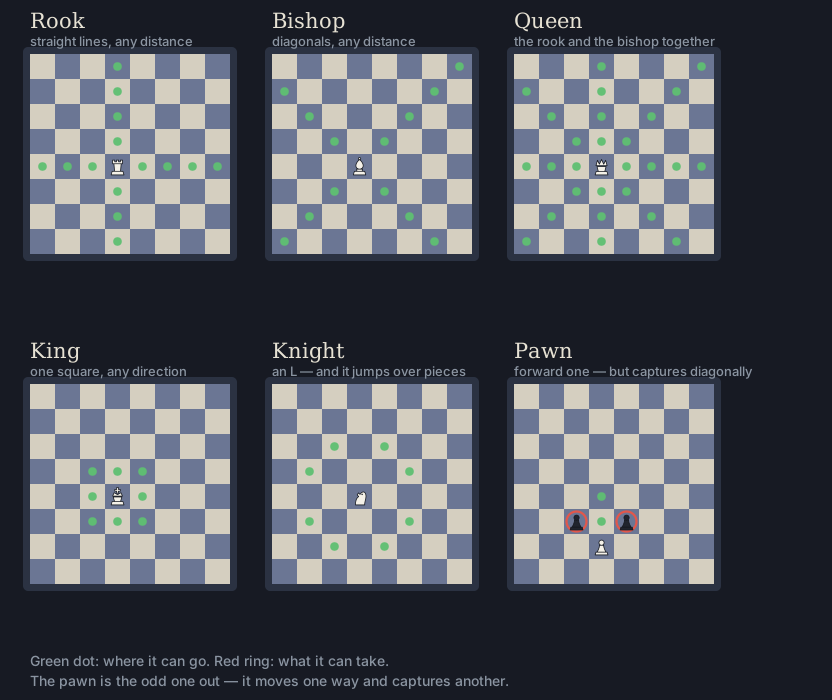
- Rook — straight lines, any distance, along its rank or file.
- Bishop — diagonals, any distance. Each bishop stays on one colour for the whole game.
- Queen — the rook and the bishop combined. The most powerful piece.
- King — one square in any direction. He can never move into check.
- Knight — two squares one way, one square across: an L. It is the only piece that jumps over others.
- Pawn — forward one square (or two on its very first move), but it captures diagonally. That split is what makes pawns confusing, and it is why they are worth teaching last.
Nothing except the knight may jump. If a piece is in the way, that is where the line stops.
Castling, en passant and promotion
Three rules that beginners meet late and nobody explains well:
Castling moves king and rook at the same time, tucking the king into a corner behind its pawns. Allowed if neither piece has moved, the squares between them are empty, and the king is not in check now, does not pass through check, and does not land in it. It is the only move where two pieces move at once.
En passant — "in passing". If a pawn uses its two-square first move to slip past an enemy pawn that would have captured it, that enemy pawn may take it anyway, as though it had only moved one square. The chance lasts exactly one move.
Promotion — a pawn that reaches the far side becomes any piece you like. Almost always a queen. You can have two queens, or nine.
Check, checkmate and stalemate
- Check — your king is attacked. You must get out of it: move him, block the line, or capture the attacker. There is no option to ignore it.
- Checkmate — you are in check and none of those three works. The game ends immediately, and whoever delivered it wins.
- Stalemate — you are not in check, but you have no legal move at all. That is a draw, not a loss, and it is how a losing position is very often saved. Take care when you are far ahead.
When a game is a draw
Four ways, and the game spots all four for you and ends the game itself:
- Stalemate — no legal move, and not in check.
- Threefold repetition — the same position has occurred three times.
- The fifty-move rule — fifty moves each with no capture and no pawn move.
- Insufficient material — neither side has enough left to checkmate at all, such as king and bishop against king.
In a club game there is a fifth: the two players simply agree. There is no draw-offer button here, because against a computer there is nobody to ask.
Your first checkmate: the ladder
If you learn one finish, learn this one.
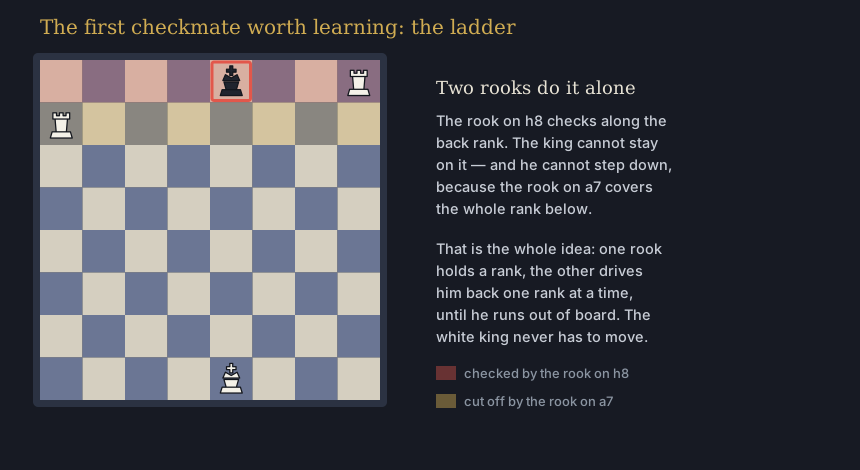
Two rooks walk a lonely king backwards, one rank at a time, until he runs out of board. One rook holds the rank in front of him so he cannot come back; the other checks the rank he is on so he cannot stay. Then they swap jobs and repeat.
It is worth learning first because it is visual, it repeats, and you can execute it without understanding a single thing about strategy. Your king never has to help.
What not to learn first is the four-move checkmate. It works twice, then never again, and the habit it leaves — queen out early, chasing one cheap threat — is exactly what your next opponent will punish.
What the first moves are for
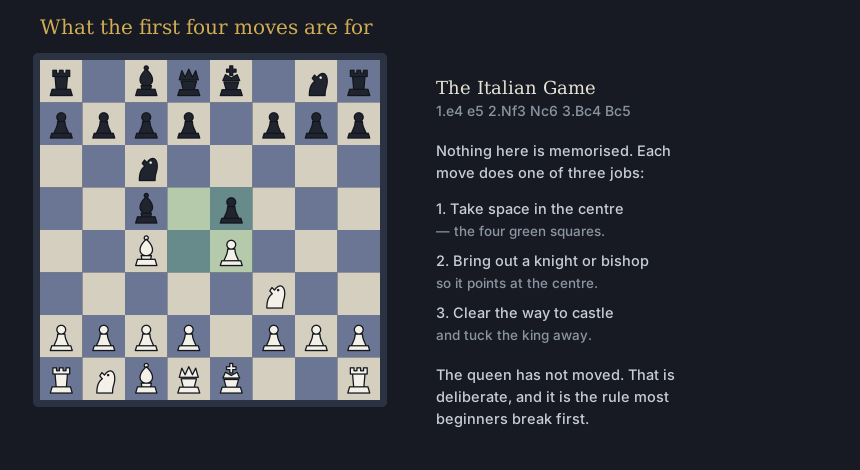
You do not need opening theory. Every sensible first move is doing one of three things:
- Take space in the centre. The four squares in the middle are where pieces reach furthest. A pawn on e4 or d4 claims some of it.
- Bring out a knight or a bishop so it points at that centre. A piece still on its starting square is doing nothing.
- Clear the way to castle, so the king can get out of the middle before the position opens up.
And one thing not to do: do not bring the queen out early. She is the most valuable piece, so every minor piece that attacks her gains a free move by chasing her. This is the rule beginners break first and pay for most often.
The built-in coach
This is what the game was built for. Turn the hints on and the board starts explaining itself.
| What you see | What it means |
|---|---|
| Blue arrow | A strong move, with a plain-English reason for it. |
| Opening name | Names what you are playing as you play it — Italian Game, Sicilian Defence and the rest. |
| Red pulse | One of your pieces can be taken for free right now. |
| Advantage bar | Who is ahead, so you can feel the game swing. |
The point is not to be told what to do. It is to be told why, on a position you are actually in — which is the difference between a lesson and a habit.
Turn it off and nothing is left but chess.
Playing on this board
Against the computer
| Level | What to expect |
|---|---|
| Easy | Looks one move ahead and plays loosely. A gentle first opponent that will let you get away with things. |
| Medium | Plans three moves ahead and follows an opening book. A fair fight for a club beginner. |
| Hard | Searches deeper, plays the best move it finds, and punishes a hanging piece immediately. |
Choose white or black before you start and the board turns to face your side. Undo steps back through the game — for a beginner that is a teaching tool rather than cheating, because "what if I had gone there instead" is where most of the learning actually happens.
Two players on one screen
Pick Two Players and the board is shared, one screen, taking turns. It is the easiest way to teach somebody, because you are sitting next to them instead of opposite a computer — the game keeps the rules so you can do the encouraging.
Common beginner mistakes
- Moving the same piece twice in the opening while the rest sit at home.
- Bringing the queen out early and losing three moves running away with her.
- Ignoring what the opponent just threatened. Before your own plan, ask what their last move attacks.
- Trading pieces for no reason. An exchange should improve something — your structure, your king's safety, your control of a square.
- Forgetting stalemate when you are winning. Leave the losing king a legal move until you are ready to mate.
Teaching a child chess
The whole first month is a different problem from playing, and we wrote it up separately: how to teach a child chess when you barely play yourself covers when a child is ready, the order to introduce the pieces — rook first, pawn last, the same order as the diagram above — why you should not start with a whole game, and what to do about the losing problem.
The two features that matter most for that job are on this board already: legal moves that light up, so a child cannot make an illegal one, and Undo, so a blunder becomes a question instead of a defeat.
Learn chess: what to do next
- Play a full game on Easy with the coach on, and read every reason it gives.
- Learn the ladder mate above until you can do it without thinking.
- Then play Medium with the coach off, and turn it back on only when you are stuck.
Away from the screen: the printable chess board gives you a full-page board with coordinates, all thirty-two pieces to cut out and the rules on one sheet — in colour, or in an ink-saving version if you need thirty copies for a class.
More is coming to this page: piece worksheets, a diagram maker for teachers, and checkmate puzzle sheets. If there is something you want for a chess club or a classroom, it is worth asking for.
About this chess game
Every rule of real chess is implemented — castling on both sides, en passant, promotion to any piece, check, checkmate, stalemate and each of the draws. Moves are recorded in standard algebraic notation and captured pieces are tracked, so you can look back over a game afterwards.
The computer opponent is our own engine, not a borrowed one: it searches with alpha-beta and a quiet-position check, and follows an opening book on the easier levels so that early play stays varied and instructive. Your hints preference is kept in your own browser and nowhere else.
If you like this one, Checkers is the natural next board, and Hnefatafl is the game chess actually replaced in northern Europe — the two compared is a good way to see what chess's symmetry actually buys you.