
Print & Play
Printable Chess Board
A full-page board with coordinates, all thirty-two pieces to cut out and the rules on one sheet — pick your paper size, press print, play.
Paper
Colours
Sheets
To get a PDF, choose Save as PDF as the printer in the print dialog.
Chess · playnook.io
Pieces
Cut along the dashed lines. Each row is already in order: back rank, then the eight pawns, white first.
A pawn that reaches the far side is promoted — usually to a queen. Print a second copy of this sheet if you want spare queens, or turn a captured rook upside down.
Chess · playnook.io
Chess — quick rules
The starting position. A light square goes bottom right. White moves first.
- Rook — straight lines, any distance.
- Bishop — diagonals, any distance. It stays on one colour all game.
- Queen — rook and bishop combined.
- King — one square in any direction, and never into check.
- Knight — an L: two squares one way, one across. The only piece that jumps.
- Pawn — forward one (or two on its first move), but it captures diagonally.
Winning. Attack the enemy king so it cannot escape — that is checkmate. If a player is not in check but has no legal move at all, the game is a draw.
Castling moves king and rook together if neither has moved and the king is not in, through or into check. Promotion turns a pawn that reaches the far row into any piece.
Play online: playnook.io/games/chess
What you get
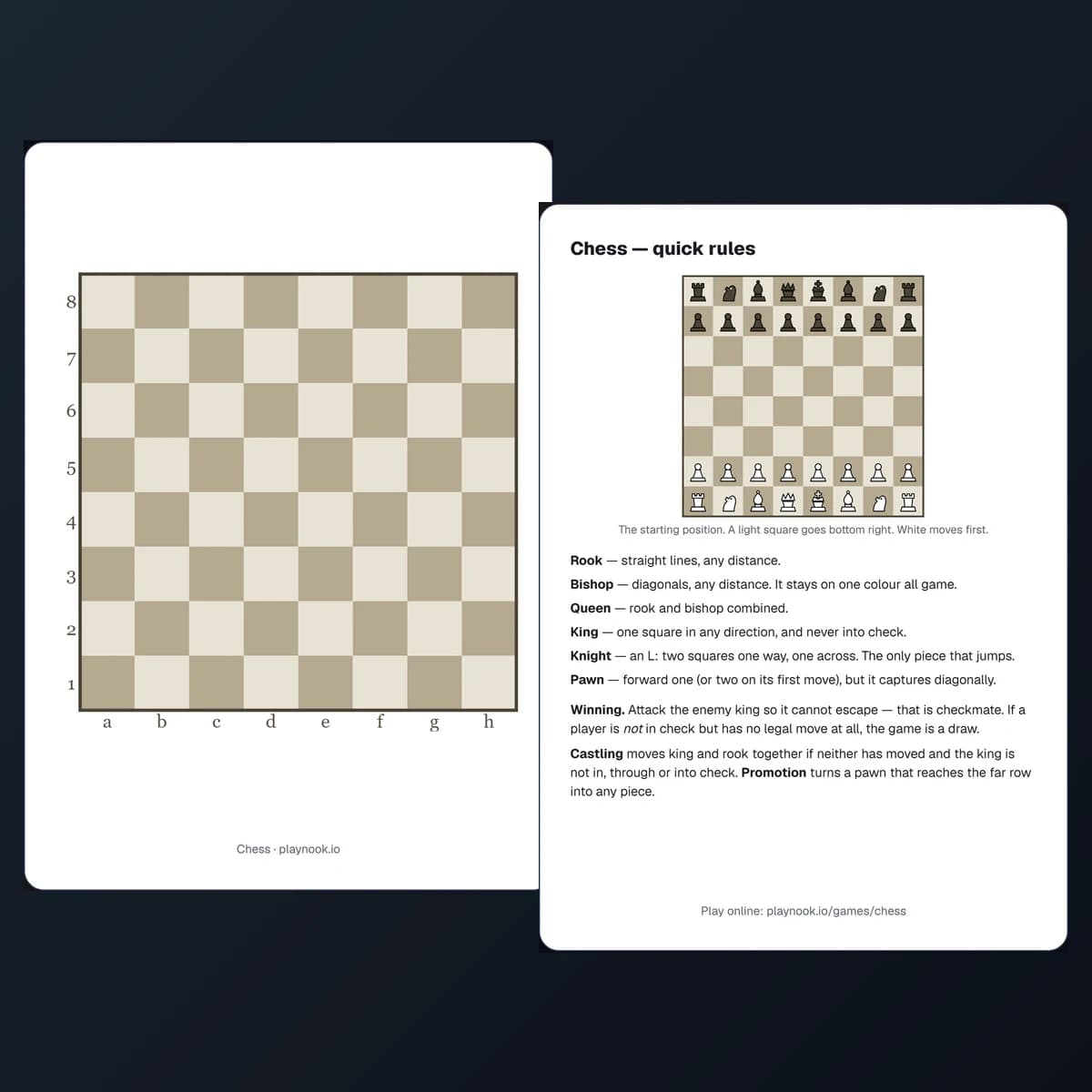
Three sheets, and you only print the ones you need. The board fills the whole page, with files a–h and ranks 1–8 printed along the edges. The pieces sheet holds all thirty-two pieces with dashed cutting lines, laid out in playing order — back rank first, then the eight pawns, white before black — so the set is already sorted when it comes off the scissors. The rules sheet fits the starting position, how all six pieces move, checkmate, stalemate, castling and promotion onto one page.
Everything renders in your browser and prints from it. Nothing is uploaded, nothing is watermarked, and the PDF route is simply the print dialog’s Save as PDF.
Why the coordinates matter
Most free printable chess boards leave the letters and numbers off, and that quietly removes half of what a beginner needs the board for. Without a1–h8 a child cannot write a move down, cannot read a puzzle from a book, cannot be told “bring the knight to f3” and cannot look back at what they played. Notation is not an advanced topic — it is the vocabulary, and it is far easier to pick up when the board says it out loud.
The board also gets the orientation right: a light square in the bottom right, which puts a1 dark on the left. Printed boards get this wrong surprisingly often.
Colour or ink saver
The colour version prints the board in warm, paper-friendly tones. The ink saver swaps every solid area for hatching and outlines — the dark squares become fine diagonal lines, the dark pieces become hatched shapes with black edges. On a laser printer that is the difference between a toner-hungry poster and a worksheet you can run off thirty times for a class without thinking about it.
For teachers and chess clubs
A printed set costs nothing and does not need to come back at the end of the lesson, which makes it the right tool for a first session, a school club that has more children than boards, or a rainy break. Thirty boards in ink-saver mode is a few minutes at the photocopier.
If you are starting a child from zero, the pieces do not all need to come out at once. Our guide to teaching a child chess makes the case for introducing them in the order rook, bishop, queen, king, knight, pawn — and for playing small games with four pieces long before playing a whole one.
Frequently asked questions
Is it really free? Yes. Print as many copies as you like, at home or for a whole classroom. No account, no watermark, and the sheets you print are yours to use however you want.
How do I get it as a PDF? Press Print, then choose “Save as PDF” as the printer in the print dialog. Every browser has that option built in — there is nothing to download from us.
How big are the squares? The board fills the page: about 186 mm square on A4 and 192 mm on US Letter, so each square is roughly 23–24 mm. That is comfortable for the printed pieces, and also for coins, buttons or a spare set from another game.
Does the board have coordinates? Yes — files a to h along the bottom and ranks 1 to 8 up the side. They are on the board deliberately: a child cannot write down a move, read a puzzle or follow a book without them, and most free printable boards leave them off.
Which way round does the board go? A light square goes in the bottom right corner, which puts a1 dark at the bottom left. The printed board already has it that way. The other memory aid is that the white queen starts on a light square.
What if I need a second queen? Print the pieces sheet twice, or do what tournament players do with a wooden set and turn a captured rook upside down. A pawn reaching the far row can promote to any piece, so it comes up more often than beginners expect.
How do I make the set last? Print on thicker paper (160–200 g/m²) or laminate the board — a laminated sheet survives years of classroom use. Glueing the board onto the lid of a cereal box works just as well, and the pieces are much easier to pick up if the pieces sheet is printed on card.
Rather play right now? Play chess online against the computer — it has a coach built in that names your opening and warns you when a piece is hanging, no printer involved. There is a printable checkers board if the same table wants a second game, and a printable Nine Men’s Morris board for something quicker.