
8 games
Math & Logic
Games built on a mathematical idea, not a designed level: MENACE, Hanoi, Nim, the Knight's Tour and the 15 puzzle — with the theory shown as you play.
 Math & Logic
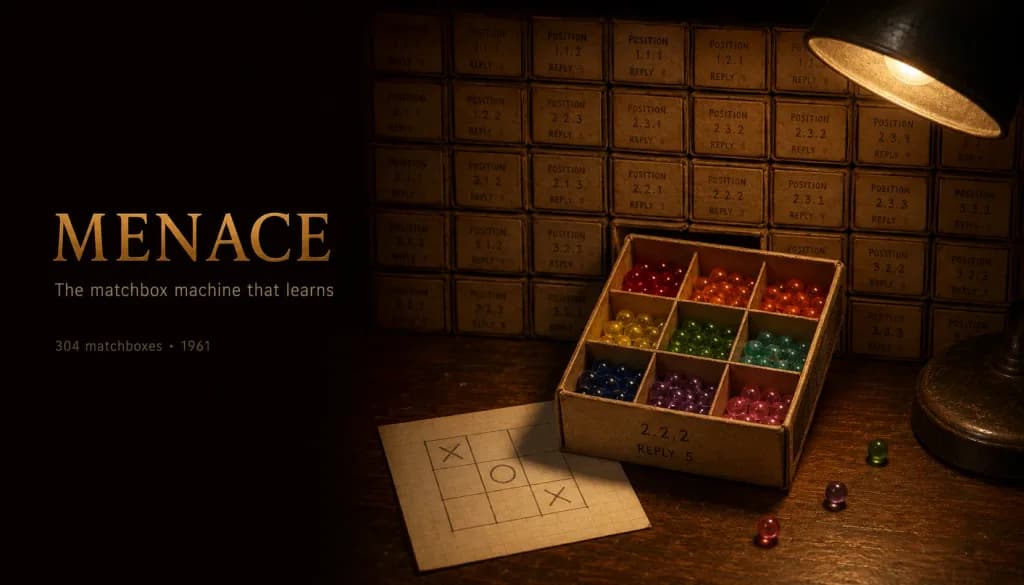
MENACE
A machine built from 304 matchboxes that learns noughts and crosses by throwing away the beads for moves that lost. It starts knowing nothing. Play it and watch it change.
- The 1961 original, rule for rule — beads, matchboxes and all
- Watch the box it opens and the beads it gains and loses
- Train it against a human, a random player or perfect play
 Math & Logic
Towers of Hanoi
The puzzle where the answer is known before you start: 2ⁿ−1 moves, never fewer. The question is whether you can find them — and the counter says the instant you cannot.
- Three to ten discs, with the target 2ⁿ−1 always in view
- A counter that tells you the moment you leave the shortest path
- Watch it solve itself, slowly, and see the recursion
 Math & Logic
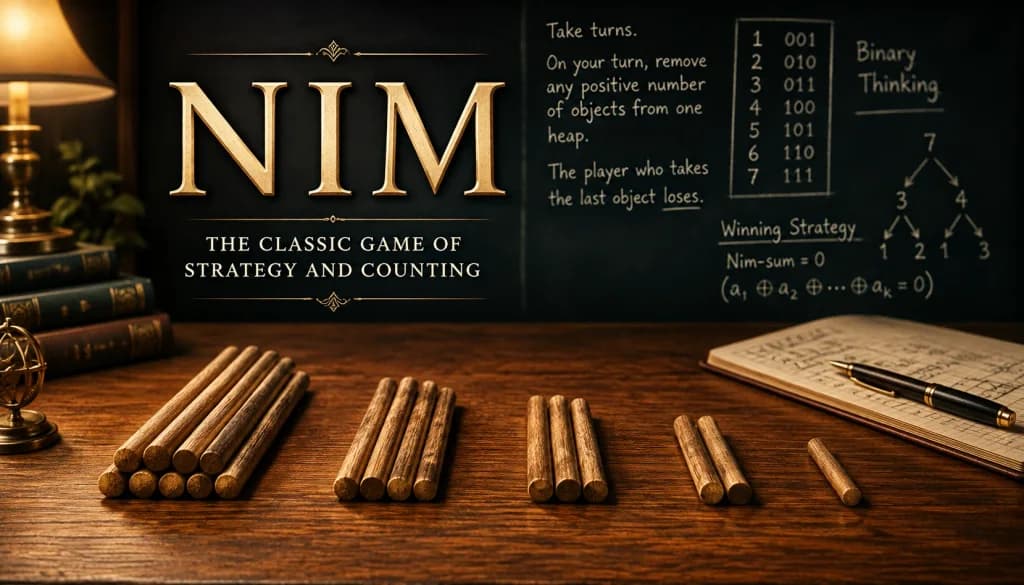
Nim
Take as many marks as you like from one row. Whoever takes the last one wins — or loses, if you agree that first. One line of binary decides every position, and the table on this page shows it live.
- Play a friend online with a table code, or the computer
- The nim-sum table runs live beside the board
- Normal and misère rules, with the ending that catches everyone
 Math & Logic
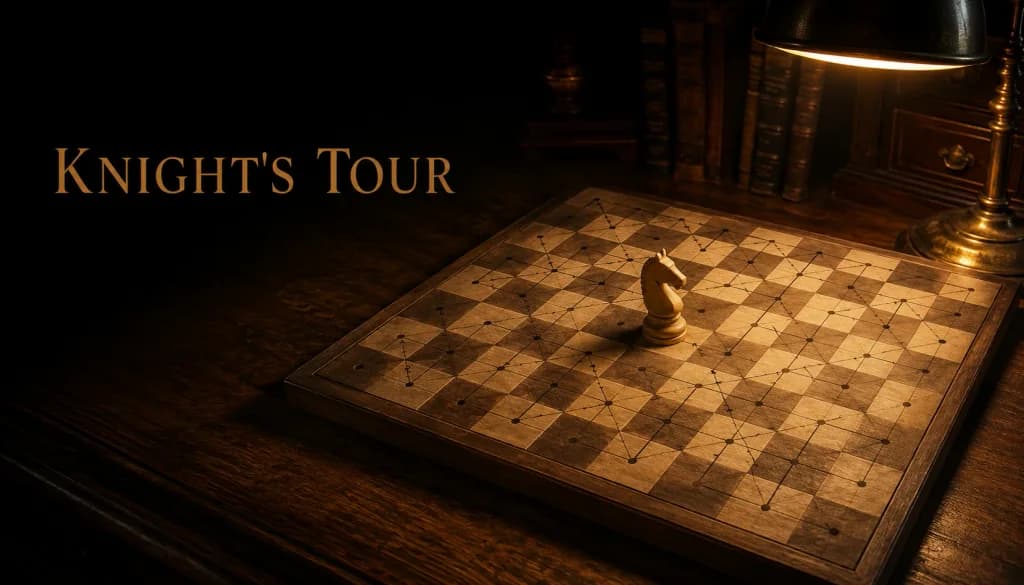
Knight's Tour
A knight, every square once, and never the same square twice. The rule that solves it is on the board while you play — and there is a two-player game hiding in the same rules.
- Warnsdorff's number printed on every square you can reach
- A duel for the same knight — online, with a table code
- Boards from 5×5 to 8×8, and the ones that have no tour at all
 Math & Logic
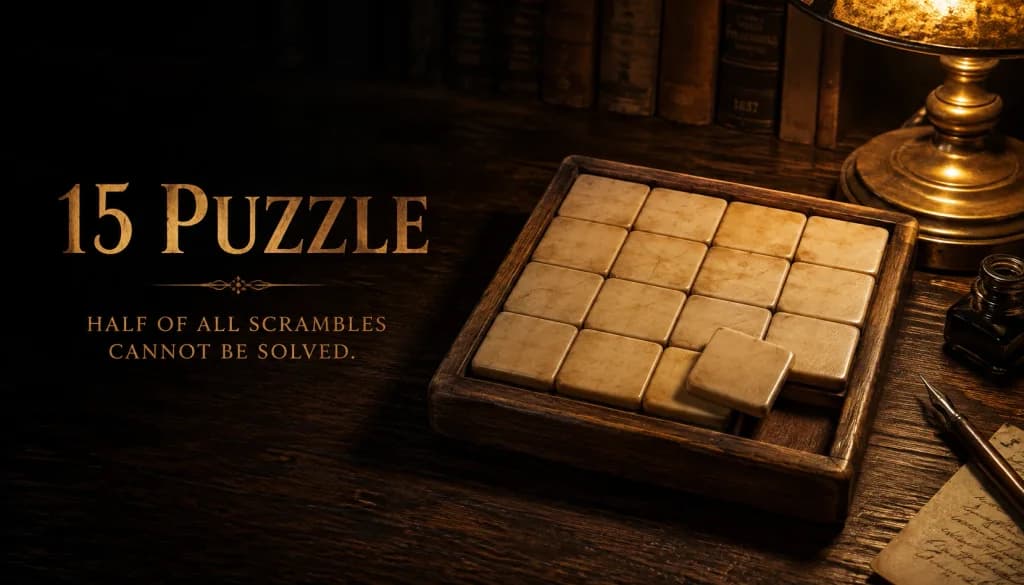
15 Puzzle
Slide the numbers into order. The catch nobody tells you: half of all possible scrambles cannot be solved at all, and you cannot see which by looking. This one tells you, and shows the arithmetic.
- A live solvability check — with the inversion count that proves it
- A button that deals a deliberately impossible scramble
- 3×3, 4×4 and 5×5, with an optimal solver on the smaller boards
 Math & Logic
Dots and Boxes
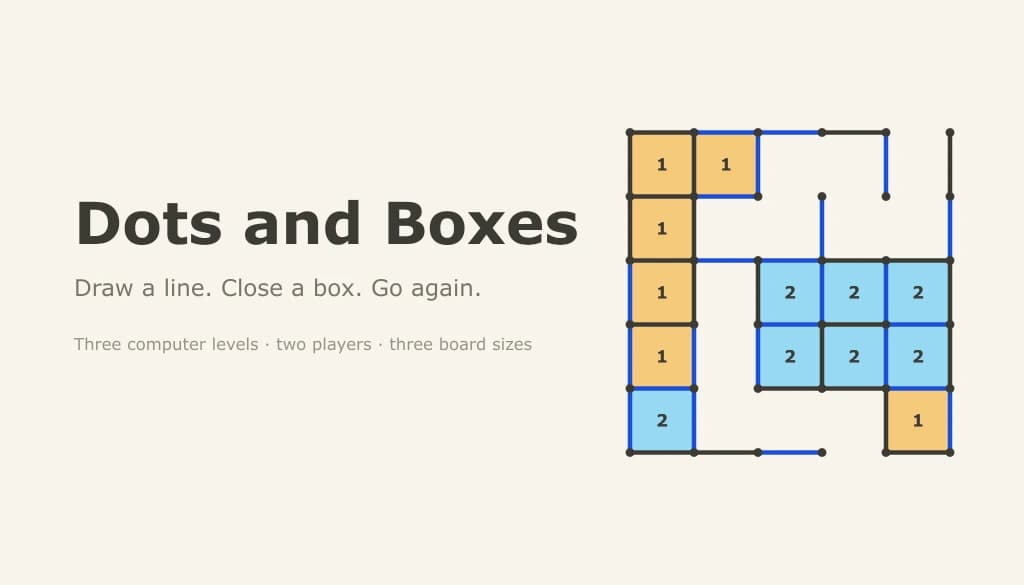
Draw a line, close a box, go again. The rules take twenty seconds and the strategy takes years — because the winning move is usually the one that gives boxes away.
- Three grid sizes and three computer levels
- We solved the small boards exactly — the numbers are on this page
- Two players on one device, no account needed
 Math & Logic
Peg Solitaire
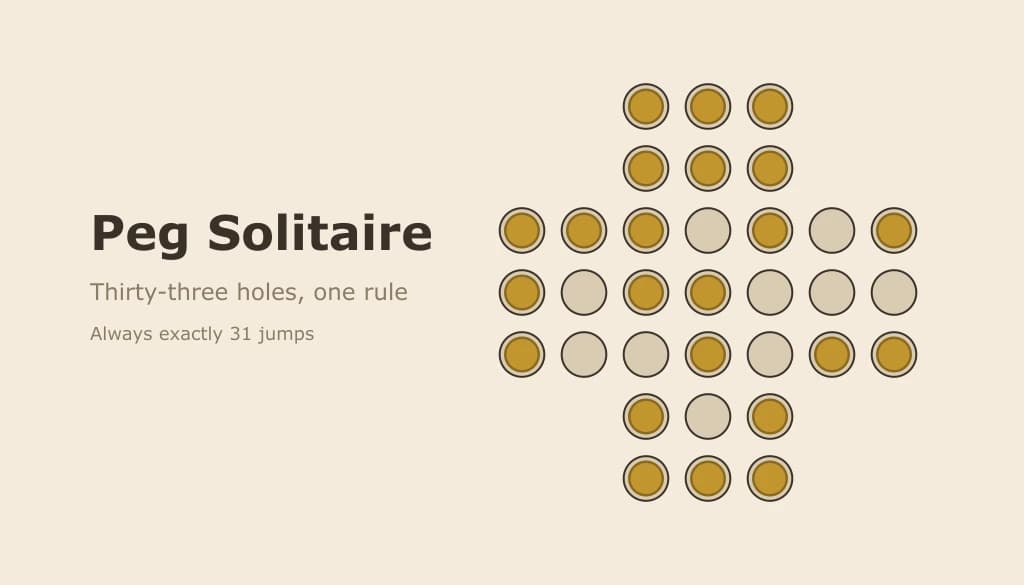
Thirty-three holes, one rule and exactly thirty-one jumps — never more, never fewer. What varies is only whether you strand yourself before the end.
- Undo as far back as you like — this is a puzzle, not a test
- Always exactly 31 jumps, and we show why that is not a coincidence
- A colouring rules out 28 of the 33 possible endings before you move
 Math & Logic
River Crossing
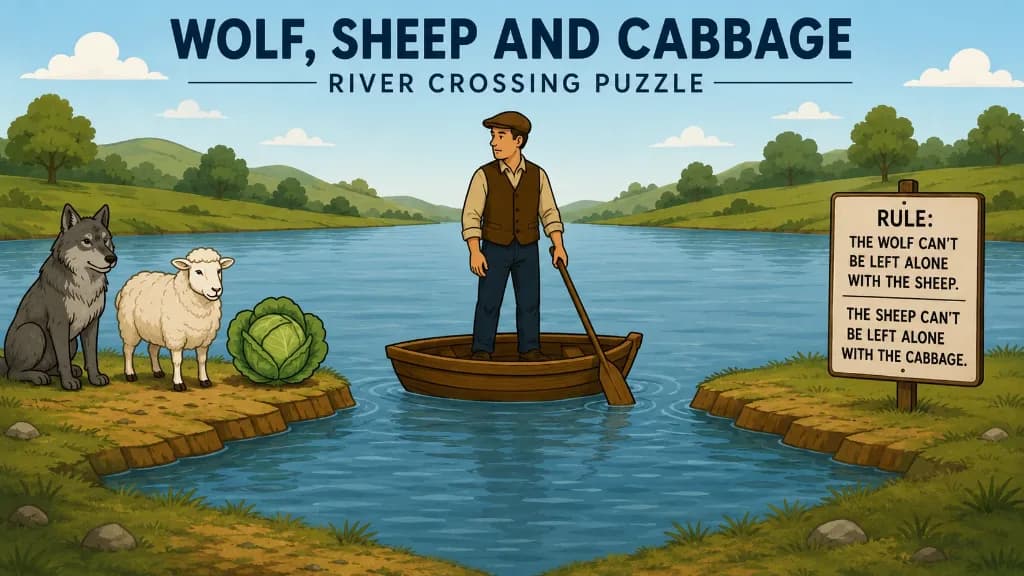
Four puzzles, three of them from the oldest surviving puzzle book. Getting everyone across is easy; doing it in the fewest crossings is the actual question.
- All three of Alcuin's river problems from around 800, plus missionaries and cannibals
- A light says whether you are still on a shortest route — computed, not guessed
- The wolf and goat puzzle has exactly two solutions, and we show the whole state graph
These are not puzzles with a solution to look up. Each one is a piece of mathematics that happens to be playable — a machine that learns without being taught, a heap of counters with a hidden binary rule, a tower that takes exactly as many moves as the arithmetic says it will.
What they have in common is that understanding them is the point. You can win a puzzle by trying things; you win these by working out why they behave the way they do, and then the winning is automatic. That is a different pleasure, and it is the one that makes them turn up in lectures.
Everything here comes with the theory alongside it, and with numbers we computed ourselves rather than copied — how many positions there really are, how quickly a machine learns, and against which opponent that answer changes.