Thirty-three holes in a cross. Every one filled but the middle. Jump a peg over its neighbour into the empty hole beyond, take the jumped peg off, and keep going until one is left.
That is the whole game, and it hides a piece of arithmetic that decides the outcome before you touch anything.
How to play peg solitaire
- Jump orthogonally only — up, down, left, right. Never diagonally.
- The peg you jump over comes off. Every jump removes exactly one.
- Finish with one peg. In the centre, if you want the version people mean when they say they solved it.
Why it is always 31 jumps
Each jump takes one peg off. You start with 32 and want to end with one, so it takes 31 jumps — every time, on every route, without exception. There is no faster solution and no slower one.
That is worth saying because it changes what the puzzle is. You are not searching for a short path. You are avoiding dead ends, and a dead end is a position where pegs still stand but no two of them line up on an empty hole.
The number people compete on is a different count: a run by the same peg, jumping several times without stopping, is traditionally one move. By that reckoning the best known solution to this board is 18. Our own search finds a solution easily — 31 jumps, 26 moves counting runs — but finding the shortest is a far harder search than finding one, and we have not done it.
The colouring that decides it before you start
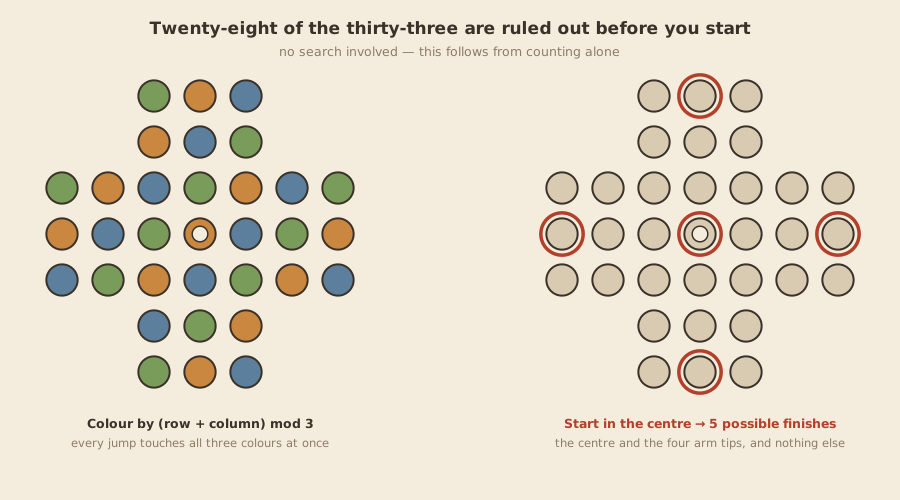
Colour every hole by (row + column) mod 3. Three colours, and on this board exactly eleven holes of each.
Now look at a jump. It touches three holes in a straight line, and three consecutive holes always carry three different colours. So every jump takes one peg from each of two colour classes and puts one into the third. All three counts change by an odd number — which means the differences between them never change at all.
Do that arithmetic for the starting position and for each possible finish, and the answer falls out without any searching:
| Starting with the centre empty | |
| Holes the last peg could occupy | 5 of 33 |
| Which ones | the centre, and the four arm tips |
| Ruled out by counting alone | 28 |
You can spend an afternoon trying to leave the last peg one hole off-centre. It cannot be done, and no amount of cleverness changes that.
Every starting hole works
Solvability of the game is a different question, and there the answer is generous: from all 33 starting holes you can reach a single peg. We searched each one.
That result also came with a lesson. Our first run reported four holes as impossible — and they were not symmetric to each other. On a board with four-fold rotational symmetry that cannot happen: if a hole is solvable, so is its rotation. The asymmetry was the tell. The four were simply beyond the search limit, and with a larger one they all solved. The symmetry check is now part of the script, precisely so that a search limit can never again be mistaken for a proof.
And it works as a game for two
Peg solitaire is a puzzle by name and by design, but there is a natural two-player version: both players jump in turn on the same board, and whoever cannot jump loses. This board offers it — against the computer or with somebody next to you.
Before building it we checked whether it was worth building, because a variant where every move wins is a formality rather than a game:
| Good play against random play | 97.3 % ± 0.9 |
| Control: random against random, first player | 46.0 % |
| Game length | 24 jumps |
The control matters as much as the headline. Had random-against-random come out at 100 % or 0 %, the winner would simply be decided by whether the number of jumps is odd or even, and skill would have nothing to do with it. At 46 % the opening decides nothing — the play does.
97.3 % is a wider gap than almost anything else on this site — wider than Yut Nori at 88 %, wider than the Royal Game of Ur at 93 %. The reason is that this version has no dice in it at all. Which jumps exist depends only on the position, never on whose turn it is, so every position is won or lost from the outset. There is nothing to guess — only right and wrong.
What we have not worked out is who wins the opening position with perfect play on both sides. That tree is too large for the search here, and rather than imply otherwise: it is open.
Play it on paper
There is a printable peg solitaire board here — the 33 holes with the jump directions drawn in, plus a one-page rules sheet. Put a coin in every hole but the middle and you have a set. Thirty-two identical coins sit in printed holes better than anything cut out of paper, which is why the sheet of paper pegs is optional and most people skip it.
The same board as Fox and Geese
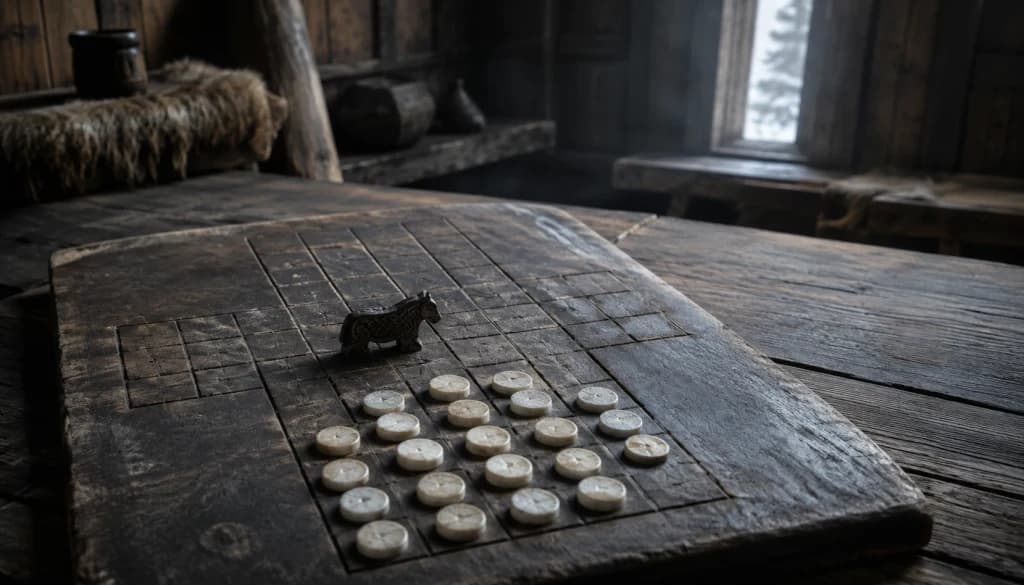
This is the cross that Fox and Geese is played on — identical, hole for hole, and we compared the two point by point rather than assuming it. One board, two completely different games: a hunt for two players, and a puzzle for one.
Where it comes from
The trail starts in France. An engraving of 1687 shows a lady of the court with the board, and in 1716 Leibniz wrote about it — which makes peg solitaire one of the earliest puzzles a serious mathematician thought worth analysing. He was interested in exactly the thing above: not how to solve it, but what the rules make impossible.
The English board has 33 holes and is the one here. The French board has 37, and it is not simply a bigger version — the arithmetic comes out differently, and a solution for one is no guide to the other.
If you like this one
- Towers of Hanoi — the other puzzle where the move count is fixed by arithmetic before you begin
- The 15 Puzzle — where a parity argument decides which scrambles can be solved at all
- Nim — a whole game reduced to one piece of binary arithmetic
- Fox and Geese — the same board, played by two
Can you always still win?
On the triangular board the answer changes with every jump, and it is computable. The triangle peg game solution works out which positions are still winnable and which are already lost — the answer for the fifteen-hole board that turns up in every roadside diner.