
The little triangular board with fifteen holes turns up on restaurant tables, in gift shops and in Christmas stockings. Everyone has failed at it, and almost everyone has been told the same two things: that there are thousands of ways to win, and that after a couple of careless jumps it becomes impossible.
Both are repeated everywhere without a source. Both are checkable, because the board is tiny — fifteen holes means 32,768 possible positions, few enough to work out every one of them rather than search.
So we did, and here is what is actually true.
Try it here — it will tell you when you have blown it
The light at the top is the point. It is not a hint system guessing — the position of every one of the 32,768 arrangements is known in advance, so the board can say with certainty whether a single peg is still reachable from where you are. Turn on Mark the losing moves and the jumps that end your game are outlined in red before you make them.
That is the thing none of the solution lists elsewhere can do. A list tells you one route. This tells you, at every point, whether you are still on a route.
How many solutions does the triangle peg game have?
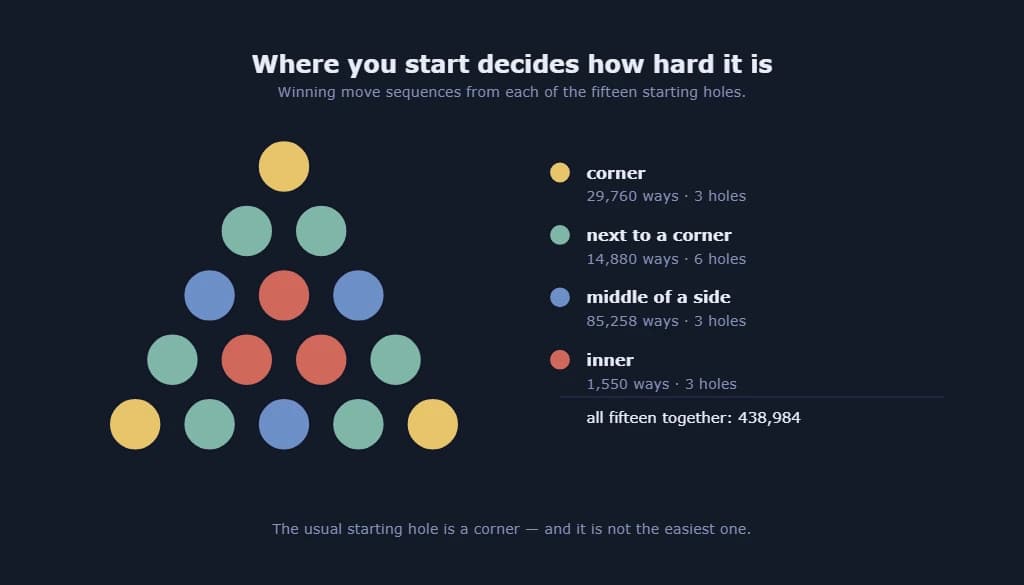
From the usual starting hole — the corner at the top — there are 29,760 winning sequences of jumps.
You will often see "over 6,000" quoted. We cannot reproduce that figure from anything; counting sequences of jumps from the corner gives 29,760, and the number of solutions from all fifteen starting holes together is 438,984, which is a figure that does appear in the literature and which our run reproduces exactly.
Which starting hole is easiest?
Not the one on the box.
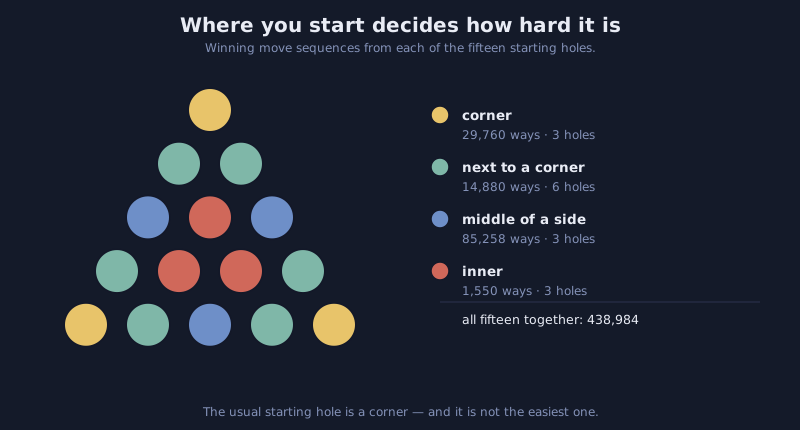
The fifteen holes fall into four kinds once you allow for the triangle's symmetry, and the difference between them is enormous:
| Start with this hole empty | Winning sequences |
|---|---|
| Middle of a side | 85,258 |
| A corner — the usual one | 29,760 |
| Next to a corner | 14,880 |
| An inner hole | 1,550 |
Starting from the middle of a side gives you nearly three times as many winning lines as the corner everyone uses, and fifty-five times as many as starting from an inner hole. If you want to win once and move on, empty a hole in the middle of a side. If you want the hard version, empty one of the three inner holes.
Every one of the fifteen can be solved down to a single peg. There is no dud start.
Where can the last peg end up?
From the top corner, in four of the fifteen holes — and never in the other two corners.
They are the corner you started from, the middle of the bottom row, and the two outer holes of the fourth row. Finishing back in the hole you emptied is the tidiest result and there are 6,816 ways to do it; the middle of the bottom row is the most common landing place by a distance, with 16,128.
Is it really impossible after two wrong moves?
No. That claim is the one piece of common wisdom that is simply wrong, and the truth is more interesting.
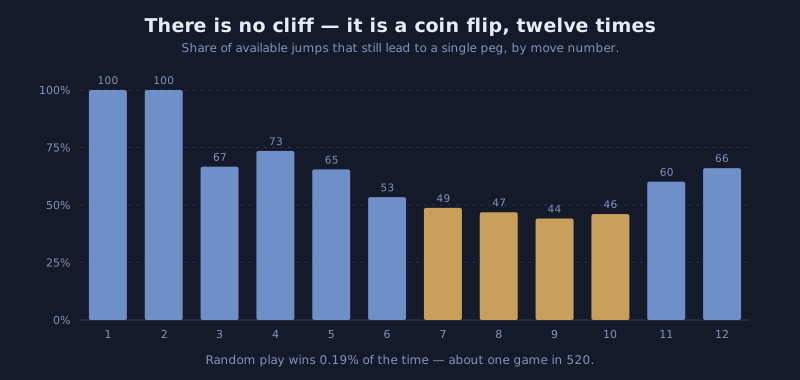
Your first two jumps cannot go wrong: from the corner start, every available move still leads to a win. After that the share of safe moves settles between about 45 and 65 per cent and stays there. There is no cliff and no point of no return — there is just a coin flip, roughly twelve times in a row.
Which is exactly why it feels impossible. Twelve coin flips is one chance in four thousand, and playing at random from the corner start wins 0.19 per cent of the time — about one game in 520. We measured that over 200,000 random games.
So the board is not punishing a mistake you made early. It is punishing the mistake you are about to make, over and over, and the reason people lose is that nothing on the table tells them which one it was.
What that means for actually playing it
Two habits are worth more than any memorised sequence.
Do not strand pegs at the edges. A peg in a corner can only be taken by a jump along one of the two sides that meet there. Once both of those lines are empty behind it, it is stuck for the rest of the game, and stuck pegs are how games end with three or four left.
Sweep, do not scatter. A jump that lands you next to another peg usually sets up the next jump. A jump into open space usually does not. The winning lines tend to be runs down one side and back, not tidy symmetrical patterns.
The board itself
Fifteen holes in five rows, and 36 jumps that the geometry allows — along each row and along both diagonals, in both directions. Of the 32,768 positions the board can be in, 13,935 are still winnable and the rest are already lost, which is a little under half.
It is the small cousin of peg solitaire proper, whose English board has thirty-three holes in a cross and where jumps go only up, down, left and right. That version has an argument that rules out twenty-eight of its thirty-three possible endings before you move at all — different board, different mathematics, same feeling of having been cheated.