
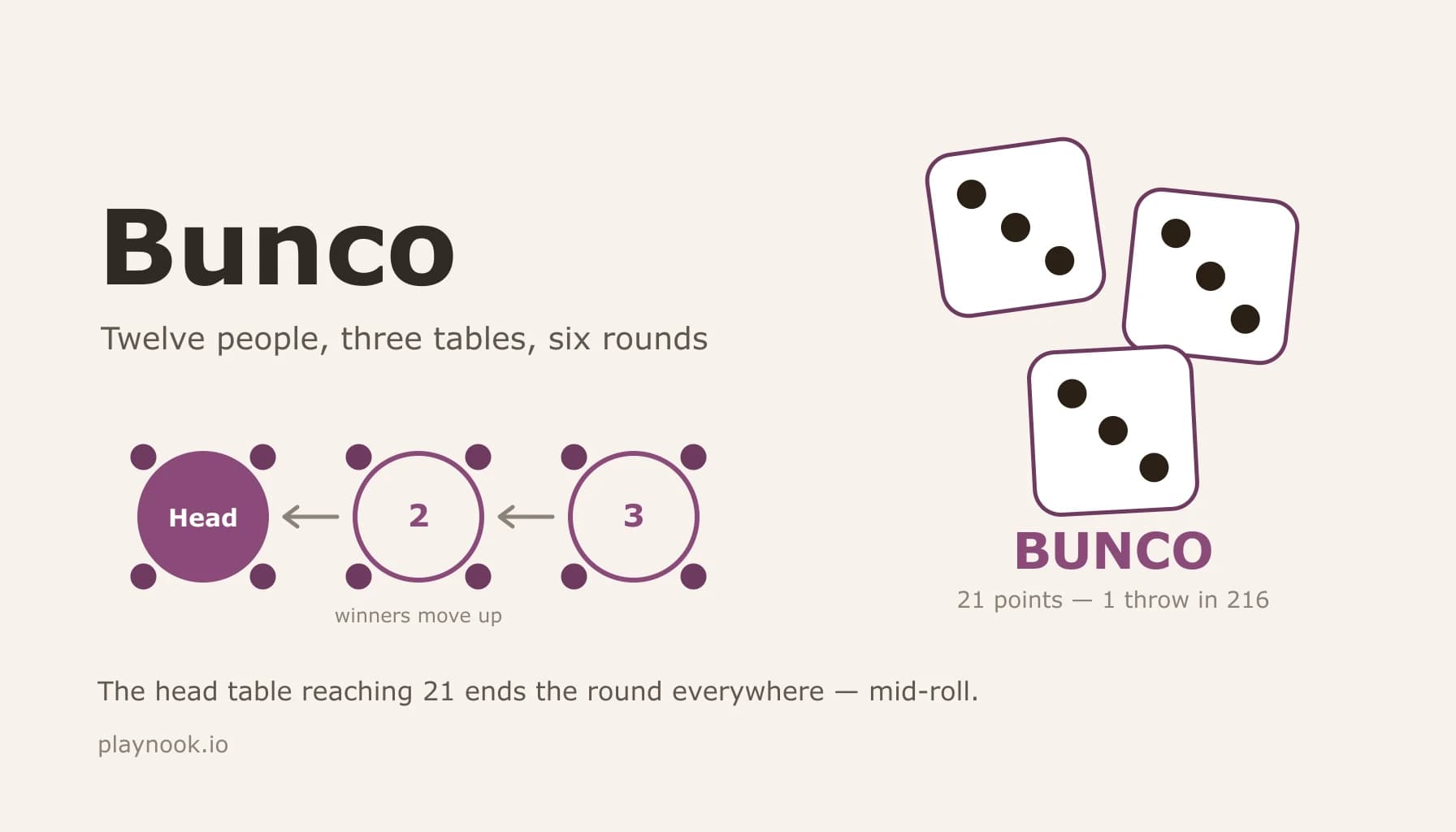
Bunco is a dice game with no decisions in it. You roll, you count, you pass — and that is the entire skill component. Which is exactly why it works for twelve people who mostly came to talk.
It also makes the game completely computable, so this page answers the questions the rule sheets skip: how long a round actually runs, how often anybody shouts Bunco at all, and the one thing every host discovers too late.
- 1 in 216 — how often a throw is a Bunco
- 55.6 % of all throws score nothing whatsoever
- 29 turns is the median length of a round to 21
- 61 % of nights end with the Bunco prize tied
What do you need for a Bunco night?
Twelve people, three tables of four, three dice on each table, and something to keep score on. Nothing else — no board, no cards, no equipment anybody has to own.
The twelve split into three tables, and at each table the four players sit as two pairs, partners opposite each other. One table is the head table, and that distinction matters more than it sounds.
How do you play Bunco?
- The round has a number. Round one is ones, round two is twos, and so on up to six.
- Roll all three dice. Every die showing the round's number is one point.
- Scored something? Roll again. You keep the dice as long as you keep scoring.
- Scored nothing? Pass them on. The dice go to the next player round the table.
- Three of the round's number is a Bunco — 21 points, and you shout it.
- Three of any other number is a mini Bunco, worth 5.
- First pair to 21 wins the round for that table.
That is the whole rulebook. There is nothing to decide at any point, which is the design, not an oversight.
What is a Bunco actually worth?
Three dice have 216 outcomes, so this is not a matter of opinion — you can count them.
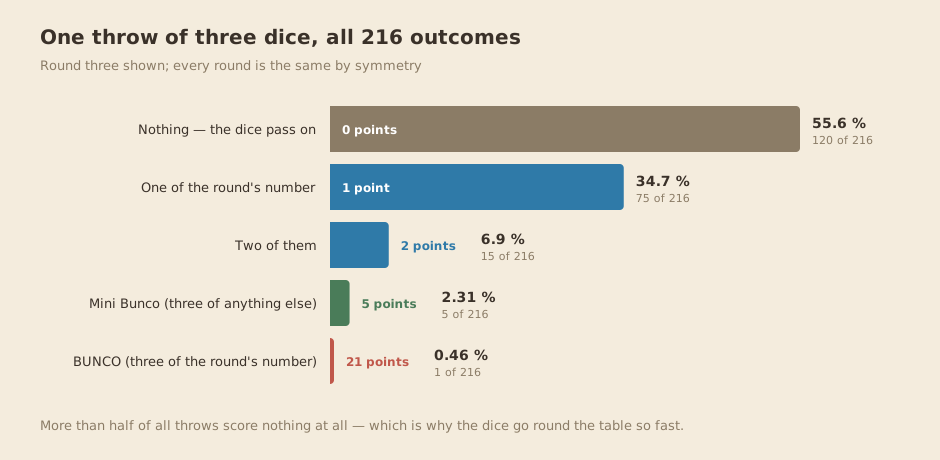
A Bunco is one throw in 216. A mini Bunco is one in 43. And the single biggest outcome, by a wide margin, is nothing at all: 120 of the 216 outcomes score zero and hand the dice straight on.
That last figure is the one that shapes the evening. A turn — roll until you fail — averages just 1.26 points and 1.8 throws. The dice move round the table constantly, nobody holds them long, and that is why a table of four can hold a conversation through the entire game.
How long does a Bunco round take?
Longer than most people expect, and with an odd shape to it.
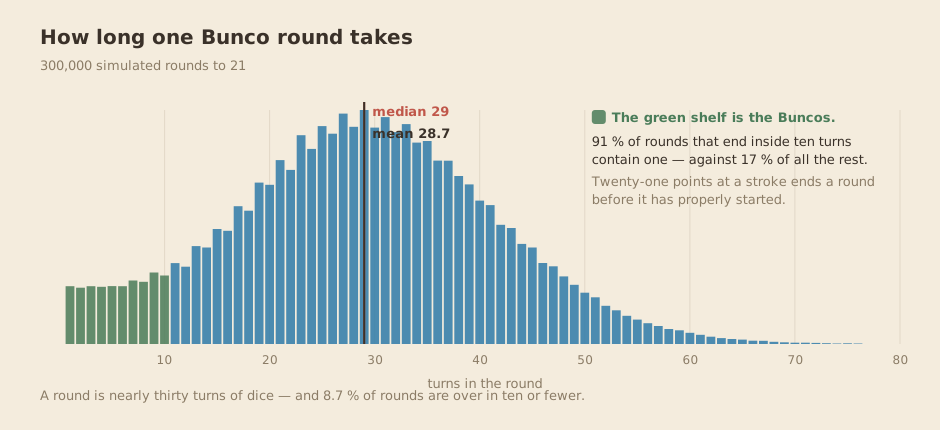
The median round is 29 turns — about seven turns each for four players. The tail runs long: one round in a hundred passes sixty turns, and if that is the head table, every other table is still waiting.
The flat shelf on the left is the interesting part. Those are rounds that end almost immediately, and they are not random luck: 91 % of rounds finishing inside ten turns contain a Bunco, against 17 % of every longer round. One shout of 21 points ends a round before it has properly started.
How does a Bunco round end?
When the head table reaches 21, the round is over everywhere. Not when your table finishes — when that table finishes, mid-roll if that is where you happen to be. It is the rule newcomers find hardest to believe, and it is what keeps twelve people moving together instead of drifting apart.
Then everybody shuffles:
- the winning pair at each table moves up a table
- the losing pair stays or moves down
- everybody swaps partners for the next round
Over six rounds you will have partnered most of the room, which is the point of the whole arrangement. It is also why the score is kept per person, not per team — your team changes every round.
What are the three Bunco prizes?
Most wins. Most Buncos. And — traditionally — most losses, which at a good night is fought over about as hard as the first one.
The middle prize is the one worth thinking about before the evening starts.
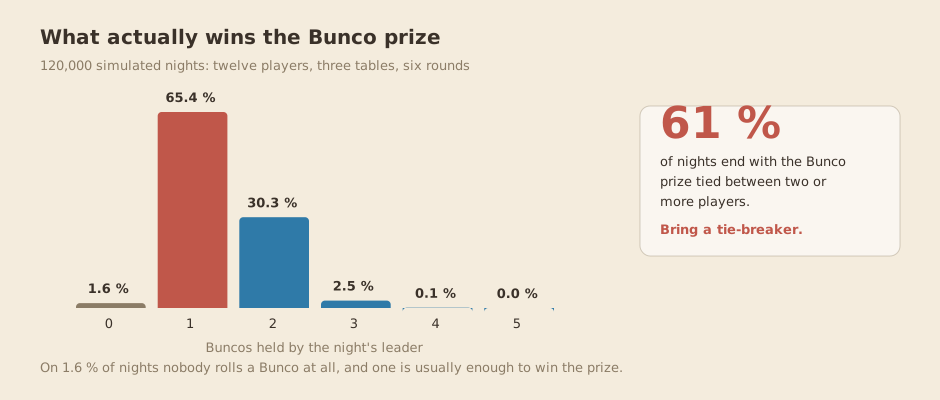
A single Bunco wins the prize on two nights in three. The whole night produces about three and a half Buncos across all three tables — and on 1.7 % of nights, nobody rolls one at all.
Which leads to the number every host eventually meets the hard way: 61 % of nights end with the Bunco prize tied. Not occasionally — most nights. If you have one prize and no plan, you are about to run an argument instead of a raffle.
How many rounds make a Bunco night?
Six rounds — ones through sixes — make one set, and a set is the natural unit: it is what the score sheet is built around and what the prizes are counted over. A set works out at roughly 43 turns of dice per player, so a single set is a short evening.
Most groups therefore play more than one, commonly two to four sets with a break between them, resetting the tables each time. If you are hosting for the first time, two sets is the safe answer: long enough to feel like an evening, short enough that nobody is looking at the clock.
Does it matter who rolls first?
Slightly. The pair who start a round win it 51.8 % of the time — worth about one round in fifty over an evening, which is small enough to ignore and real enough to be worth knowing.
That figure is exact. A Bunco round is a Markov chain with no player in it, so every position can be evaluated directly rather than estimated; a separate run of 400,000 simulated rounds landed on 51.78 % against the computed 51.77 %, which is the check that the arithmetic is right.
What do you print for a Bunco night?
Three different things, and they are not interchangeable:
- Player cards travel with the person — six rounds, W or L, and a tick for every Bunco. This is what decides the prizes.
- Table sheets stay on the table. Four people play as two pairs, so a table sheet has two rows, not four.
- Table markers stop the same question being asked six times: which one is the head table?
All three are on the Bunco score sheet — free, no sign-up, and it will also keep score in the browser if you would rather not print anything at all.
Can you play Bunco with fewer than twelve?
Yes. Eight people at two tables works exactly the same way, and four at a single table works as a plain dice game — you lose the moving-between-tables part, which is most of the social machinery, but the rules are unchanged.
What you cannot easily do is play with an odd number. Bunco is built on pairs at tables of four, so eleven people means somebody sits out a round or a "ghost" seat rolls for itself.
Where does Bunco come from?
The usual account traces it to an English dice game that arrived in the United States in the middle of the nineteenth century, where it was taken up in gambling parlours — respectable enough that police departments ran squads named after it, which is the origin of "bunco squad" for a fraud unit.
It faded, and then came back in the 1980s as something completely different: a suburban social game, organised in leagues, played for small prizes by twelve people who wanted an excuse to meet monthly. That is the version described on this page, and the transformation is unusually complete — the same dice, an entirely different reason to roll them.
More dice games
If you want a dice game where there is something to decide, Farkle and Pig are both playable here against a computer that plays the solved strategy, and dice games for two players compares seven of them by how much skill is genuinely in each. For keeping score at a table with real dice, there is a dice score sheet too.