
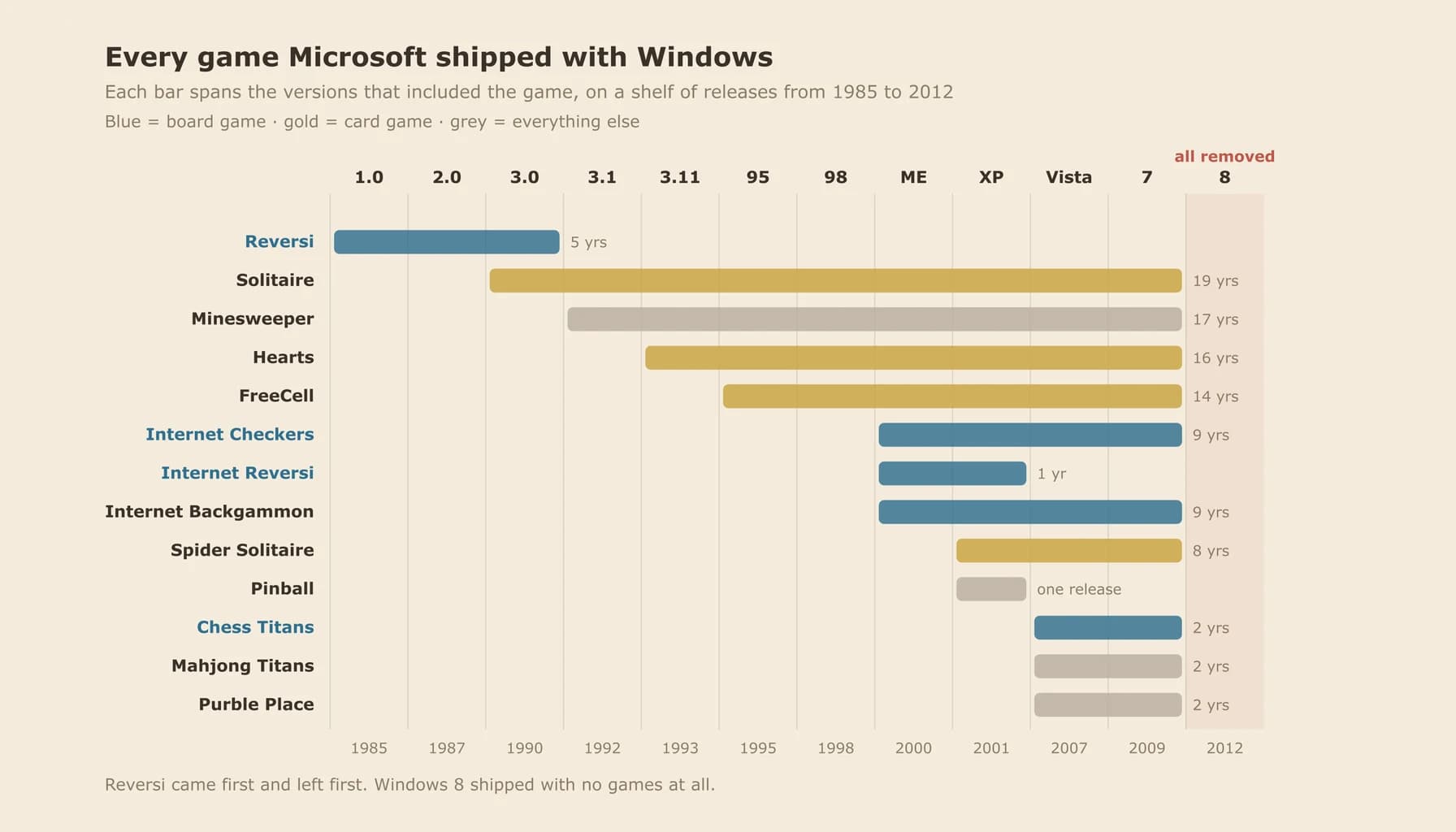
Ask which game came with Windows and almost everyone says Solitaire. It is the wrong answer by five years and one whole game.
The first game Microsoft ever shipped with Windows was Reversi, in Windows 1.0, in 1985. It was the only game in the box, it stayed for three versions, and then it was quietly dropped in Windows 3.1 to make room for Minesweeper — which is why hardly anybody remembers it.
- 1985 — Reversi ships in Windows 1.0, the first game Microsoft included
- 5 years it lasted, then it was cut for Minesweeper
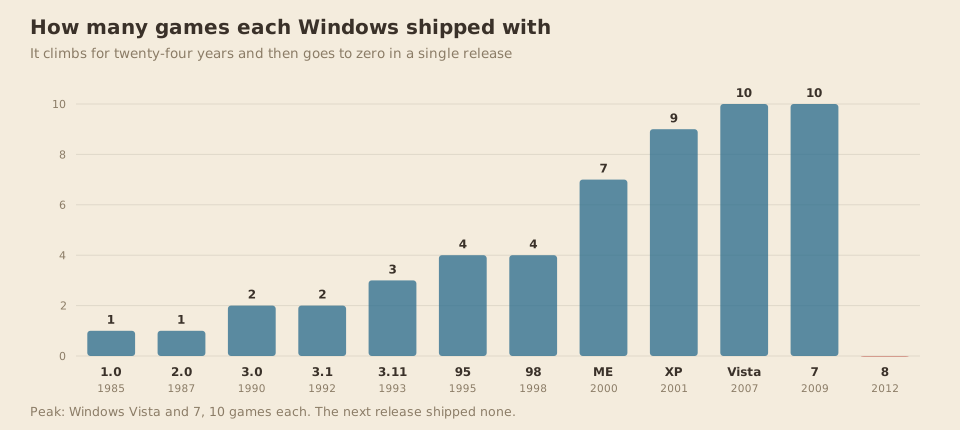
- 10 games at the peak, in Windows Vista and Windows 7
- 0 in Windows 8, which removed every one of them
What was the first game that came with Windows?
Reversi, in November 1985. Windows 1.0 was not an operating system so much as a graphical shell over MS-DOS, and it needed something to demonstrate that a mouse was worth having. A board of sixty-four squares where you click a square and watch a row of discs flip is close to a perfect demonstration: it needs precisely one input, and the result is visible instantly.
It survived Windows 2.0 and Windows 3.0. Then Windows 3.1 arrived in 1992 with Minesweeper instead, and Reversi was gone from the default install for good.
Why did Windows come with games at all?
Because they were training. This is not a retrospective theory — it is what the games were for, and it explains both which ones were chosen and the order they arrived in.
In 1985 the mouse was an unfamiliar object. Most people buying a PC had spent years at a keyboard and had no instinct for pointing, clicking, dragging or double-clicking, and no patience for a manual that explained it. A game solves that problem in a way no tutorial can: people will repeat a motion for an hour because they want to win, and come out the other side having learnt it without noticing.
Each game drills a different skill, and they line up almost too neatly with the order of release:
| Game | Arrived | What it teaches |
|---|---|---|
| Reversi | 1985 | Point and click a single target accurately |
| Solitaire | 1990 | Drag and drop — the hardest gesture to explain in words |
| Minesweeper | 1992 | The right mouse button, and precision at speed |
| Hearts | 1993 | Finding other machines on a network |
| FreeCell | 1995 | Nothing new — it was a 32-bit showcase |
Reversi came first because it asks least. One click, one square, and the board answers immediately with a row of flipping discs — instant, visible feedback that you hit what you aimed at. That is the first thing a person has to believe about a mouse before anything else can be taught.
Solitaire is the famous case: Microsoft intern Wes Cherry wrote it, and it shipped in Windows 3.0 in 1990 explicitly to teach dragging. Hearts arrived in Windows for Workgroups 3.11, the networking release, and needed three other players on the same LAN — a game that quietly demonstrated the feature the product was named after.
Which board games came with Windows?
Five, across the whole history — a small number next to the card games, which is the thing most people get backwards.
| Game | Versions | Years | Playable here |
|---|---|---|---|
| Reversi | 1.0 – 3.0 | 1985–1990 | Yes |
| Internet Checkers | ME – 7 | 2000–2009 | Yes |
| Internet Reversi | ME – XP | 2000–2001 | Yes |
| Internet Backgammon | ME – 7 | 2000–2009 | No |
| Chess Titans | Vista – 7 | 2007–2009 | Yes |
Everything else people remember is a card game (Solitaire, FreeCell, Hearts, Spider), a puzzle (Minesweeper, Mahjong Titans) or neither (Pinball, Purble Place). Solitaire had the longest run of any of them at 19 years.
Was Halma ever a Windows game?
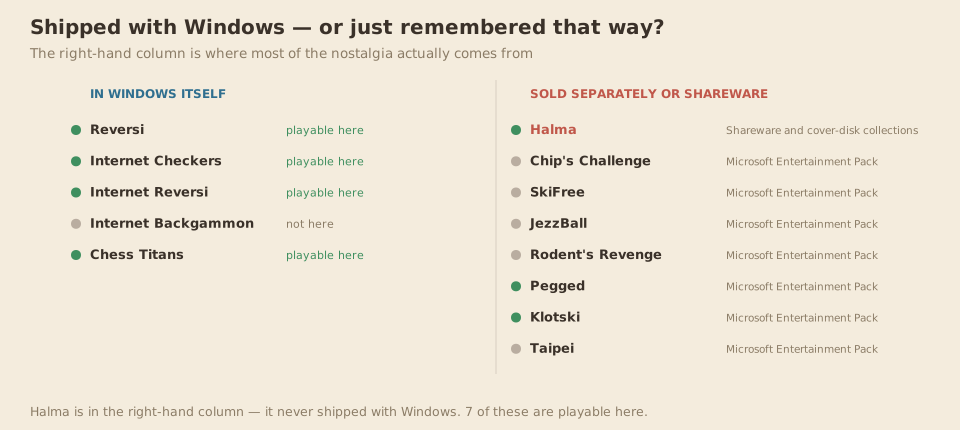
No — and this is the single most common misremembering of the lot, common enough that people still search for "free Halma for Windows 95" three decades later.
Halma never shipped with any version of Windows. What did exist, in enormous quantity, was shareware: Halma was a favourite of hobbyist programmers writing small Windows 3.1 and Windows 95 games, distributed on cover disks, on BBSs, and later on the shareware CD-ROMs that came taped to computer magazines. If you played Halma on a Windows 95 machine, you almost certainly played somebody's shareware version, not a Microsoft one.
There is a reason Halma in particular got written so often. It is trivial to program — a grid, one move rule, and jumps that chain — and it was already familiar to a European audience: invented near Boston around 1883 by the surgeon George Howard Monks, it became a fixture of German households, where the star-shaped version is still sold as Sternhalma and the rest of the world calls it Chinese Checkers. A game everybody's grandmother owned, that a hobbyist could finish in a weekend, arriving exactly when shareware distribution was at its peak. It is the sort of thing that ends up on ten thousand hard drives without a single corporation involved.
The same confusion swallows a whole generation of games. Chip's Challenge, SkiFree, JezzBall, Rodent's Revenge, Taipei and Pegged are remembered as "Windows games", and none of them shipped with Windows either. They came from the Microsoft Entertainment Pack, a series of boxed collections sold separately between 1990 and 1995. Microsoft made them; Windows did not include them.
Two of those are on this site under their proper names: Pegged is peg solitaire, and Klotski is a sliding block puzzle — with a solvability checker for the ones that cannot be solved at all.
Why did Microsoft remove the games from Windows?
Two separate decisions, eight years apart, which is why it felt so abrupt.
- Windows 8, in 2012, shipped with no games in the operating system. They moved to the Windows Store as free downloads — chiefly the Microsoft Solitaire Collection, which was free but carried advertising, with a paid tier to remove it. The games did not die; they stopped being there by default, which for a game somebody only ever played by accident amounts to the same thing.
- The Internet games were switched off on 31 July 2019. Internet Checkers, Backgammon, Spades, Hearts and Reversi all relied on Microsoft's matchmaking servers. When those were retired, the games remained installed on millions of machines and simply could no longer find an opponent.
Where can you play the Windows board games now?
Four of the five, free and in the browser, with no install and no account:
- Reversi — the original Windows 1.0 game, the same 8×8 board and the same flip. If you want the history of the name, Reversi vs Othello explains why it has two
- Draughts — what Internet Checkers was. For online matchmaking, ratings and the international variants, Checkers Arena does the job Microsoft's servers used to
- Chess — Chess Titans without the 3D pieces
- Halma — the one that was never there, in case the memory turns out to be the real reason you came
Internet Backgammon has no equivalent here. It needs dice, a doubling cube and a proper engine, and half-doing it would be worse than not doing it.
Questions people actually ask
What was the first game on Windows?
Reversi, included with Windows 1.0 in 1985. Solitaire did not appear until Windows 3.0 in 1990, which makes Reversi the first by five years.
Did Windows 95 come with Halma?
No. Windows 95 shipped with four games: Solitaire, Minesweeper, Hearts and FreeCell. Halma was widely available as shareware for Windows 3.1 and 95, which is almost certainly where the memory comes from. You can play Halma here in the browser.
What games came with Windows 95?
Solitaire, Minesweeper, Hearts and FreeCell — four in total. Hearts had arrived two years earlier with Windows for Workgroups 3.11 as a network game for office LANs.
Why did Reversi disappear from Windows?
It was dropped in Windows 3.1, in 1992, when Minesweeper took its place. Reversi returned briefly as Internet Reversi in Windows ME and XP, then went for good when Microsoft retired the Internet game servers in July 2019.
Was Chip's Challenge a Windows game?
Not one that shipped with Windows. It came in the Microsoft Entertainment Pack, a boxed collection sold separately in the early nineties, along with SkiFree, JezzBall, Rodent's Revenge, Taipei and Pegged.
Can you still play Internet Checkers?
Not the Windows version — the servers were shut down on 31 July 2019, so the game can no longer find an opponent even where it is still installed. A modern browser version of the same game is here.
Why did Microsoft remove the games from Windows 8?
They were moved out of the operating system and into the Windows Store as free, ad-supported downloads. Nothing was cancelled; the games simply stopped being installed by default, which ended the habit of finding them by accident.