A 121-point star, ten pieces a side, starting in opposite corners. Step or chain-jump across — nothing is ever captured — and be first to fill the point directly opposite yours.
How to play Chinese Checkers
Two players, ten pieces each, opposite points of a six-pointed star. Move exactly one piece a turn, and be first to move your whole ten-piece triangle into the triangle straight across the board.
How do you set up a Chinese Checkers board?
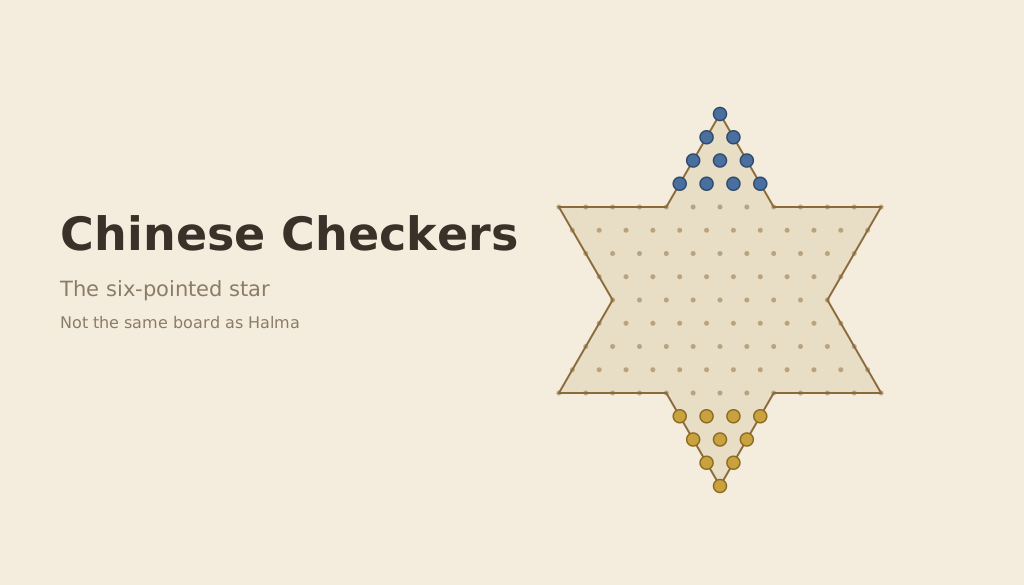
The star has six points, each a ten-piece triangle, but a two-player game only ever uses one opposing pair. Fill your own point completely — that is your whole starting position, nothing sits anywhere else on the board — and your opponent does the same to the point directly across the central hexagon. The other four points stay empty the entire game; they only come into play with three or six players sharing the board at once, which this page does not offer.
Moving: step or jump
- Step — to an adjacent empty point, any of the six directions the board's lines actually draw. This ends your turn.
- Jump — over any piece, yours or the opponent's, into the empty point directly beyond it in a straight line. Nothing is ever captured; the jumped piece stays exactly where it was. Land, and if another jump is available from there, take it too, and it does not have to continue the same direction — a chain can turn any corner it likes, hop after hop, for as long as jumps keep being available. Stop whenever you want, as soon as you've moved at all.
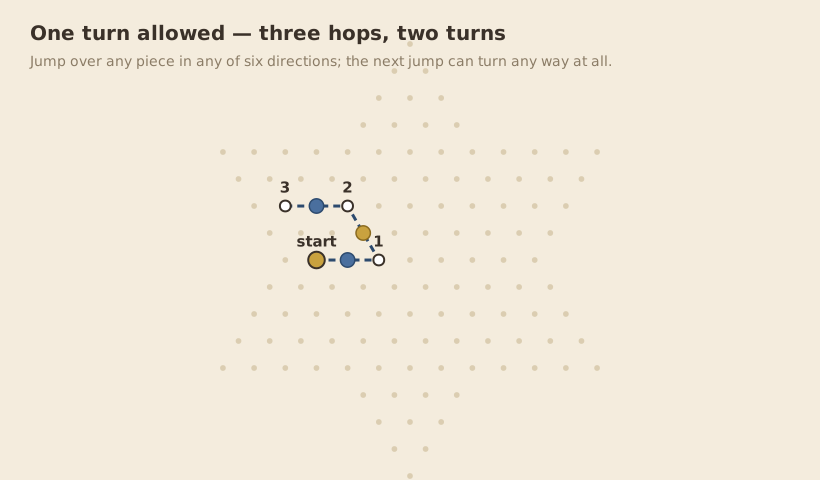
That freedom to turn is the one rule change that actually matters between this board and a square one. A single unbroken jump chain here can zigzag across the entire star rather than run out along one straight line, which is most of why games on this board tend to move faster once both sides have a few pieces loose in the middle.
How do you win?
Move all ten of your pieces into the point directly opposite your own. Your own point does not have to be empty — only the far one has to be full — though leaving pieces behind just slows down everything trying to move through them.
How is this different from Halma?
They are related, not identical, and the confusion runs deep enough to be worth a whole section: in German-speaking countries, this star board is very often itself called "Halma", which is exactly backwards from how the two games are usually distinguished in English.
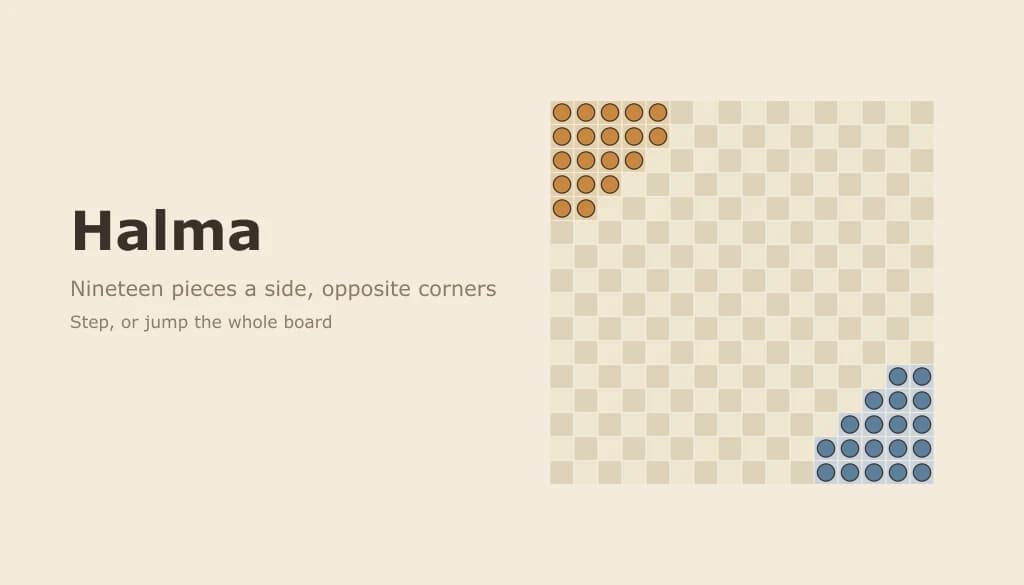
Halma, elsewhere on this site, is the original board: a 16×16 square grid, 19 pieces a side, built in the United States in 1883 or 1884. This page's board is the six-pointed star built a few years later in Germany — 121 points, ten pieces a side, properly designed for anywhere from two to six players rather than Halma's maximum of four. The two share the jump rule and essentially nothing else about their shape.
The star board's 121 points break down cleanly: a 61-point hexagon in the middle, with a ten-point triangle at each of the six points — 6 × 10 + 61 = 121. It can also be seen as two large triangles of 91 points each, rotated 60° from one another and overlapping in that same 61-point hexagon: 91 + 91 − 61 = 121, the two ways of counting agreeing exactly.
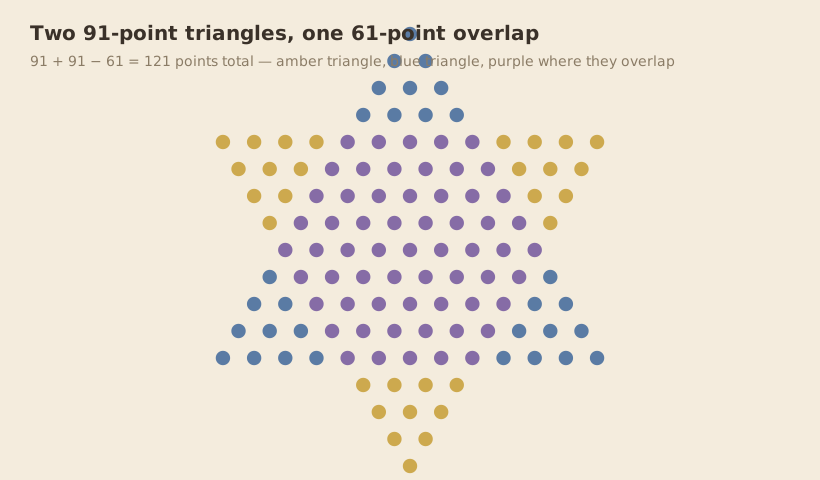
This is also exactly why the board looks the way it does under a straight-line count: every point on this page's board is generated from one condition in cube coordinates — a point belongs to the star if all three of its coordinates are at least −4 (the amber triangle) or all three are at most 4 (the blue one) — checked against all 121 points before a single pixel of the board was drawn.
Chinese Checkers strategy
How do you win at Chinese Checkers?
Build a ladder before you walk it. The single-step move covers one point a turn — at that pace, crossing the whole star from one tip to the opposite one takes far more turns than either side has patience for. Every fast game is won by lining pieces up early so a chain has something to jump over: a diagonal or straight run of your own pieces across the centre works exactly as well as an opponent's, since nothing is ever captured and colour never matters for a jump.
Why the straight-up-the-middle plan is usually wrong
The obvious opening — push pieces straight from your own point toward the opposite one — is also the slowest, because a single-file line only lets a chain jump along it, not turn off it. Spreading two or three pieces slightly sideways from the direct line, into the flat sides of the central hexagon, gives a jumping piece somewhere to turn — exactly the freedom the diagram above shows — and a turning chain reaches awkward corners of the board that a straight one never touches.
Don't strand your own last piece
The most common losing pattern isn't a bad jump, it's a forgotten piece: one straggler left in your own home point, or worse, off to one side of the board, with no chain running near it. Every one of your ten has to arrive for the win to trigger, so the last piece home is often the one that decides how long the game runs — worth tracking on every turn, not just once the other nine are already in place.
Playing against the computer
How do the three computer levels differ?
In how many candidate moves get a second look at the reply and how often a merely good move gets played instead of insisting on the exact best one — the same design as the Halma and Reversi opponents on this site. Each piece is scored by its hex distance to the nearest point of its target — the fewest single steps between them, ignoring every other piece on the board, the same idea as king-move distance did for Halma's square grid.
We measured matched levels against themselves rather than guess at pace: games settle in roughly 170 to 240 plies.
Can a player refuse to finish?
Structurally, yes — the identical quirk Halma has, and for the identical reason. The win condition only ever checks the opponent's target point; nothing requires a losing player to empty their own. Leave one piece sitting at home forever, and the game can never officially end. This page plays the rule exactly as written rather than patch it, the same call made on the Halma page: a house rule here would make this a slightly different game from the one everybody else plays, and in practice nobody actually stalls a game they've already lost.
Where the name "Chinese Checkers" actually comes from
Marketing, not China. The star board was published in Germany in 1892 by Ravensburger as Stern-Halma — star Halma. It reached the United States in the late 1920s under names like Hop Ching Checkers, and the name that actually stuck, Chinese Checkers, was invented in 1928 by Bill and Jack Pressman of the Pressman Company, sold under the line "a game from the Orient for all ages" — at a moment when almost anything that sounded vaguely Chinese moved product in America. The game has no real connection to China at all.
If you like this one
- Halma — the square board this one is related to but not identical with, own history and own page
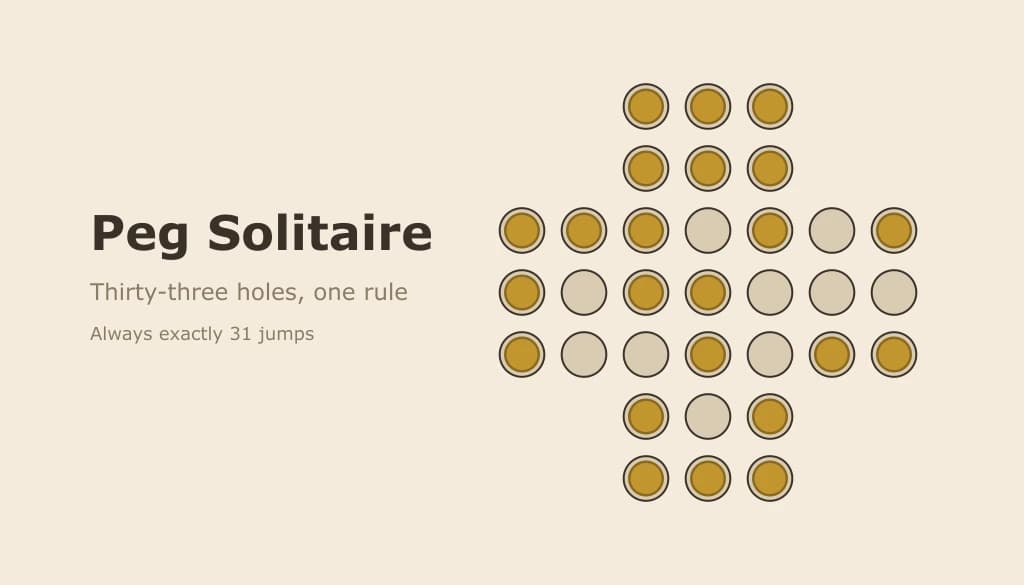
- Peg Solitaire — the opposite kind of jump: there, every jump removes a piece; here, none ever does
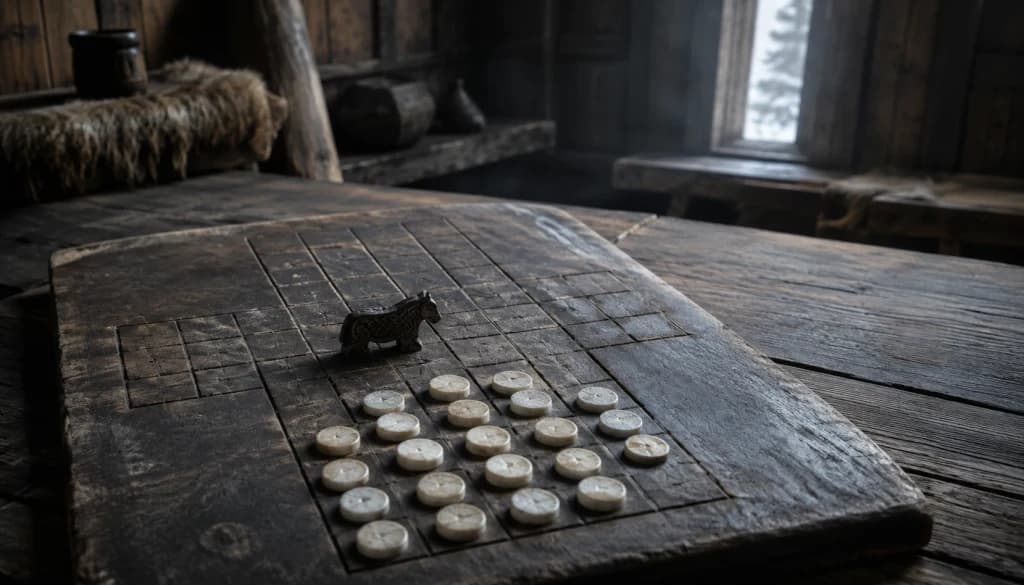
- Fox and Geese — the same orthogonal jump idea, turned into a hunt instead of a race
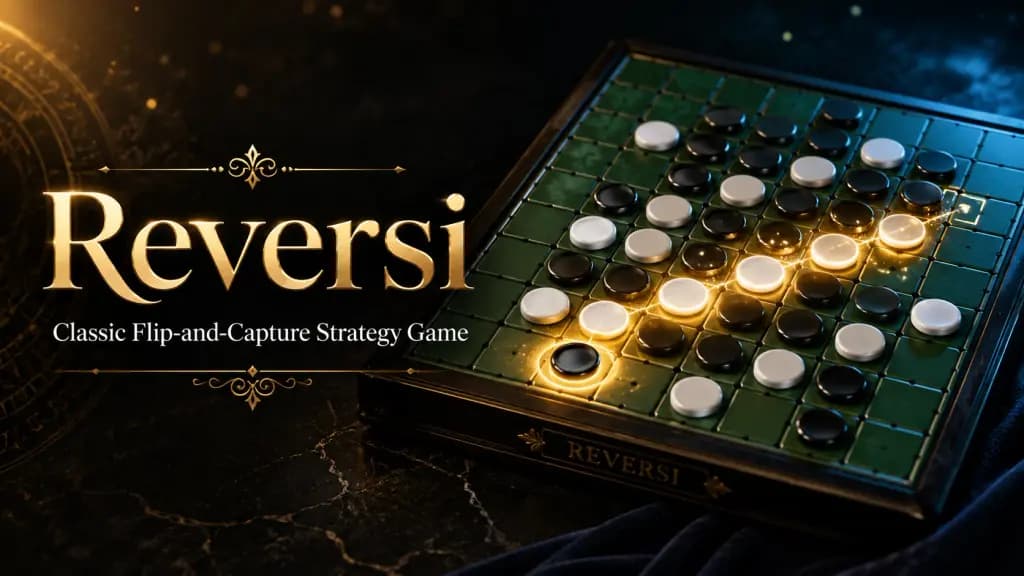
- Reversi — the computer opponent here shares its candidate-scoring approach