PlayNook

Board Game · Hunt Game

Play Fox and Geese Online — Free Board Game

One fox against thirteen geese on the old cross board. The fox jumps to eat; the geese cannot capture at all and win by leaving him nowhere to go.

Thirteen geese against one fox, and the fox is the favourite. That is the whole game in a sentence, and it is why Fox and Geese belongs to the family of hunt games rather than to the ordinary board games where both players start with the same pieces and the same job.

The board and the opening
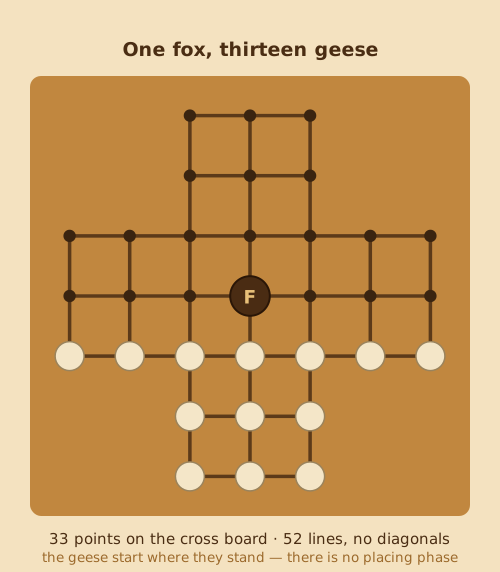
The cross-shaped board of thirty-three points with a dark fox marked F on the centre point and thirteen pale geese filling the lower arm and the row across it.
Thirty-three points, fifty-two lines, no diagonals. The geese stand where they start — there is no placing phase.

The board is the cross: a seven by seven grid with the four corners cut away, leaving 33 points. Most people now meet it as the peg solitaire board. Moves run along the drawn lines only — up, down, left, right, and never diagonally, which matters more than it sounds. It means every point has at most four neighbours, and the tips of the arms have only two.

The fox sits in the middle. The geese fill the lower arm and the row across it, and they move first.

The one number this game needs, and where it comes from
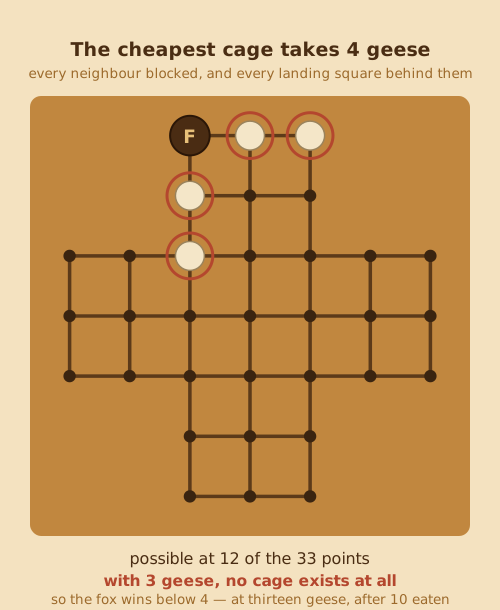
The cross board with the fox on the top-left point of the upper arm and four geese ringed in red on the points that pen him in, with a note that this is possible at 12 of the 33 points.
Every neighbour blocked, and every square he could jump into blocked as well. Four geese, and not fewer.

The geese have a clean win condition: the fox cannot move. The fox does not. He eats geese, but eating them is not by itself a win, and every version of this game has to decide at what point the geese are beaten. Most simply pick a number.

We worked ours out instead. To pen the fox at some point, two things must be true at once:

  1. every point next to him is occupied, and
  2. for each of those, the square directly behind it is occupied or off the board — otherwise he jumps.

Run that over all 33 points and the cheapest cage costs four geese, and can be built at 12 of the 33 points — always out at the tips and edges of the arms, where there are fewer neighbours to block and more jumps that would land off the board. In the middle it costs eight.

So: with three geese there is nowhere on this board the fox can be trapped. The geese cannot win, whatever they do. Our rule follows from that and nothing else — the fox wins when fewer than four geese remain, which at thirteen geese means after ten are eaten.

It is deliberately a lower bound. It ends the game when a geese win has become impossible, never when it has merely become unlikely. Whether four geese can actually force the cage is a different and much harder question, and we have not answered it.

How to play the geese

  • Advance as a wall, never as a line of stragglers. A goose with another goose directly behind it cannot be jumped — there is nowhere for the fox to land. One goose alone in the open is simply food.
  • Drive him into an arm. The tips of the cross have two neighbours; the middle has four. Every step the fox takes outwards makes the cage cheaper.
  • Do not count geese, count his moves. Losing four geese while shrinking the fox from four moves to two is a good trade.
  • Fill from behind. The rear geese are the ones that make the front ones safe. Pushing everything forward at once is how the fox gets his double.

How to play the fox

  • Stay in the middle while you can. Four ways out and four possible jumps beats two of each.
  • Look for the goose that has nothing behind it. That is the whole game on your side.
  • Break the wall before it forms. Once the geese are a solid block, there is nothing to jump and you are being walked backwards.

Thirteen, fifteen, seventeen

The count in this version is the earliest recorded one. Edward IV of England bought "two foxes and 26 geese" — two sets, at thirteen apiece. Later versions raise the geese to fifteen and then seventeen and simultaneously restrict how they may move, precisely because the extra numbers made it too easy.

That is the whole story of the hunt games in miniature: nobody could calculate the balance, so they tuned the counts over generations until it played well. There is more of it, including the tafl branch and the Nepalese one, in hunt games: where the two sides are not equal.

The rest of the family

  • Bagh-Chal — four tigers against twenty goats, and the goats arrive one per turn
  • Hnefatafl, Tablut and Brandubh — a king running for a corner against twice his number
  • Alquerque — the symmetric game whose jump-capture the whole family borrowed

Play a friend online

Choose With a friend online under the board and press Open a table. You get a four-character code — send it over, they type it in, and you are playing. Then swap sides: it is a different game with the same equipment, which is the point of the entire family.
Frequently asked questions

+ How do you play Fox and Geese?

One fox starts in the middle of the cross-shaped board; thirteen geese fill the lower arm and the row across it. Geese move first. A goose moves one step to an empty neighbouring point and can never capture anything. The fox moves one step, or jumps a goose into the empty point beyond it and eats it — one jump per turn, no chains. The geese win by leaving the fox no legal move at all; the fox wins when fewer than four geese are left.

+ Why does the fox win when three geese are left?

Because at that point the geese provably cannot win. To pen the fox, every point beside him must be occupied and every square he could jump into must be blocked or off the board. We worked out the cheapest such cage on this board: it needs four geese, and it can be built at 12 of the 33 points. With three there is nowhere on the board the fox can be trapped, so the game is decided and the rule says so instead of letting it run on.

+ Thirteen against one — how is that fair?

It is not, quite, and the history shows people noticing. The earliest recorded form is one fox against thirteen geese. Later versions raise the geese to fifteen and then seventeen, and at the same time restrict how they may move, to offset the extra numbers. That is a balance patch applied by nobody in particular over a few hundred years.

+ Can the fox jump more than one goose?

Not here. One jump per turn, over exactly one goose, into the empty point directly behind it. Versions that allow chained jumps as in draughts make the fox far stronger and need more geese to compensate.

+ What is the board?

The cross: a seven by seven grid with the four two-by-two corners removed, leaving 33 points and 52 lines. Moves run up, down, left and right only — there are no diagonals. It is the board most people now know as the [peg solitaire](/games/peg-solitaire) board.

+ How do the geese actually win?

By advancing as a wall rather than as individuals. A goose standing directly in front of another cannot be jumped, because the landing square is occupied — so a block of geese is safe where a scattered line is food. The geese push the fox towards an arm of the cross, where a point has only two or three neighbours and a cage is cheap.

+ Is it the same as Asalto?

The same skeleton with different uniforms. Asalto — also sold as German Tactics or Officers and Sepoys — is a nineteenth-century reskin where the few become officers holding a fortress and the many become attackers storming it. The Old Norse halatafl, glossed as fox game, points at something like this game several centuries earlier.

+ Can I play Fox and Geese with a friend online?

Yes. Choose 'With a friend online' below the board and press Open a table. You get a four-character code; send it to your friend, they type it in and press Join. There is a chat window built in, and neither of you needs an account or a download.

More games like this

Kaooa — screenshot of the browser gameBoard Game
Hunt Game2 Players

Kaooa

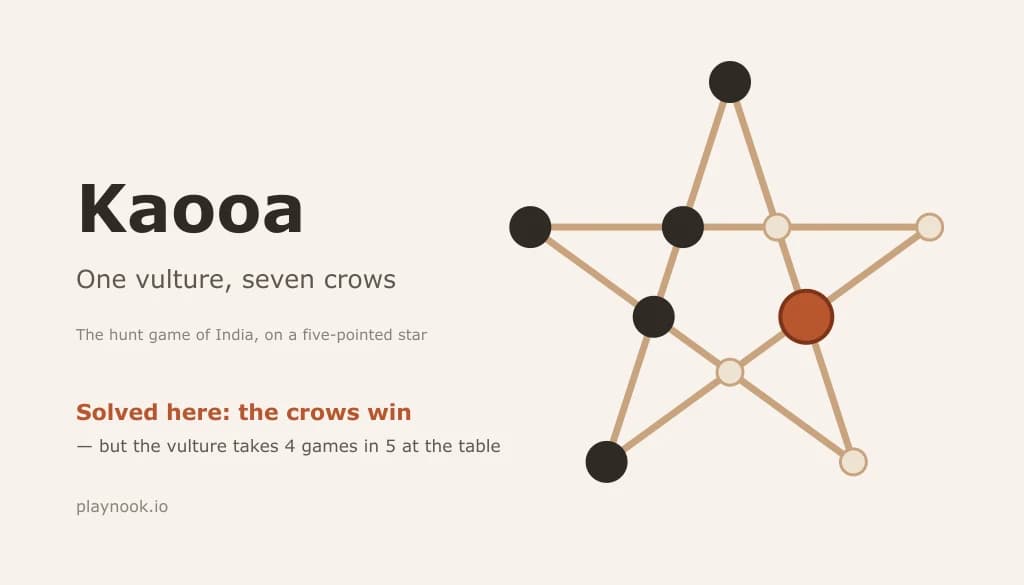
One vulture against seven crows on a five-pointed star. The vulture jumps to eat; the crows cannot capture at all and win by leaving it nowhere to go.

  • Solved here for the first time — and the crows win, which nobody had written down
  • Measured: the vulture wins 4 games in 5 at casual strength, and none at all against perfect play
  • Play a friend online — share a four-letter code, no sign-up
Play Kaooa
Peg Solitaire — screenshot of the browser gameMath & Logic
Solitaire Puzzle1-2 Players

Peg Solitaire

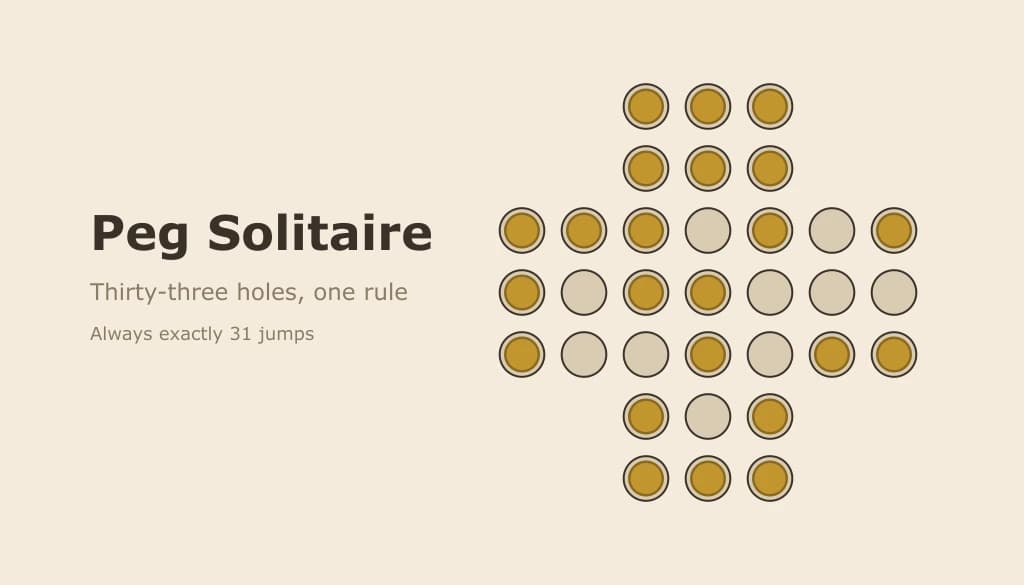
Thirty-three holes, one rule and exactly thirty-one jumps — never more, never fewer. What varies is only whether you strand yourself before the end.

  • Undo as far back as you like — this is a puzzle, not a test
  • Always exactly 31 jumps, and we show why that is not a coincidence
  • A colouring rules out 28 of the 33 possible endings before you move
Play Peg Solitaire
Bagh-Chal — screenshot of the browser gameBoard Game
Hunt Game2 Players

Bagh-Chal

Four tigers against twenty goats on the old Alquerque grid. The tigers jump to eat; the goats never capture anything at all and win by leaving the tigers nowhere to go.

  • Two sides with completely different jobs — play both
  • Measured: four against twenty is fair once both sides know what they are doing
  • Play a friend online — share a code and chat
Play Bagh-Chal
Alquerque — screenshot of the browser gameBoard Game
Capture Game2 Players

Alquerque

Play the medieval ancestor of checkers. Move across the lined board, make compulsory captures and chain jumps together to clear the board.

  • Easy, medium and hard difficulty
  • Compulsory captures and chain jumps
  • Play as White or Black
Play Alquerque