One vulture against seven crows on a five-pointed star. The vulture jumps to eat; the crows cannot capture at all, and win by leaving it nowhere to go.
- 10 points — five tips of the star and five crossings
- 7 crows against 1 vulture, and the vulture needs 4 of them
- 79.5 % — how often the vulture wins when both sides play at random
- 0 % — how often it wins against crows that play perfectly
How do you play Kaooa?
- The crows place first, one crow on any empty point.
- Then the vulture chooses its starting point — any empty point.
- The crows keep placing, one per turn, until all seven are down. Only then may they start moving.
- The vulture moves from its second turn onwards, while crows are still arriving.
- Everything steps one point along a drawn line.
- The vulture may jump instead — over an adjacent crow, straight along a chord, onto the empty point beyond. That crow is taken.
- Four crows taken and the vulture wins. No legal move for the vulture and the crows win.
Who actually wins Kaooa?
The crows — and this does not appear to have been written down before.
We solved the game completely: every position of the movement phase evaluated, then the placing phase worked back through it. With both sides playing perfectly, the crows win.
The result was checked by a second method that shares no code with the first — a backward analysis working out from the finished positions instead of a forward fixed point. The two agree on all 7,440 positions of the movement phase. A third check came from the game playing itself: two copies of the strongest computer level, 120 games, and the vulture won none of them.
Is it still worth playing?
Yes, and the numbers say why.
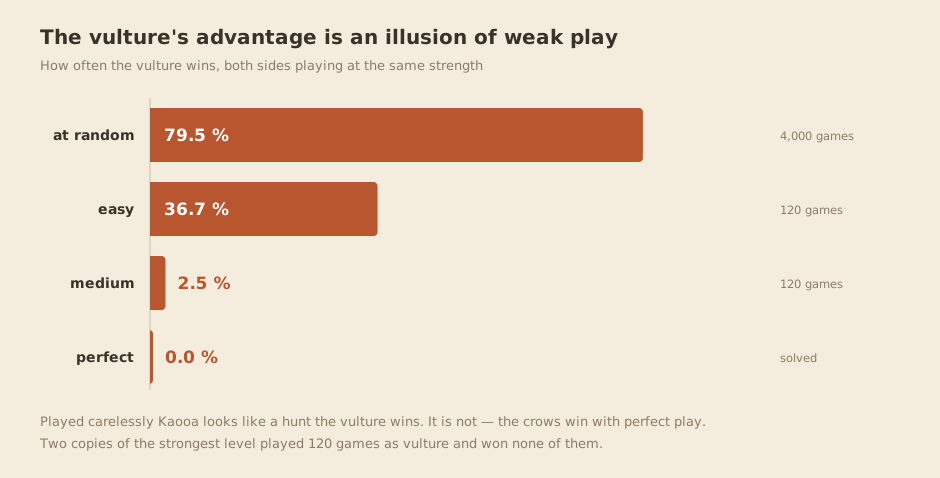
At the table Kaooa feels like a vulture's game — it wins four in five against careless play, and beginners playing crows lose quickly and often. The crow win exists, but you have to be good to find it. That gap between what the game is and what it feels like is unusual, and it is the reason the game survived.
How many crows would be fair?
Six. We computed every variation, and the threshold is sharp:
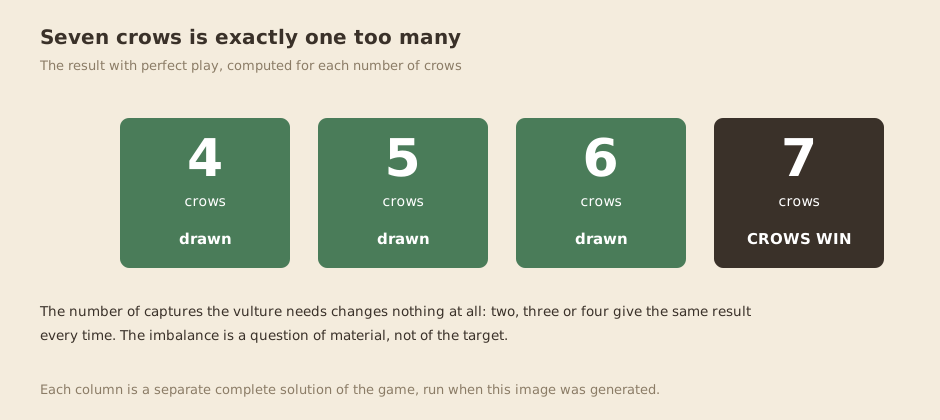
What makes no difference at all is how many captures the vulture needs. Two, three, four — the outcome is identical every time. The imbalance is entirely a question of material, not of the target.
So the traditional rules sit exactly one crow past fair. Which is worth knowing, and not worth "fixing": the historical game is the one people played.
What should you actually do at the board?
Three things follow from the geometry, and all three are countable rather than matters of taste.
A tip is a trap. Each of the five points of the star has only two neighbours; each crossing has four. A crow on a tip has half the escape routes, and a vulture on a tip is half as hard to shut in. That single asymmetry is most of the game.
Every jump needs a landing point. The vulture can only take a crow if the point directly beyond it is empty. So a crow with something behind it is safe, and a crow standing alone in open space is not — which is why the danger is worst in the first few turns, when almost everything is empty.
The vulture's clock runs out. It has to reach four captures before the crows finish arriving and seal the board. Every quiet turn it spends repositioning is one it does not spend eating, and after the seventh crow lands there is very little left to work with.
How strong is the computer?
| Level | How it plays | Result |
|---|---|---|
| Easy | looks a move or two ahead | wins 9 games in 10 against random play |
| Medium | a deeper search | beats easy comfortably as crows |
| Hard | deepest search in the time it has | beat medium in all 120 games as crows |
The hard level playing crows is, in practice, unbeatable — which is exactly what the solved result predicts. If you want a game you can win, take the vulture against easy or medium, or take the crows yourself and see how quickly you can shut the bird in.
Playing a friend online
Pick With a friend online under the board and press Open a table. You get a four-character code; whoever you send it to types it in and presses Join. No account, no download, and there is a chat window in the corner.
Both sides see the same board, and the server holds the position — so there is no argument about whether a jump was legal.
Where Kaooa comes from
Kaooa is played in India, traditionally on a star scratched into the ground with stones or seeds for pieces. It belongs to the same family as Bagh-Chal from Nepal and Fox and Geese from northern Europe: one strong hunter against many weak pieces that cannot fight back.
What makes it unusual in that family is the board. Almost every hunt game uses a grid or a cross. Kaooa uses a pentagram — the same figure as the one-person puzzle Pentalpha — and the geometry does real work: a tip has only two neighbours, a crossing has four, and jumps run only along the five straight chords. That is why the corners of the star are dangerous places for a crow.