Before checkers, there was Alquerque. Twelve pieces each, one empty point in the middle, and one merciless rule: every capture is compulsory.
The goal
Capture all twelve of your opponent's pieces — or seal them in so that they cannot move at all.
How to play
- Step. Click one of your pieces, then a highlighted point. Pieces slide one step along the drawn lines to an adjacent empty point: sideways and backwards included. Diagonals exist only where a diagonal line is drawn.
- Jump to capture. If an enemy piece stands next to yours with an empty point directly beyond it on the same line, you jump it and it leaves the board.
- Follow the chain. Landed next to another jumpable piece? Your piece must continue. One turn can sweep up several pieces, turning corners as it goes.
You cannot decline a capture. When a jump exists anywhere on the board, every quiet move is locked.
Controls
| What you see | What it means |
|---|---|
| Gold dashed ring | A piece that may move. When a capture exists, only jumping pieces get the ring. |
| Green dot | A quiet move to an adjacent free point. |
| Red ring and red dot | A capture: the pulsing piece will be jumped, the dot marks your landing point. |
In the side panel you can set the difficulty to Easy, Medium or Hard, play as White or Black, undo your whole last turn, toggle the sound and reopen the rules.
Rules
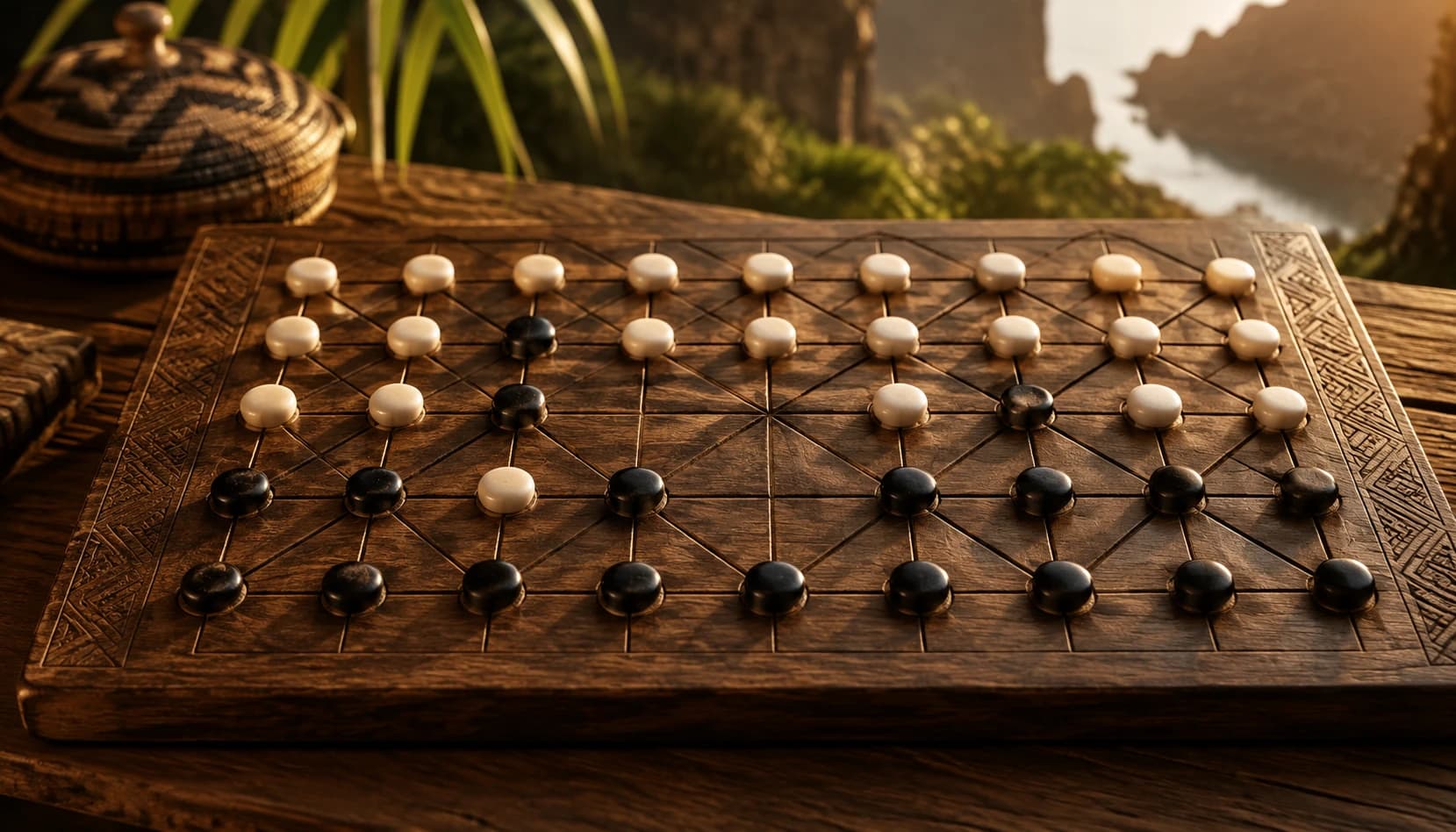
- The board has 25 points joined by lines: the full grid, both main diagonals and the inscribed diamond. Pieces stand on the points.
- Each player starts with 12 pieces; only the centre is empty. White moves first.
- Capturing is compulsory, and a piece that can keep jumping must continue.
- The four corner points lie on no capture line: pieces there can neither capture nor be captured.
- Threefold repetition, or sixty moves without a capture, is a draw.
Strategy
- Look one jump ahead. The most common beginner loss is moving a piece to a point where it can be jumped for free. Check every quiet move for that first.
- Weaponise the forced capture. Because your opponent must take what you offer, you control where their piece lands. Sacrificing one piece to set up a three-piece counter-chain is the defining tactic of the game.
- Value the diagonal points. Only half the points allow diagonal movement, so pieces there see more, threaten more and escape more easily.
- Advance as a wall. A lone advanced piece is chain fodder. Move up in connected formations that guard the points behind each other.
Play it away from the screen
Nobody sells an Alquerque set, so print one: the printable Alquerque board puts the full 25-point board with its diagonal pattern on one sheet, twenty-four men to cut out on a second, and the rules on a third. Carved wood, temple slab, parchment or an ink-saving outline for a class set.
Want the deeper game?
The full Alquerque guide has the board explained with diagrams — including why half the points are worth twice the others — the chain jump, and how compulsory capture turns a sacrifice into the game's defining weapon.
About the game
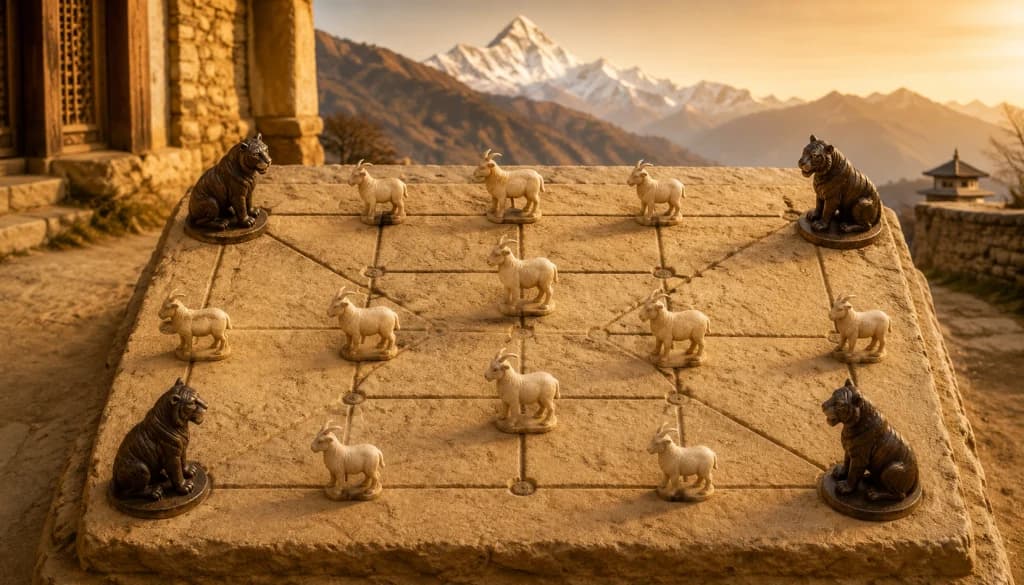
Boards of this distinctive lined pattern have been found scratched into Egyptian temple slabs, Roman paving and medieval cathedral benches. The Arab world knew the game as al-qirkat; the Moors carried it into Spain, where in 1283 King Alfonso X had its rules written down in the Libro de los juegos. Sometime around the twelfth century players moved its pieces onto the chessboard — and draughts was born.