Sixteen by sixteen squares. Nineteen pieces a side, clustered in opposite corners. Get all nineteen into the far corner before your opponent does the same to yours — that is the whole of it, and the one rule worth learning properly is the jump.
How to play Halma
Sixteen by sixteen squares, nineteen pieces a side, opposite corners. Move exactly one piece each turn, and be first to swap places with your opponent.
Moving: step or jump
- Step — one square, in any of the eight directions, to an empty neighbour. This ends your turn.
- Jump — over any piece, yours or the opponent's, into the empty square directly beyond it. Nothing is ever captured or removed; the jumped piece stays exactly where it was. Land, and if another jump is available from there, take it too — any number in a row, your choice when to stop.
How do you win at Halma?
By filling every one of the nineteen squares of the camp diagonally opposite yours with your own pieces. Your own camp does not have to be empty — only the far one has to be full — but leaving pieces at home too long just gets in their own way: the earlier they clear their own camp, the sooner the rest can step and jump through it.
How many pieces does Halma start with?
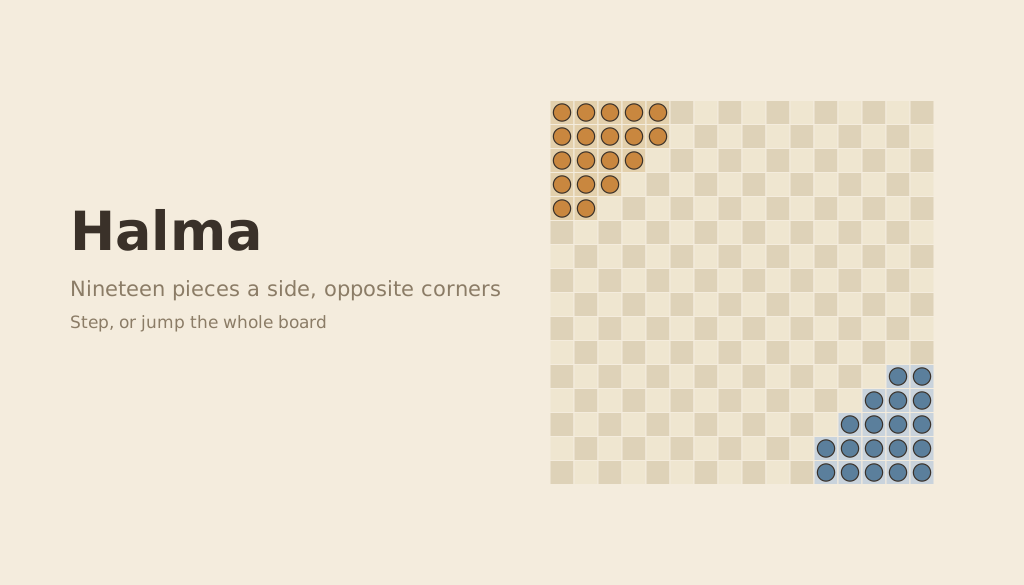
Nineteen a side, in the traditional 1-2-3-4-5-4 camp: five whole rows out from the corner, growing 1, 2, 3, 4, 5 — then a sixth row of only 4, the middle four squares of what would otherwise be a row of 6. That is the number everyone quotes, and we checked it against the board itself rather than trusting the count: written out by board row instead of by diagonal, it comes to 5, 5, 4, 3, 2 squares, left-aligned against the corner. Both ways of slicing it land on the same nineteen squares.
Controls on this board
Click a piece — every square it can reach this turn lights up, step and jump destinations both, worked out in full before you choose. Click one of those squares and the whole move happens at once, however many jumps it took to get there. Play the computer at three levels, pass the device for two players in the same room, or open a table and send the code to play a friend online, with a chat window built in.
Halma strategy: how far can one jump chain reach?
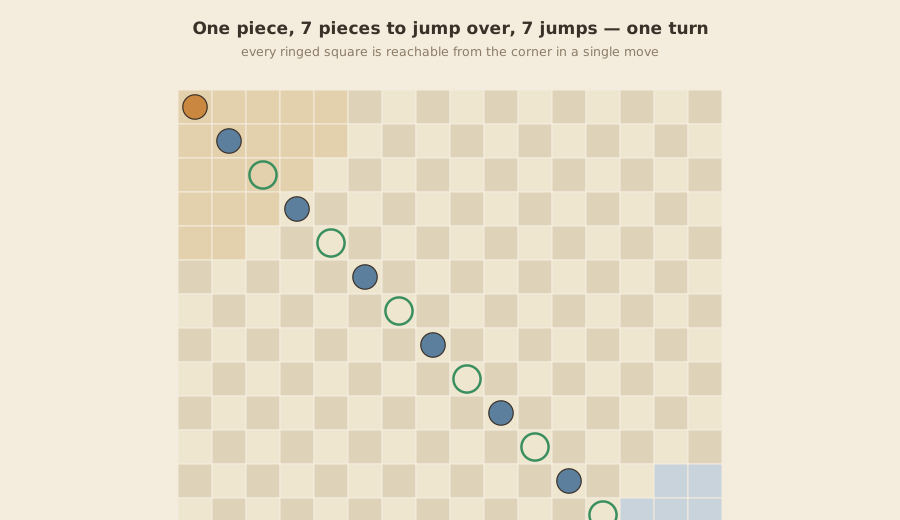
Walking corner to corner one step at a time takes fifteen turns — that is just the king-move distance across the board. Line seven pieces up along the diagonal instead, and the piece at the corner can jump all seven in a single turn, landing seven squares out, one short of the corner itself. That is not a rule of thumb; it is the actual output of this page's own move generator, run against exactly that position.
It is also the whole strategic idea of Halma in one picture. Walking is slow. A line of pieces to jump over — your own included, since nothing is ever captured — is what actually wins the race. Beginners tend to walk their whole army forward one square at a time; the faster habit is building a diagonal early and using it as a ladder for everybody else.
Why can a losing player refuse to finish a Halma game?
The win condition only checks the opponent's camp. Nothing in the rule requires you to empty your own. A player who is clearly beaten can simply leave one piece sitting at home forever, and since the win condition can then never be satisfied for that one square, the game has no forced ending.
This is a real, documented quirk of Halma — not something specific to this page — usually discussed under the name spoiling strategy. We play the rule exactly as printed rather than patch it with a house rule of our own; a "no sitting still" clause would make this a slightly different game from the one everybody else is playing. In practice it essentially never comes up: there is nothing to gain from refusing a game you have already lost.
Playing Halma against the computer
How do the three computer levels differ?
In how much of the board the computer bothers to think about — not in some unbeatable fixed depth, the same design as the Reversi opponent on this site. Every legal move is scored by a simple rule — how much closer does this get each piece to its target corner — and the levels differ in how many of the best-looking candidates get a second look at the reply, and how often a merely good move gets played instead of insisting on the best one.
How long does a game of Halma take?
We played each level against itself to see how long a real game actually runs: 200 to 300 plies to fill a camp, which comes to roughly 100 to 150 moves a side. Halma is a longer game than most of what is on this site by design — closer to an hour of real play between two people than a quick round — and the computer opponent runs at that same pace rather than a sped-up one.
Who invented Halma?
George Howard Monks, an American thoracic surgeon at Harvard Medical School, put the game together in 1883 or 1884 as a simplification of an earlier English game called Hoppity, from 1854.
Is Halma related to Chinese Checkers?
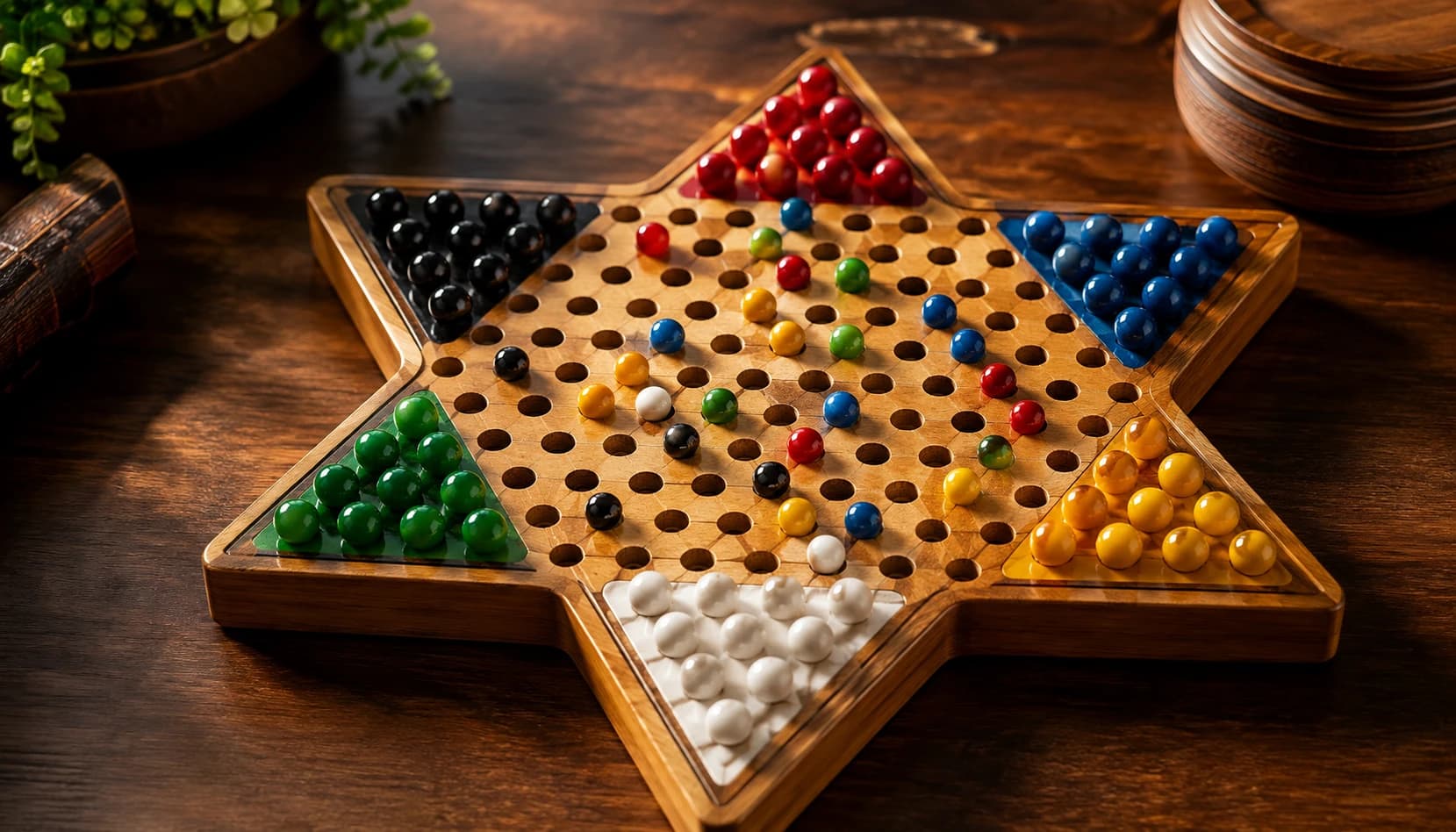
Yes, but backwards from how most people assume: Chinese Checkers is the descendant, not the ancestor. It was published in Germany in 1892 as Stern-Halma — star Halma — on a six-pointed star board rather than Halma's square one, and only picked up its present, misleading English name once it reached American toy shops decades later. It has no real connection to China, and none to draughts.
If you like this one
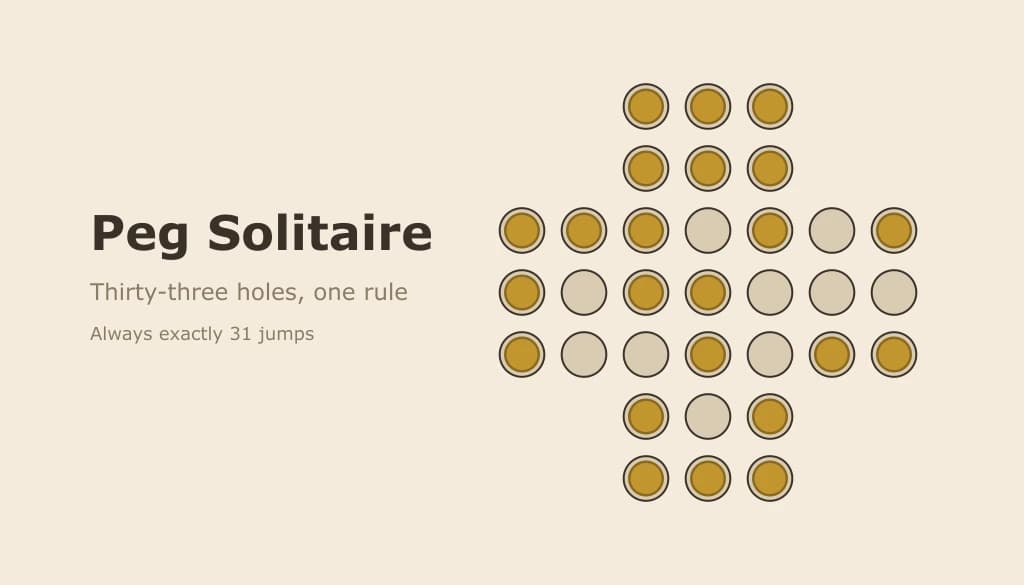
- Peg Solitaire — jumps with the opposite purpose: there, every jump removes a piece; here, none ever leaves the board
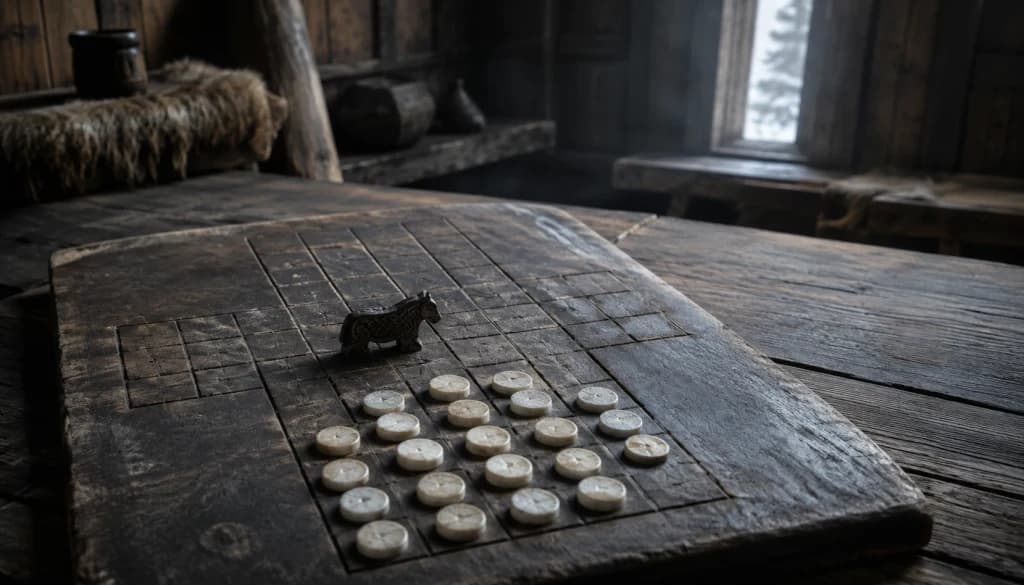
- Fox and Geese — the same orthogonal jump, used to hunt instead of to race
- Surakarta — captures without a single jump at all, travelling around loops in the board's corners instead
The Windows connection
If you remember this board from a beige desktop rather than a box, the board games that came with Windows is the piece for you — which ones shipped, which were dropped, and what happened to them.