A 5×9 board, 22 pieces a side, every point full except the very centre. Capture is compulsory whenever it's on offer — and it comes two different ways, sometimes both at once from the very same move.
How to play Fanorona
How do you set up a Fanorona board?
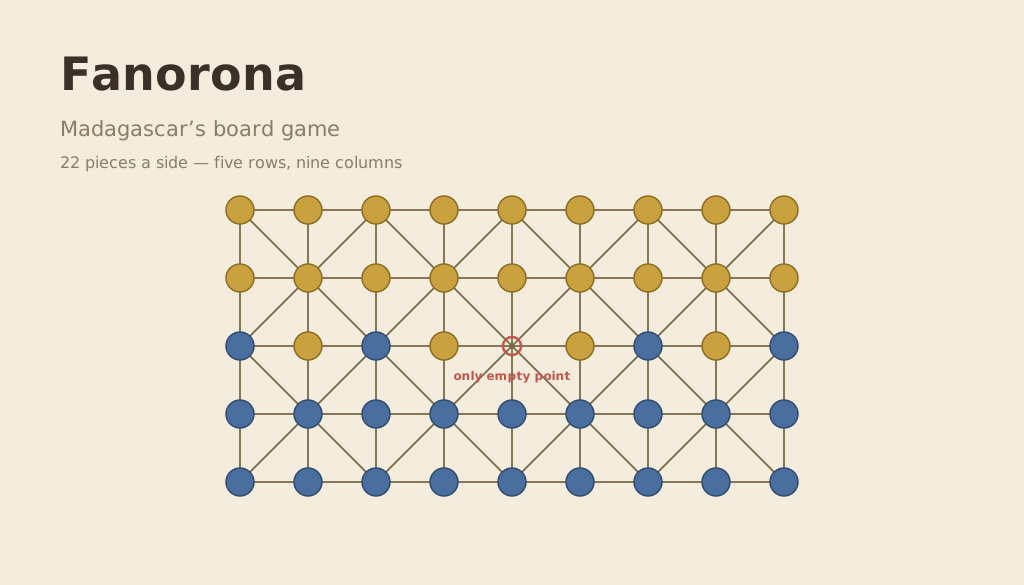
Both players' back two rows start completely full, 18 pieces each. The middle row adds four more a side, alternating column by column out from the centre — and that centre point is the only one on the entire board that starts empty. Whoever moves first is generally agreed to have an edge, so this page settles that by turn: you move first against the computer, and hotseat and online games alternate the traditional way.
Moving: step to an empty point
A piece moves one step along a drawn line to an adjacent empty point. Every point connects orthogonally to its neighbours; a diagonal connection exists only where the board actually draws one — the same woven "tetrakis" pattern this site's Alquerque board uses, just five rows deep and nine wide instead of five and five.
Capturing: approach and withdrawal
The one rule that makes Fanorona genuinely different from every other capture game on this site: a single step can capture in two entirely different directions, and which one happens is your choice.
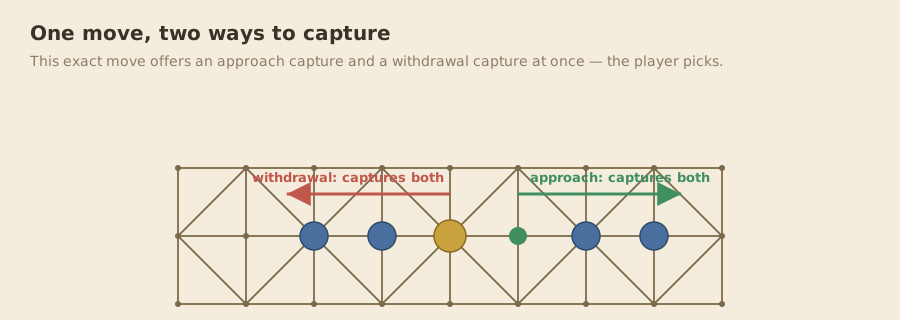
- Approach — every enemy piece in an unbroken line directly beyond your destination, continuing the same direction you just stepped, is captured.
- Withdrawal — every enemy piece in an unbroken line directly behind the point you just left, continuing that same direction backward instead, is captured.
Either way, every piece in the line goes, not just the nearest one — an empty point or a piece of your own colour is what finally breaks the chain and stops the capture. And when a move genuinely offers both at once, as in the diagram above, the choice is yours: this page shows both options and waits for you to pick.
Capturing is never optional when it's available. If any of your pieces can capture anywhere on the board, a quiet step is illegal that turn — you must play a capture, though which one, and against which piece, is still entirely up to you.
Chain captures: turning between hops
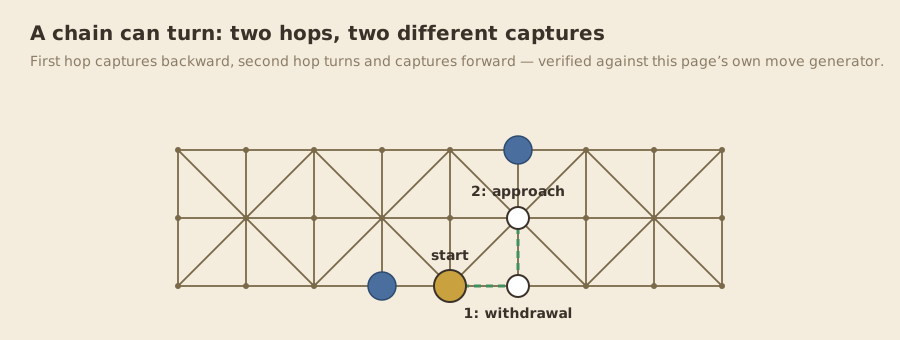
Land a capture, and if the same piece can capture again from its new spot, it may — but the next capture has to use a different direction than the one just used, and the piece can never land back on a point it has already stood on this same turn. Both restrictions exist to stop a chain from just oscillating back and forth between two points. Stopping is always allowed, even mid-chain with more captures still on the table — this page shows a Stop capturing button the moment that choice is live.
How do you win?
Capture every one of the opponent's pieces. There's no secondary condition and no stalemate escape hatch here the way some of this site's other capture games have — with mandatory capture in force, a side with pieces left almost always has a legal move.
Fanorona strategy
Why mandatory capture changes everything
Most capture games on this site let you decline a capture if you'd rather do something else. Fanorona never does. That single difference means a piece placed carelessly next to an enemy line isn't a minor inconvenience — it can force a capture you didn't want to make, opening a hole the opponent walks straight through. Counting captures one move ahead, for both sides, matters more here than in almost anything else on this site.
It also means the opening matters less than it looks like it should. With both back rows full and only the centre empty, the first several moves are heavily constrained anyway — there simply aren't many pieces that can step anywhere yet. The game's real character shows up a little later, once the middle row has opened up enough for the first captures to start, and it's there that the mandatory rule starts doing its work.
How to win as either side
Central points matter more than edge points, and not just for the usual board-game reason. A point in the middle of the grid connects in up to eight directions instead of four, which means more potential capture lines run through it — both the ones you can use, and the ones an opponent can force you into. Holding the centre with pieces that support each other, rather than racing pieces out to the edges, tends to keep the number of forced captures working in your favour rather than against you.
Playing against the computer
How do the three computer levels differ?
In how many candidate moves get weighed and how often a merely good one gets played instead of insisting on the best — the same approach used for Reversi and every other computer opponent on this site. Material dominates the scoring, since the game is won outright by elimination; a small bonus goes to pieces sitting on well-connected points and pieces kept nearer the centre, for the reason above.
How long does a game of Fanorona take?
We measured matched medium-level games against themselves rather than guess: most settle in anywhere from a few dozen to a few hundred plies. That's fast by the standards of this site — mandatory capture keeps removing material every few moves, instead of letting both sides manoeuvre indefinitely the way an optional-capture game can.
The history of Fanorona: a throne lost to a board game
Fanorona is Madagascar's national game, and the most-repeated story about it is a succession dispute, recorded from Malagasy oral history and set in the reign of King Ralambo, who ruled roughly 1575 to 1610. Wanting to test which of his sons should inherit the throne, Ralambo feigned illness and sent word for them to hurry home — the first to arrive would succeed him.
Prince Andriantompokoindrindra, the elder son, was in the middle of a notoriously difficult Fanorona position at the time — a telo noho dimy, "three against five," a famous endgame problem where the side with only three pieces tries to hold off five. He stayed to finish it. His younger brother, Andrianjaka, rode straight home, arrived first, and inherited the kingdom instead — going on to found what is now Antananarivo, Madagascar's capital.
Where the board itself comes from
The game's mechanical roots are usually traced to Alquerque, a much older capture-and-jump game that reached Madagascar through Arab or Southeast Asian trade contact and was reshaped into something distinctly its own from there. Alquerque has no withdrawal capture, no mandatory double-direction choice, and no direction-changing chain rule — Fanorona kept the general idea of jumping to capture and rebuilt almost everything else around it. This page's own Alquerque board uses the identical tetrakis point pattern, just smaller.
If you like this one
- Alquerque — the older, simpler capture game Fanorona is usually traced back to
- Surakarta — a different national capture game with its own single unusual rule, corner loops instead of two capture directions
- Nine Men's Morris — another game where a captured piece is gone for good, on a very differently shaped board
- Reversi — the computer opponent here shares its candidate-scoring approach