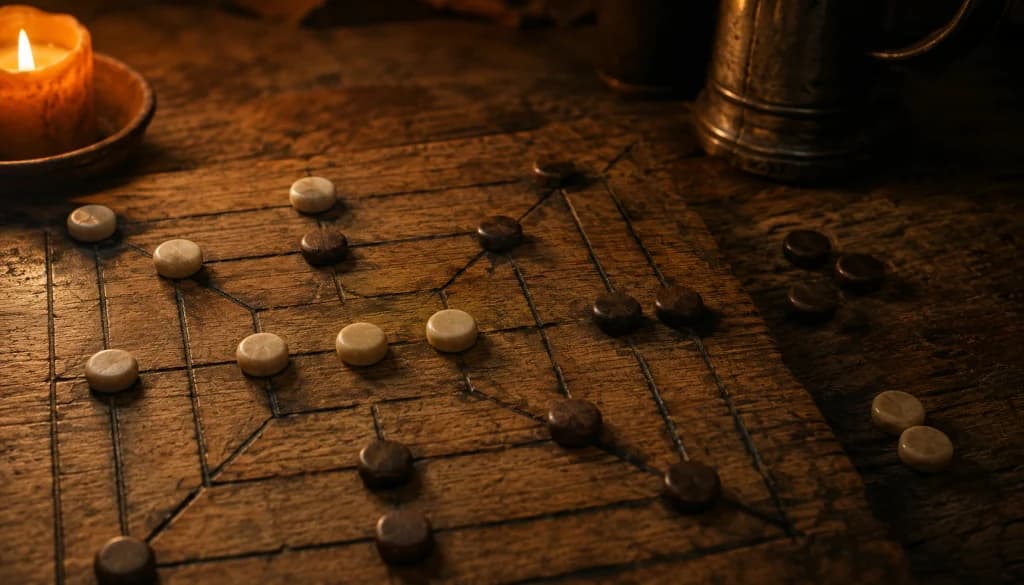
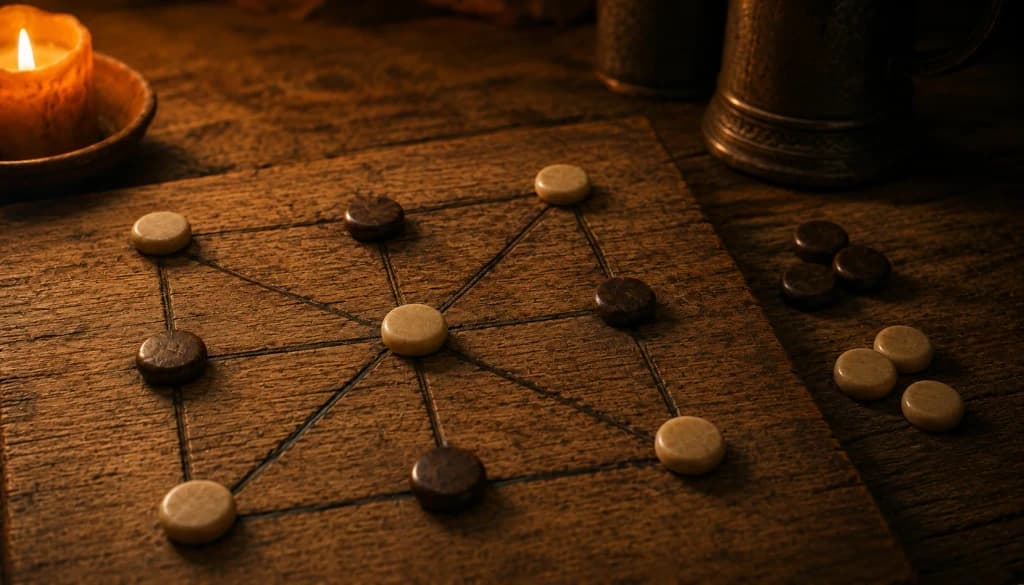
A duel of mills that has been played for two thousand years. Line up three pieces, take one of your opponent's, and grind them down until they cannot move.
The goal
Form mills — three of your pieces in a straight line along a board line — to capture enemy pieces. Reduce your opponent to two pieces, or trap them so that they cannot move at all, and you win.
The three phases
- Placing. Take turns putting your nine pieces, one per turn, on any empty point of the board.
- Moving. Once all pieces are placed, slide one piece per turn along a line to an adjacent empty point.
- Flying. Down to your last three pieces? They may then jump to any empty point on the board.
Mills and capturing
Closing a mill lets you remove one enemy piece of your choice. Pieces standing in a mill are protected and cannot be taken — unless every enemy piece is in a mill, in which case the protection lapses.
The sharpest weapon in the game is the swinging mill: open a mill by moving one piece out, then close it again on a later turn to capture once more. A player who builds one can take a piece every second move.
Controls
| What you see | What it means |
|---|---|
| Green dot | An available point — place a piece there, or move your selected piece. |
| Gold dashed ring | One of your pieces that can move. Click it to select. |
| Solid gold ring | Your currently selected piece. Click again to deselect. |
| Pulsing red ring | You closed a mill — click a highlighted enemy piece to capture it. |
In the side panel you choose your opponent — the computer or a friend online — set the difficulty, play as White or Black, undo your last move, toggle the sound and reopen the rules.
Play 2 player Nine Men's Morris online with a friend
Most Morris you find online is you against a machine. This one is also a table for two people. Pick With a friend online, press Open a table and you get a four-character code. Send it to whoever you want to play — they open the same page, type the code and press Join.
There is no account, no download and no waiting room. The board runs on the server, so neither side can be shown a move the rules do not allow, and a chat window sits in the corner for the part that is not the game. Whoever opened the table plays White and places first.
It is a good game to play this way: a Morris match is short, the rules fit in a sentence, and the mill-and-capture rhythm gives you something to say to each other every couple of moves.
Winning and draws
You win when your opponent is reduced to two pieces, or cannot make a single legal move. The game is a draw if the same position occurs three times, or if fifty moves pass without a capture.
Three quick tips
- Claim the crossings. The four mid-points of the middle ring touch four lines each — the most valuable points on the board.
- Threaten twice. Set up two mills that could both be completed on your next turn. Your opponent can only block one of them.
- Respect the placing phase. Most games are decided before a single piece ever slides. Place every one of your nine with a plan.
Play it away from the screen
No board in the cupboard? Print one: the printable Nine Men's Morris board puts a full-page board on one sheet, nine men a side to cut out on a second, and the rules on a third. Three, Six, Nine and Twelve Men's Morris, in carved wood, cloister stone, parchment or an ink-saving outline for a class set.
Explaining a position to someone? The Nine Men's Morris diagram maker places pieces on the 24 points, marks the mills and exports the board as an image — and the link reopens the exact position, which is easier than describing it.
Want the deeper game?
The full Nine Men's Morris guide covers every rule with board diagrams, the double mill that decides most games, where the rule sets disagree, and why perfect play ends in a draw.
If it is the age of the thing that interests you, the history of Nine Men's Morris follows the board from Roman roof tiles to Viking ships, cathedral cloister benches and a village green in Shakespeare.
And there is more than one Morris: the Morris family explains Three, Six and Twelve Men's Morris, Lasker's ten-piece version and Morabaraba, which is a recognised sport in South Africa.
Wondering how this differs from noughts and crosses? So does everybody: Nine Men's Morris vs Tic-Tac-Toe.
About the game
Nine Men's Morris is among the oldest strategy games still played. Boards are found scratched into Roman roof tiles and into the cloister benches of medieval cathedrals — wherever people had a blade, some time, and an opponent.
Still played, after all this time
Morris boards are scratched into cathedral steps and Roman pavements, and the game is still played today — the oldest games still played today sets out which ones can honestly make that claim.