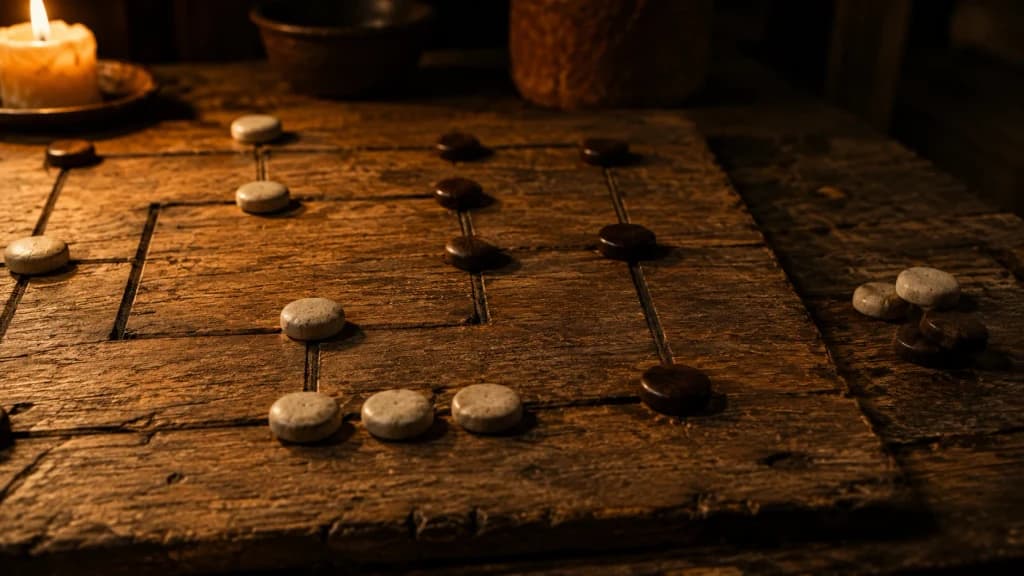
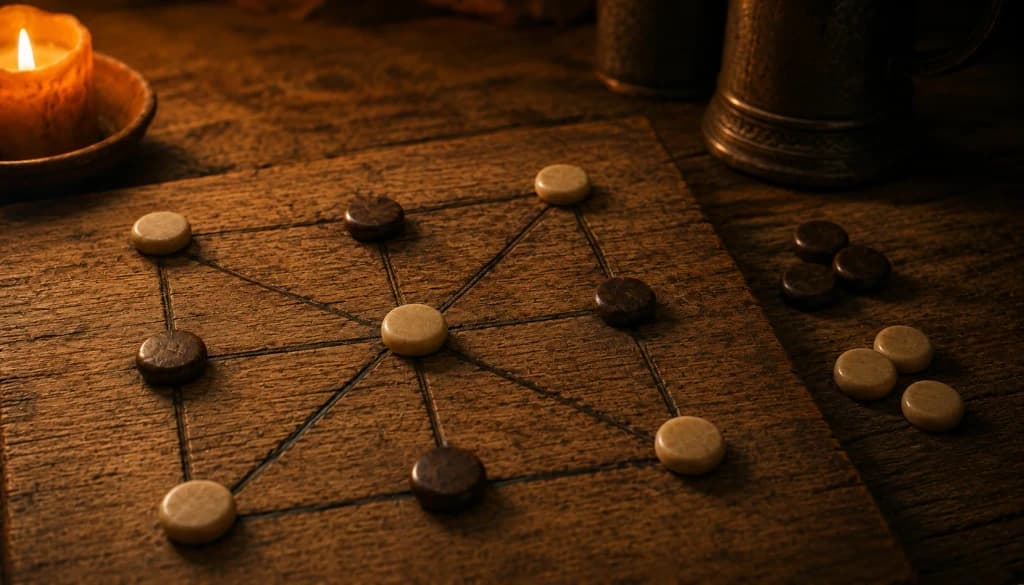
Morabaraba is the mill game of southern Africa, and it is not a small variation on the European one. Twelve pieces a side instead of nine, and a board with four extra lines that turn the corners from the worst points into some of the best.
The pieces are called cows. The game is played in South Africa, Botswana and Lesotho, traditionally by herd boys with stones in the sand, and it is organised as a competitive sport in South Africa.
The board is the difference
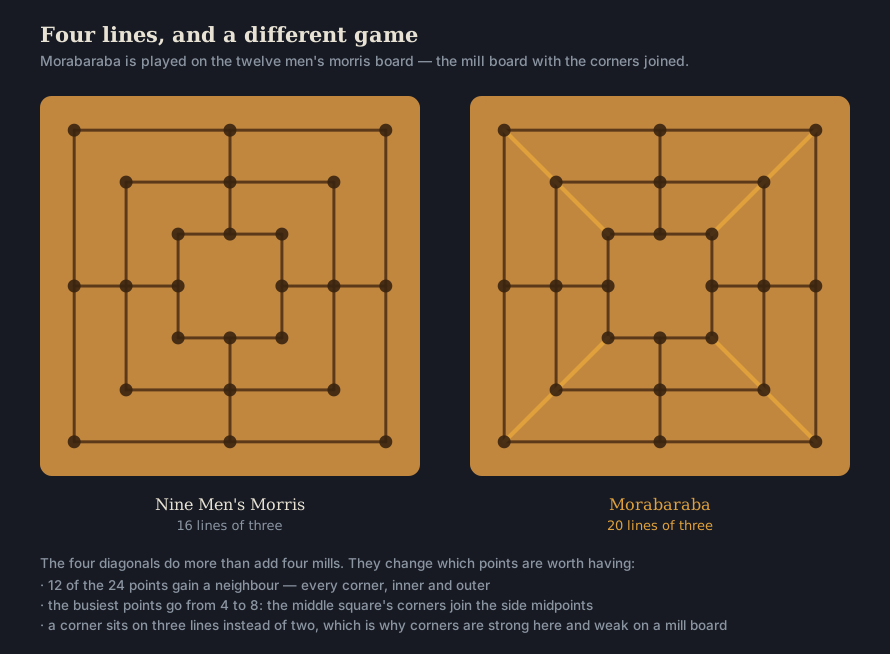
Both games use the same twenty-four points. Morabaraba adds the four diagonals — corner to corner through all three squares — and that single change does more than add four mills:
- Twelve of the twenty-four points gain a neighbour, every corner of every square.
- The busiest points go from four to eight: the middle square's corners join the side midpoints as the places worth fighting for.
- A corner now sits on three lines instead of two. On a mill board the corners are where you park a piece you have nothing better to do with. Here they are prime.
How to play Morabaraba
Placing
Dark places first. Take turns putting one cow on any empty point until all twelve each are down. Mills made during placing shoot straight away — you do not wait for the moving phase.
Making a mill and shooting
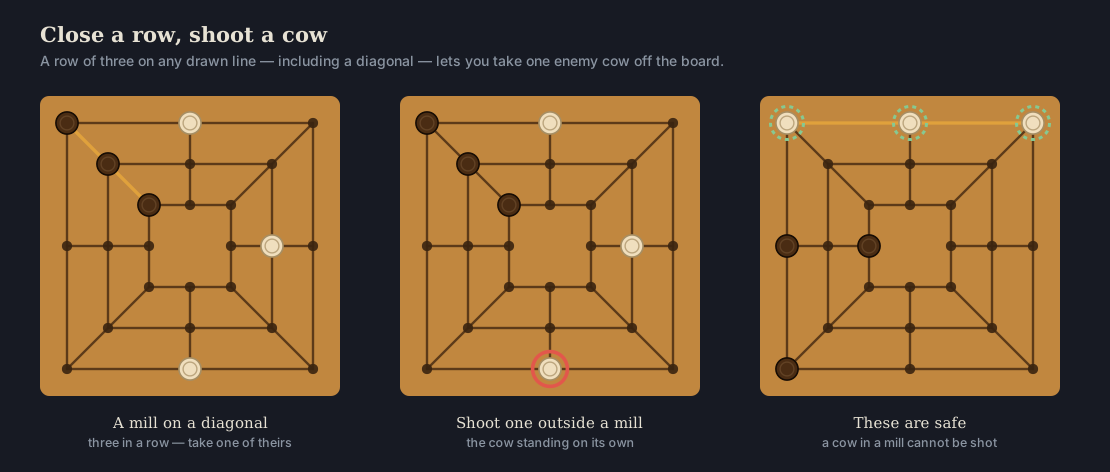
Three cows in a row on any drawn line is a mill, and it lets you shoot one enemy cow off the board.
- You may not shoot a cow that is inside a mill — unless every one of theirs is, in which case any may go.
- You may break your own mill and remake it next turn to shoot again.
Moving and flying
Once all cows are placed, a turn is moving one cow along a line to an empty neighbouring point. Down to three cows, that player may fly — move a cow to any empty point at all. It is a real lifeline, and it is why being reduced to three is not the end.
Winning and drawing
You win by reducing your opponent to two cows — too few to ever make a mill again — or by leaving them with no legal move.
Away from a screen: the printable Morabaraba board prints the board with the diagonals, twelve cows a side to cut out, and the rules on a third sheet.
Three ways to draw: three cows and no shot for ten moves; the same position three times; or the board filling up during placing.
That last one deserves a note, because it is repeated everywhere and it is almost never true in practice. Twelve cows each is exactly twenty-four points, so a placing phase in which nobody makes a mill would end with a full board and nobody able to move. Measured over 200 games against a real opponent, it happened not once — mills form, cows get shot, and space opens up long before the last cow goes down. With both sides moving at random it turned up eight times in a thousand.
What wins games
- Take a corner early. Three lines run through it here, against two on a mill board.
- Build a double threat: two rows each needing the same empty point, so whichever way they block, the other closes.
- A mill you can open and close again is worth more than a static one. Move a cow out, move it back, shoot again.
- Do not spend cows guarding. A cow inside a mill is safe; a cow parked next to a threat is just a cow you cannot use.
How strong is the computer, and who should move first?
Three levels. The important number first, because it changes how you should set the game up:
The first move is worth a great deal. Measured over 200 games at the medium level with sides swapped, the player who moved first won 86% ±3 of the decided games. Nine Men's Morris under the same measurement is nothing like as lopsided. That is why which side you play is a setting under the board — dark moves first, as in the traditional game, and you can take either.
The opponent itself is the same search that plays Nine Men's Morris here, with the board and the piece count swapped. It was rebuilt while this game was being added: at a fixed search depth the outcome used to be decided by the depth alone — an even depth handed the first player 95% of games, an odd depth handed them 0%. Fixing that made it measurably stronger, by 67% and 56% in head-to-head play against the previous version.
It is still not a hard opponent for a good player, and the first-move advantage above is the honest reason why.
Playing a friend online
Pick With a friend online under the board and press Open a table. You get a four-character code; whoever you send it to types it in and presses Join. No account, no download, and there is a chat window in the corner. Whoever opens the table takes the dark cows and moves first.