
Print & Play
Printable Morabaraba Board
The board with the diagonals — twenty rows of three, not sixteen. Twelve cows a side to cut out, and the rules on a third sheet.
Style
What the board looks like when someone made one — the default worth printing.
Paper
Sheets
For a PDF, pick Save as PDF as the printer in the print dialog.
Morabaraba · 24 points, 20 lines of three · playnook.io
Cows
Cut along the dashed lines — twelve cows a side, plus a spare. Card stock or a cereal box glued behind the sheet makes them survive a game. Bottle caps and stones work just as well; that is what they are usually played with.
Morabaraba · playnook.io
Morabaraba — the rules
Three cows in a row on any drawn line is a mill — the diagonals count. Close one and shoot one enemy cow off the board.
Placing
Dark places first. Take turns putting one cow on any empty point until all twelve each are down. Mills made while placing shoot at once.
Moving
Then a turn is moving one cow along a line to an empty neighbouring point.
Flying
Down to three cows, that player may move a cow to any empty point.
Shooting
You may not shoot a cow that is inside a mill — unless every one of theirs is. You may break your own mill and remake it to shoot again.
Winning
Reduce your opponent to two cows, or leave them with no legal move.
Draws
Three cows and no shot for ten moves; the same position three times; or the board filling up while placing.
The board is the mill board with the corners joined: 20 rows of three instead of 16. Play it against a computer at playnook.io/games/morabaraba
Want the European boards instead? Three, Six, Nine and Twelve Men’s Morris print from the same set, and the morris family explains what each one changes.
What you get
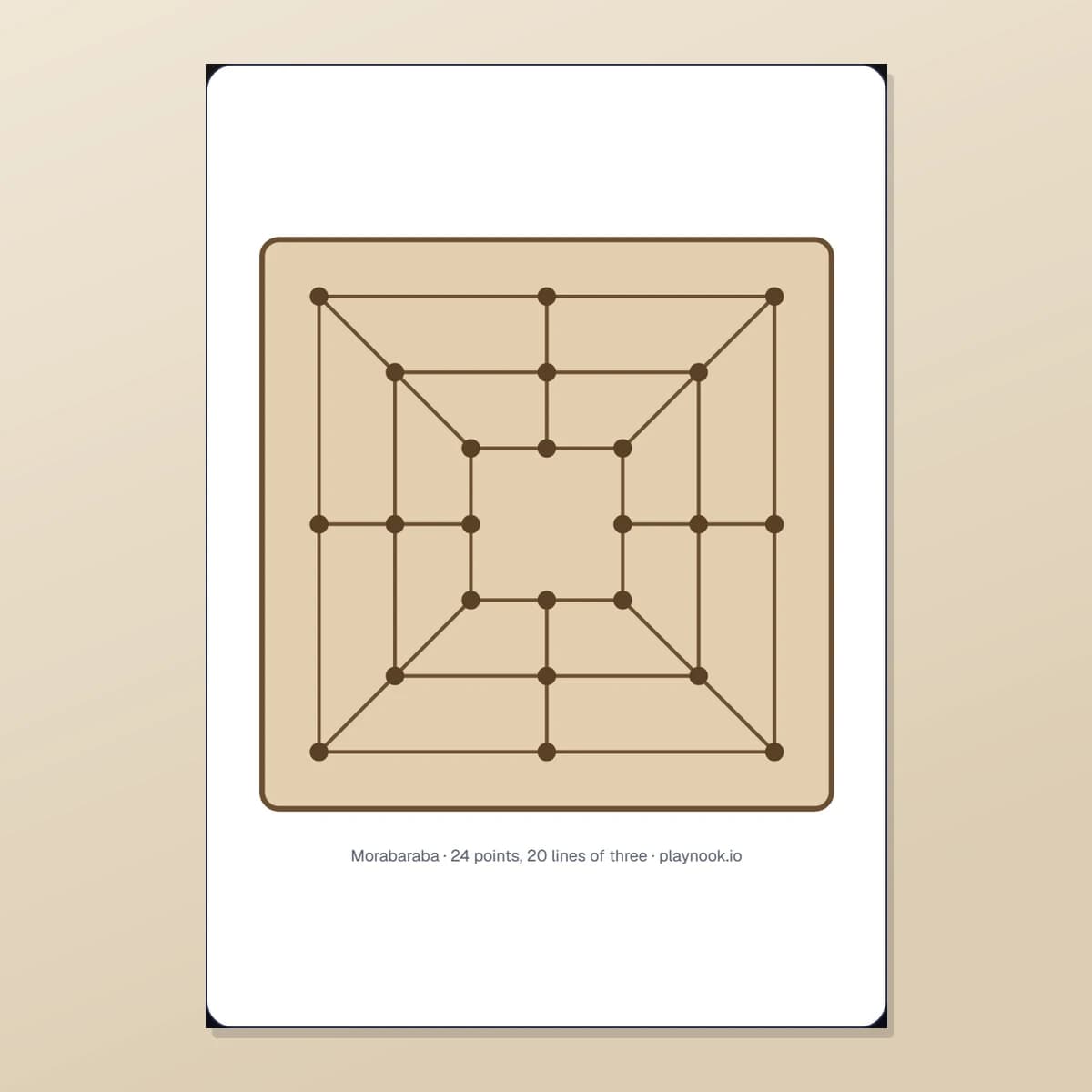
The board fills a portrait page — twenty-four points at a size that takes a bottle cap, not a diagram of a board. The cows sheet prints twelve a side plus a spare. The rules sheet fits the whole game on one page, with a diagram of a closed mill so nobody has to be talked through it.
The diagonals are not optional
Search for a Morabaraba board and you will mostly find a Nine Men’s Morris board: three squares joined at the middle of each side and nothing across the corners. That is the wrong board. Morabaraba joins the corners too, which takes the number of rows of three from sixteen to twenty.
It is not a cosmetic difference. On a mill board a corner sits on two lines and is where you park a piece you have nothing better to do with. Here it sits on three, and the corners are prime. A board printed without them plays a different game.
Four styles
Carved wood is what a board looks like when somebody made one. Cloister stone is the pale, incised look of a board cut into a bench. Parchment is warm and easy on the toner, and ink saver drops the fills entirely — outlines only, so a class set of thirty costs almost nothing to print.
Whichever you pick, the lines are drawn from the same table the playable game uses, so a board printed here has exactly the twenty rows of three the rules talk about.
Or draw your own
Morabaraba is usually played on a board scratched into the ground, and it is worth knowing how because the layout is easy to get wrong from memory. Three steps:
- Draw three squares, one inside the other, evenly spaced — the middle one halfway between the outer and the inner.
- Join the middle of each side across all three squares. Four short lines, one per side. Do not run them through the centre; the centre stays empty.
- Join the corners the same way — outer corner to inner corner, through the middle square. Four more lines. This is the step that separates a Morabaraba board from a mill board.
You should end with 24 points and 20 rows of three: twelve along the squares themselves — four sides each — plus the four through the side midpoints and the four through the corners. Count the points before you start; if you have 24, the board is right.
For a classroom
Morabaraba is played across South Africa, Botswana and Lesotho, and it is organised as a competitive sport in South Africa — it turns up in schools rather than only in museums. For a class set, print the ink saver style on plain paper and the cows on something stiffer; bottle caps in two colours are the traditional answer and cost nothing.
Twelve cows a side on twenty-four points also makes a neat counting exercise: the placing phase would fill the board exactly, if only mills never formed.
Related boards
The European members of the family — Three, Six, Nine and Twelve Men’s Morris — print from the morris board set, and the morris family explains what each of them changes. To see a turn before you print anything, Morabaraba in the browser plays the same rules against a computer opponent or a friend online.