
Print & Play
Printable Nine Men’s Morris Board
Three sheets and a pair of scissors make a complete set: the board, the men to cut out, and the rules on one page. Four boards from the same family, four styles.
Board
The classic. Three squares, 24 points, nine men each — the board carved into medieval cloister benches.
Style
What the board looks like when someone made one — the default worth printing.
Paper
Sheets
For a PDF, pick Save as PDF as the printer in the print dialog.
Nine Men's Morris · 9 men each · playnook.io
Pieces
Cut along the dashed lines — 9 men per side, plus a spare. Card stock or a cereal box glued behind the sheet makes them survive a game.
Nine Men's Morris · playnook.io
Nine Men's Morris — quick rules
White has closed a mill and may take a black man.
- Set up. The board starts empty. Each player takes 9 men — one colour each.
- Placing. Take turns putting one man on any empty point, until all 18 are on the board.
- Mills. Three of your men in a row along a marked line is a mill. Close one and remove any enemy man from the board.
- What you may take. Never a man that stands in a mill — unless every enemy man does. Removed men are out for good; they do not come back.
- Moving. Once all men are placed, each turn slides one man along a line to an adjacent empty point. Opening a mill and closing it again next turn is allowed, and it is the strongest thing on the board.
- Flying. A player down to three men may move to any empty point on the board instead of an adjacent one. Some play without this rule — agree before you start.
- Win. Your opponent loses when they are down to two men, or when they cannot make a legal move.
Play online: playnook.io/games/nine-mens-morris
What you get
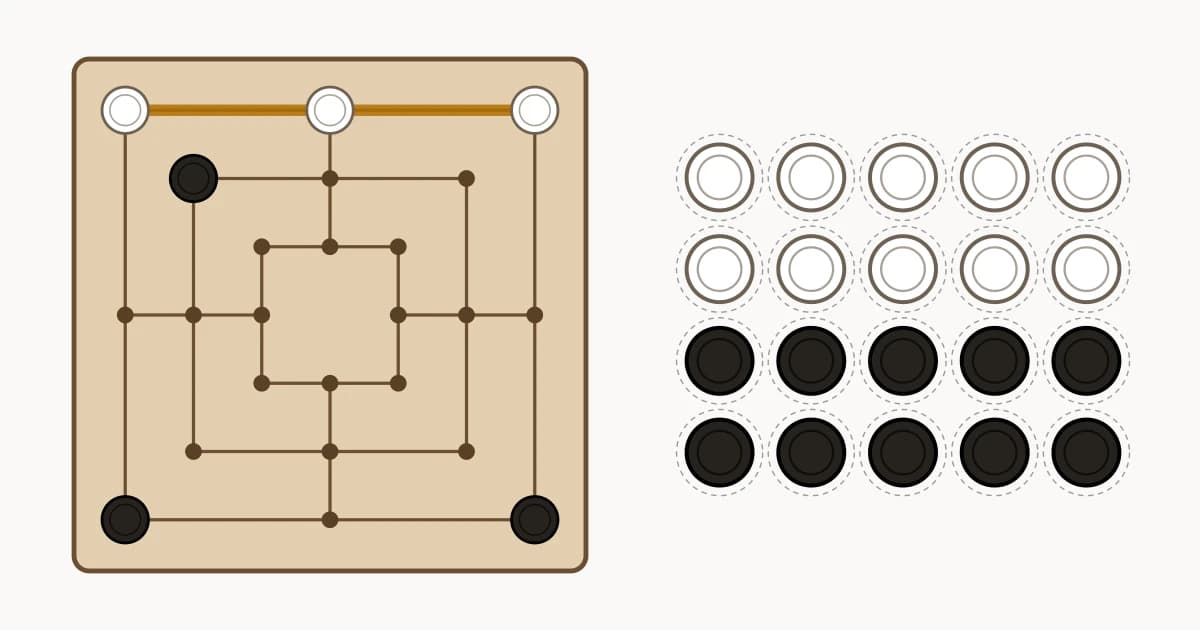
The board fills the page — three squares, twenty-four points, drawn at a size that takes real pieces rather than pencil marks. The piece sheet prints nine men a side plus a spare, each on a dashed cutting circle and sized to sit on a point without crowding its neighbours. The rules sheet fits the whole game on one page, with a diagram of a closed mill so nobody has to take the wording on trust.
Four boards, one family
Morris is a family of games that share a board and differ in how much of it you use.
Nine Men’s Morris is the one people mean: three squares joined at the edge midpoints, nine men each. It is the board medieval masons cut into the stone benches of cathedral cloisters, and the boards are still there. Twelve Men’s Morris adds diagonals from corner to corner, which makes four more mills and a sharper game. Six Men’s Morris drops the outer square — sixteen points, six men, and a game short enough to finish in a break. Three Men’s Morris is nine points and three men each: it opens like noughts and crosses and then carries on, because when the board fills up you start sliding men instead of placing them.
Every board prints with the rules sheet for that variant — the piece counts and the winning condition genuinely differ, and a sheet that quietly described the wrong game would be worse than none.
Four styles
Cloister stone is the board as the masons left it: grey, chiselled, plain. Carved wood uses the same warm board as our diagram maker, so a printed set and a diagram in a lesson look like they belong together. Parchment keeps it pale and easy on the toner, and ink saver drops the fills entirely — outlines only, so a class set of thirty costs almost nothing to print.
Making a set that survives
Paper men slide about and bend. Two fixes, both cheap: print the piece sheet onto card stock, or print on paper and glue the sheet to a cereal box before cutting. Either way you get pieces thick enough to pick up, which is most of what a bought set gives you.
For a board that lasts a term, print it on thicker stock and laminate it — the lines are drawn heavy enough to stay legible through lamination, and a wiped board outlives the pieces every time.
For teachers and classrooms
Nine Men’s Morris earns its place: the rules take two minutes, a game takes ten, and the whole thing is spatial reasoning wearing a disguise. Print the ink-saver style for a class set and let the pupils cut their own pieces — that part is the craft lesson. Three Men’s Morris works for younger classes as the same game with less to hold in your head. The boards you print are yours to use, in class or commercially.
Frequently asked questions
What do I use as pieces? The second sheet prints them — nine men a side plus a spare, sized to the points on the board. If you would rather not cut, two kinds of coin work perfectly: nine 5c and nine 10c, or buttons in two colours.
What is the difference between Nine and Twelve Men's Morris? The board is the same three squares, but Twelve Men's Morris joins the corners with diagonal lines. Those diagonals count as mills, and with twelve men each the board fills up almost completely.
Is Three Men's Morris just noughts and crosses? It starts the same way, but it does not end when the board fills. Each player has three men, and once all six are placed you keep sliding them along the lines until someone lines up three. That second half is a real game.
How big does the board print? It fills the page, edge to edge inside the margins — about 165 mm across on A4. The pieces are sized to match, so a man sits comfortably on a point without touching its neighbours.
Is it really free? Yes. Print as many copies as you like, at home or for a whole classroom. No account, no watermark.
How do I get it as a PDF? Press Print, then choose “Save as PDF” as the printer in the print dialog. Every browser has that option built in.
Rather play right now? Play Nine Men’s Morris online against the computer — no scissors involved. For the opening theory, the mill traps and the endgame, read the full guide. While you are here, print a checkers board or a mancala board too.