
Print & Play
Printable Mancala Board
A full-page board with the starting count in every pit, and the rules on a second sheet. Four layouts, four styles, a handful of beans — and you are playing.
Style
Bordered in the stripes of Ghanaian kente cloth — the home of Oware.
Board
The set sold in most Western shops. Two rows of six, a store at each end.
Paper
Extras
For a PDF, pick Save as PDF in the print dialog.
Kalah · 6 pits a side · playnook.io
Mancala (Kalah) — quick rules
Setting up
Four seeds in each of the twelve pits — 48 in play. Both stores start empty. Each player owns the six pits in front of them and the store to their right.
Sowing
Take all the seeds from any non-empty pit on your own side and drop them one at a time into the following pits, going counterclockwise. Add a seed when you pass your own store; skip your opponent’s entirely.
Extra turn
If your last seed lands exactly in your own store, you move again. Several extra turns can follow one another.
Capturing
If your last seed lands in an empty pit on your own side and the pit opposite has seeds, take that seed and everything opposite into your store.
Ending
The game ends the moment one player’s six pits are all empty. The other sweeps every seed left on their own side into their store. Most seeds wins — 25 takes it, 24 each is a draw.
You will need 48 counters
Dried beans, lentils, buttons, beads or coins. Paper has no hollows, so seeds roll: stand an egg carton or a muffin tin on the sheet and let the printed board be the layout rather than the container.
Play online: playnook.io/games/mancala
What you get
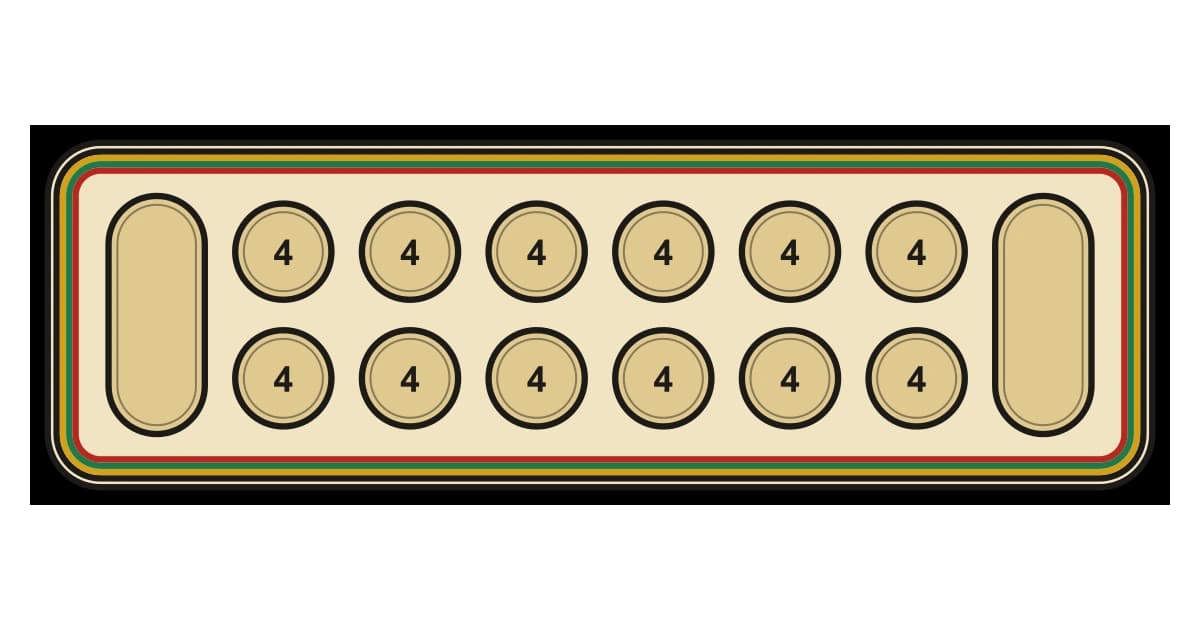
The board prints across a landscape page — twelve pits and two stores at a size that takes real beans, not a diagram of a board. Each pit carries the number of seeds it starts with, so setting up needs no counting and no explanation.
The rules sheet fits all of Kalah on one page: sowing, the extra turn, capturing, and how the game ends. It also lists what to raid the kitchen for.
Four styles
Kente frames the board in the stripes of Ghanaian kente cloth — Oware comes from Ghana, and the bold outlines make every pit legible from across a table. Carved wood is what a mancala board looks like when someone made one. Sand & shell keeps it pale and easy on the toner, and ink saver drops the fills entirely — outlines only, so a class set of thirty costs almost nothing to print.
Every pit is drawn as a hollow rather than a flat circle, which sounds like a detail and is the difference between a diagram of a board and something you want to put beans on.
The honest bit about paper
A printed sheet has no hollows, and beans roll. The fix every classroom already knows: stand an egg carton or a muffin tin on the sheet and let the printed board be the layout rather than the container. Twelve egg cups and two bowls for the stores make a set that survives a whole game — and the sheet keeps everyone straight on whose side is whose.
For a board that lasts on its own, print on thicker stock and laminate it, then use flat counters like buttons or coins rather than round beans.
Four boards, not one
Mancala is a family, not a game, and the boards differ. Kalah — two rows of six with a store at each end — is the set in most Western homes and what people usually mean by mancala. Oware from West Africa uses the same twelve pits without stores; captured seeds are kept beside the board. Congkak from Malaysia and Indonesia has seven pits a side, and Toguz kumalak from Central Asia nine, with nine seeds in each — the long game of the family.
All four print here. The rules sheet describes Kalah, because the capture rule is exactly what separates these games — printing Kalah’s rules beside an Oware board would teach the wrong game. The full guide covers the differences.
For teachers and classrooms
Mancala earns its place in maths lessons: sowing is counting, the extra-turn rule is arithmetic with a purpose, and a game takes ten minutes. Print the ink-saver style for a class set — outlines only, almost no toner — and let the seed counts save you from explaining the setup fifteen times. The boards you print are yours to use, in class or commercially.
Frequently asked questions
What do I use as seeds? Dried beans, lentils, buttons, beads, coins or counters from another game — anything small enough to sit in a pit. Kalah needs 48 of them, four to a pit.
Seeds roll off the paper. What do I do? Paper has no hollows, so stand an egg carton or a muffin tin on the sheet and let the printed board be the layout rather than the container. A dozen egg cups plus two bowls for the stores is the classic classroom set.
Which version does the rules sheet describe? Kalah — two rows of six pits with a store at each end, the set sold in most Western shops. Oware, Congkak and Toguz kumalak change the capture rule, so their boards print without a rules sheet.
Is it really free? Yes. Print as many copies as you like, at home or for a whole classroom. No account, no watermark.
How do I get it as a PDF? Press Print, then choose “Save as PDF” as the printer in the print dialog. Every browser has that option built in.
Rather play right now? Play mancala online against the computer — no beans involved. For the history, the variants and the strategy behind the counting, read the full mancala guide, or print a checkers board while you are here.