
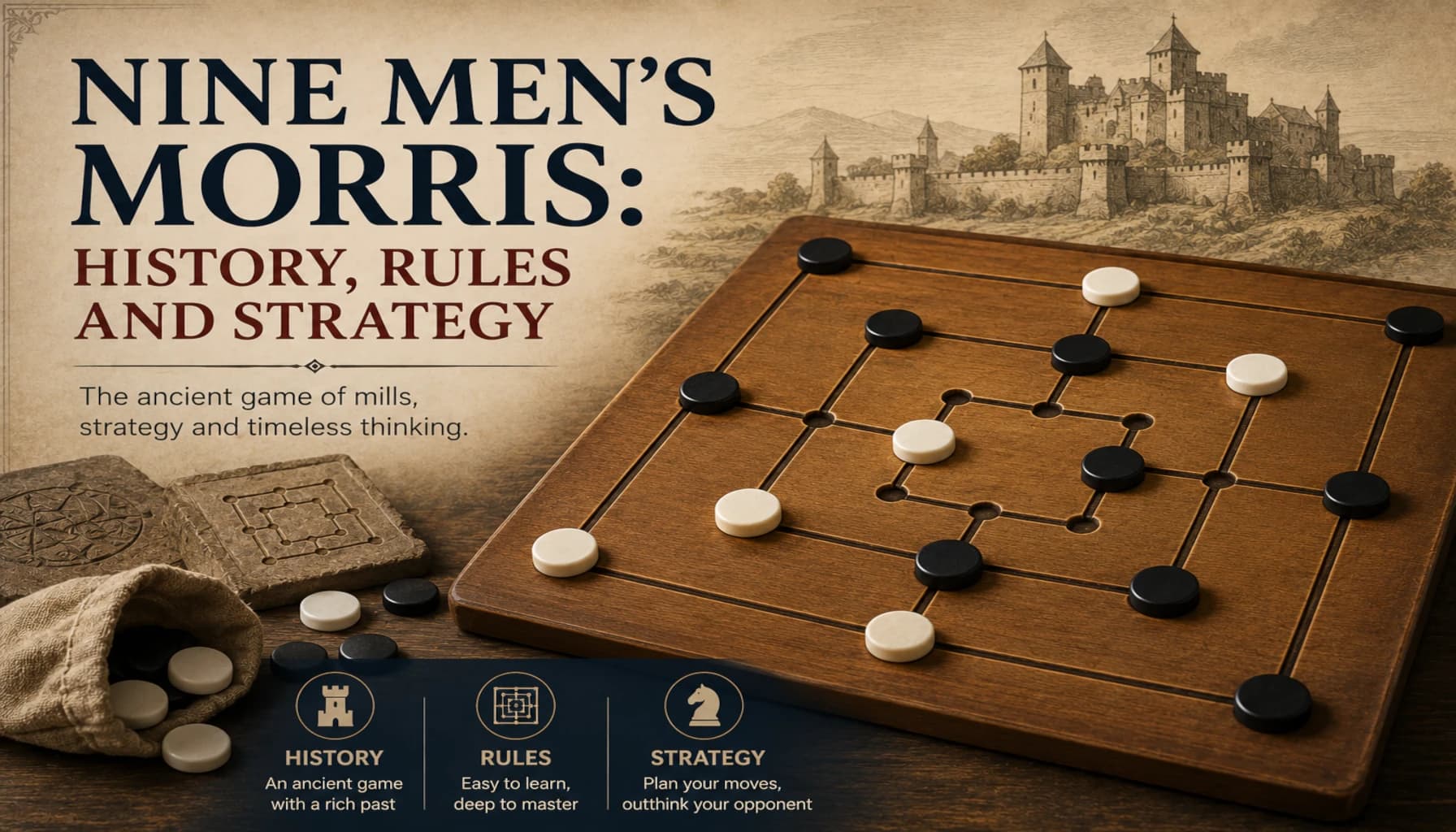
Nine Men's Morris is a game about lines of three. Place a piece, slide a piece, and the moment three of yours stand in a row along a board line, you take one of your opponent's off the board.
It is simple enough to explain in a minute and old enough that Roman soldiers scratched boards into paving stones to pass the time. Somewhere between those two facts sits a game with real depth — and one tactic that decides more matches than everything else combined.
Where it comes from, briefly
The name has nothing to do with Morris dancing. The likelier root is the Latin merellus, a gaming counter, which survives in the English Merels and the French mérelles; in German the game is Mühle, a mill. The "nine" is simply how many pieces each player gets.
As for its age: firmly attested under the Roman Empire, so around two thousand years — and not the 1400 BC you will often read, a date that rests on carvings nobody can actually date. From Rome the trail runs north to a board in a Viking ship burial and into the cloister benches of medieval English cathedrals.
That is the short version. The long one, with the evidence attached and Shakespeare's village green in it, is the history of Nine Men's Morris.
The board
Three concentric squares, joined by four lines running from the midpoint of each side. Where the lines meet, you get 24 playable points. Pieces sit on the points, not in the spaces.
Not all points are equal, and this matters more than beginners realise.
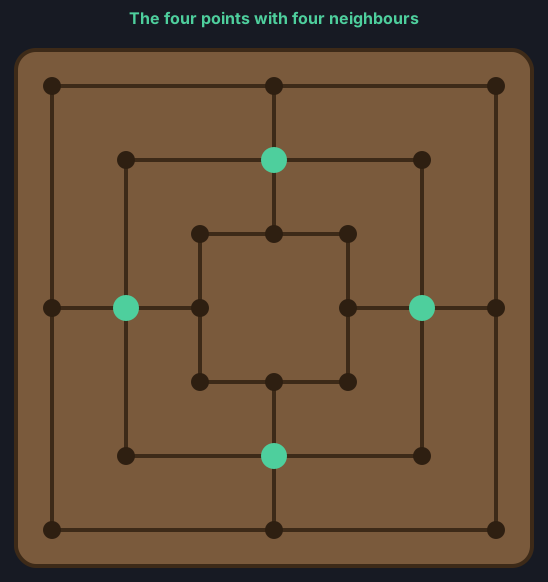
| Point type | How many | Neighbours |
|---|---|---|
| Corners of the three squares | 12 | 2 |
| Side midpoints, outer and inner ring | 8 | 3 |
| Side midpoints, middle ring | 4 | 4 |
A corner piece can only ever go two places. A piece on one of those four crossroads has twice the freedom and sits on twice as many potential mills.
Sixteen ways to make a mill
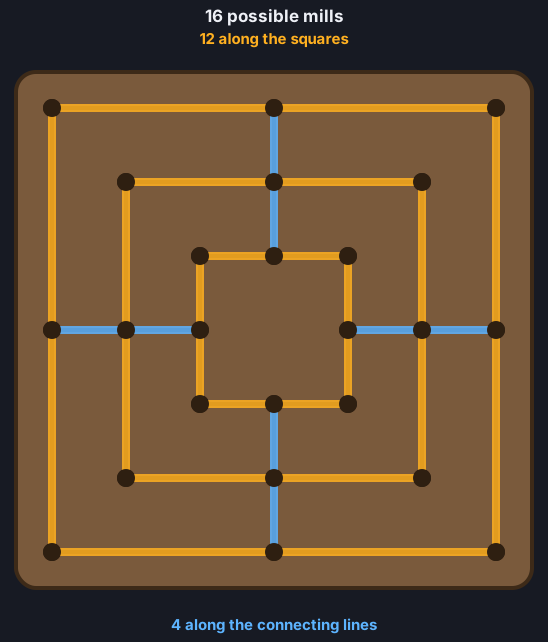
Only these sixteen lines count. Three pieces that merely look aligned across the board — for example three corners — are not a mill. If there is no drawn line joining them, nothing happens.
The three phases
1. Placing. Players take turns putting one of their nine pieces on any empty point. All eighteen go down before anything moves.
2. Moving. Once every piece is placed, a turn means sliding one piece along a line to an adjacent empty point. No jumping, no skipping over occupied points, no diagonal shortcuts.
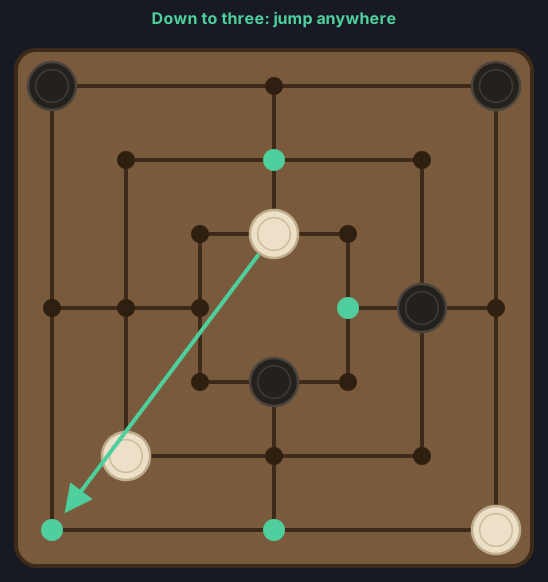
3. Flying. When a player is reduced to exactly three pieces, those pieces may move to any empty point on the board.
Closing a mill
Get three of your pieces onto one of those sixteen lines and you have a mill. Closing one lets you remove any one enemy piece from the board.
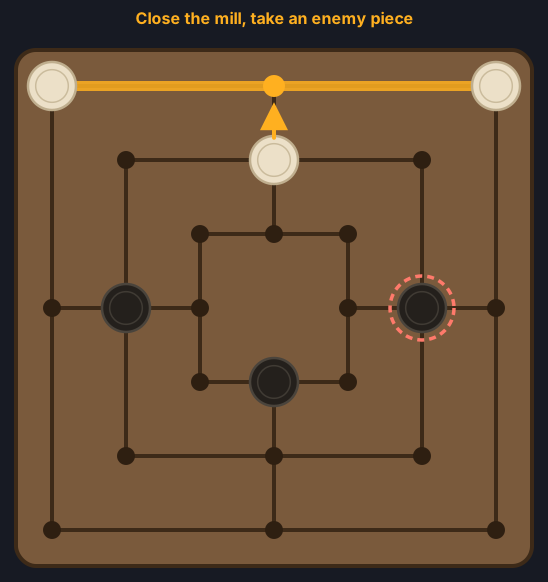
The standard restriction: you may not take a piece that is standing in a mill — unless every one of your opponent's pieces is in a mill, in which case the protection lapses and anything is fair game.
Breaking your own mill and reforming it later counts as a fresh mill, with a fresh capture. Which brings us to the game's defining weapon.
The double mill
Also called the swinging mill or running mill. Arrange two mills that share a piece, or that overlap so a single piece can step out of one and directly into the other. Now every move you make closes a mill.
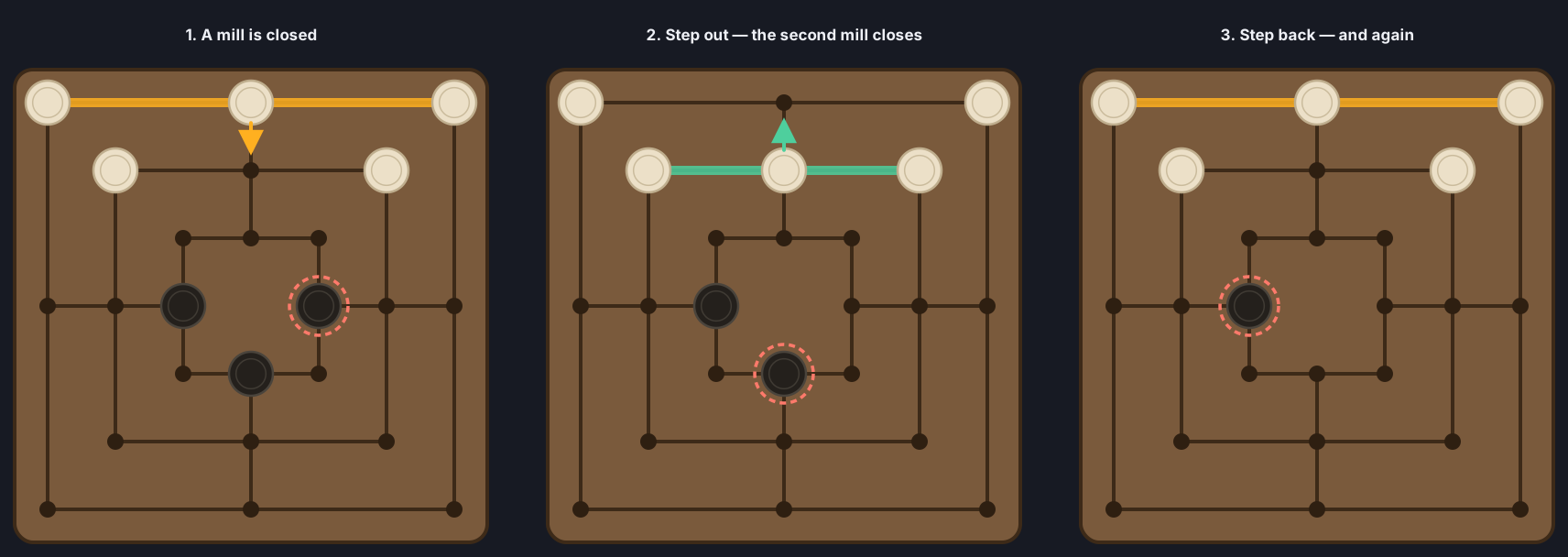
A capture every turn, indefinitely, until your opponent runs out of pieces or finds a way to block the empty point the swinging piece needs. Nothing else in the game comes close.
Half of competent play is building one. The other half is spotting your opponent's setup two moves before it locks in and dropping a piece into the hole that kills it.
How a game ends
You lose when you are down to two pieces — a mill is then impossible — or when you cannot make a single legal move.
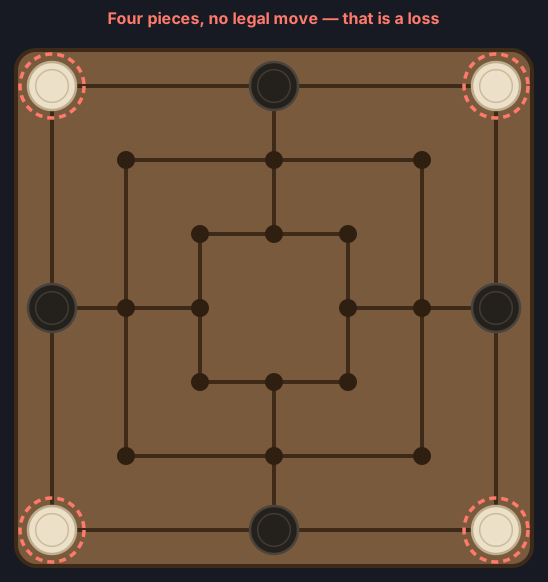
That second condition is easy to overlook and perfectly winnable: you do not need to capture your way to victory if you can wall your opponent in instead. Note that the blockaded player here has four pieces — with three they could fly out of trouble.
Draws happen too. The usual cutoffs are threefold repetition or fifty moves without a capture.
Where the rule sets disagree
Agree on these before you start, especially online or with a new opponent:
| Rule | Common version | Alternative |
|---|---|---|
| Flying at three pieces | Allowed | Removed entirely — strongly favours the leader |
| Taking from a mill | Forbidden unless all enemy pieces are in mills | Always allowed |
| Two mills at once | Capture one piece | Capture two |
| Draw | Threefold repetition, or 50 moves without a capture | Play on until someone blunders |
Strategy
Take the crossroads early. Those four middle-ring midpoints touch four lines each. A piece there is involved in more potential mills and has more escape squares than a piece in a corner. Corners are where pieces go to be trapped.
Value mobility over early mills. The most common beginner mistake is chasing the first mill at any cost and ending up with three pieces welded into a corner that can never move again. A mill that cannot open is a mill that captures once. Loose, flexible pieces are worth more than locked ones.
Threaten two mills at once. Set up so that two different mills could be completed on your next turn. Your opponent can block only one. This is the whole placing phase in miniature.
Play the placing phase like it counts, because it does. Strong players spend it building a flexible shape and denying the crossroads, not grabbing a quick capture. When the moving phase opens, whoever has room to manoeuvre usually wins.
Blockade instead of capturing. You do not need to reduce your opponent to two pieces. A player who cannot move loses on the spot. Sometimes the fastest win is walling in their last mobile pieces — and it is often available when a capture race is not.
Count before you break a mill. Opening a mill costs you nothing only if you can close it again. If your opponent can occupy the point you need to step back into, you have simply given up a mill for free.
What beginners get wrong
| Habit to build | Why it matters | The mistake it replaces |
|---|---|---|
| Claim the crossroads | Four lines, four escape routes | Filling corners because they feel safe |
| Keep pieces mobile | A frozen mill captures once and never again | Locking three pieces into a corner mill |
| Set up double threats | Only one can be blocked | Building one mill at a time in plain sight |
| Watch their swinging piece | A double mill ends the game in a few turns | Reacting only once the captures start |
| Consider blockading | No legal move is a loss | Grinding down pieces when a wall would be faster |
| Plan the placing phase | Most games are decided before anything slides | Placing pieces reactively, one move at a time |
The game is solved
In 1993 Ralph Gasser at ETH Zürich worked through the game completely. The verdict: with perfect play by both sides, Nine Men's Morris is a draw. Neither the first nor the second player can force a win.
That is good news for human players. Perfect play means navigating a state space of roughly ten billion positions, which is well out of reach at the board. Between two people the game still turns on who spots the double mill first.
The wider family
Nine is the middle of a range. There is a three-piece version on a 3×3 grid, a six-piece version on two squares, a twelve-piece version that adds diagonals — and Morabaraba, the South African game played with "cows", which is a recognised sport there — the same board plus four diagonals, and twelve cows a side.
The one to try first if the standard game starts to feel worked out is Lasker Morris, devised by the chess world champion Emanuel Lasker: ten pieces, and on any turn you may place a new piece or move one you already have. That single change removes the sharp division between the phases and makes the opening far less predictable.
All of them, and which is worth your time, are in the Morris family.
Common questions
How many pieces does each player get? Nine, hence the name. Twelve Men's Morris and Lasker Morris change the count.
Can I capture a piece that is inside a mill? Normally no — not unless every enemy piece is inside a mill.
Do three pieces in a row always count? Only along the sixteen drawn lines. Three corners in a row are not a mill.
What happens when I get down to three pieces? Under standard rules your pieces gain the ability to fly to any empty point. Lose one more and you lose the game.
Can I lose without losing my pieces? Yes. A player who cannot make a legal move loses immediately, however many pieces are still on the board.
Can the game end in a draw? Yes. Threefold repetition or fifty moves without a capture are the usual cutoffs, and with perfect play a draw is the theoretical result.
Is it luck or skill? Pure skill. No dice, no cards, nothing hidden — both players see the whole board at all times.
Ready to try it? Play Nine Men's Morris against the computer — three difficulty levels, play as White or Black, and an undo button for when the double mill catches you out. Or take it to the table: the printable Nine Men's Morris board prints the board, the men to cut out and these rules on one page — in the Three, Six, Nine or Twelve Men's version.