
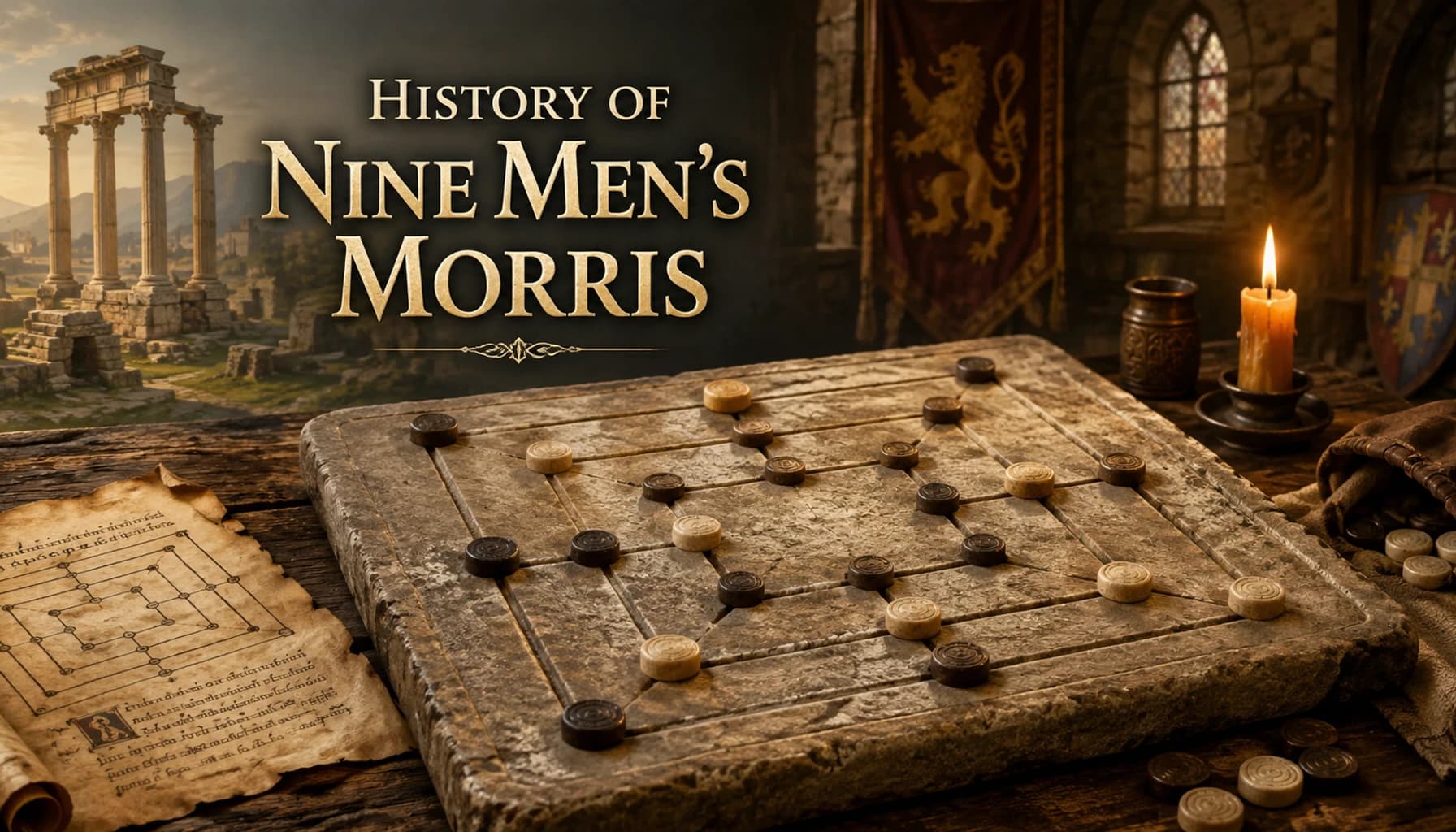
Most old games survive because someone wrote the rules down. Nine Men's Morris survives because people kept cutting the board into things that were not meant to have a board cut into them.
Roof tiles. Cathedral benches. The steps of a temple. The deck planking of a ship. Wherever archaeologists dig up a flat surface that somebody sat near for a long time, the three squares turn up sooner or later — and they turn up across two thousand years and half a continent.
That is the real story of this game, and it is a better one than the version that usually gets repeated. It also has a firm ending: in 1993, a computer scientist in Zurich finished the game off for good.
The Egyptian date that will not die
Start with the claim you will meet first, because you should know what it is worth.
Search for the origins of this game and you will be told, again and again, that boards were cut into the roof slabs of the temple at Kurna in Egypt around 1400 BC. The number is quoted with great confidence. It appears in books.
The carvings are real. The date is not evidence.
Here is the problem. You cannot date a scratch in stone. Carbon dating needs organic material; stratigraphy needs the object to be buried in a layer you can date. A mark cut into a roof slab is neither. All the 1400 BC figure really tells you is when the roof was built — not when somebody sat on it with a blade. Roman soldiers, Coptic monks and Christian pilgrims all used that temple long afterwards, and all of them are far likelier candidates than a New Kingdom Egyptian.
None of which makes the game young. It just means the oldest honest evidence starts somewhere else.
Rome is where the ground gets firm
From the Roman world the evidence is abundant and it is unambiguous.
Morris boards appear scratched into paving slabs, into steps, into the tops of walls and into roof tiles across the empire — including in Rome itself. Ovid mentions a game of three-in-a-row played on a small board in the Ars Amatoria, recommending that a young woman learn it. That is a reference to the small cousin, Three Men's Morris, rather than to the nine-piece game, but it puts the family firmly in the first century.
What makes the Roman evidence convincing is not any single find. It is the pattern: the same figure, cut by different hands, in places thousands of miles apart, on surfaces nobody would have decorated on purpose. That is what a popular game looks like in the archaeological record. It looks like graffiti.
A board on a Viking ship
The trail runs north with the Norse.
A gaming board was recovered from the Gokstad ship burial in Norway, the great ninth-century vessel now in Oslo. One face carries a Nine Men's Morris pattern; the other is laid out for a different game entirely. Somebody took it to sea, and somebody thought it worth burying with a chieftain.
It is worth pausing on what that means. A ship burial is where you put the things a man will want in the next world: weapons, horses, a vessel to sail. The board made that list.
Bored monks and a cathedral bench
The medieval English evidence is my favourite, because of who left it.
Morris boards are cut into cloister benches, window ledges and seat-backs at Canterbury, Gloucester, Salisbury and Westminster Abbey, among others. These are not floors where a visitor might crouch. They are the places where monks and masons sat — during long services, during long waits.
Somebody with a knife, a stone seat and more time than piety carved a game board into the furniture of a cathedral, and then somebody else sat down and played on it. The boards are still there. It is the least reverent and most human thing in the building.
The one on the village green
And then there is the largest version of all, which was not on a board at all.
In A Midsummer Night's Dream, Titania describes a countryside ruined by a wet summer, and includes this line:
The nine men's morris is fill'd up with mud, And the quaint mazes in the wanton green For lack of tread are undistinguishable.
She is not talking about a tabletop. In Elizabethan England the pattern was cut into the turf of a village green at human scale, and played with the players themselves — or with large stones — standing on the points. A wet season turned the cut lines to mud and the game vanished until the ground dried.
Shakespeare expected his audience to know this without explanation. That tells you more about how common the game was than any archaeological find: it was ordinary enough to use as shorthand for the weather.
The name has nothing to do with dancing
Given the turf boards and the village greens, the obvious guess is that morris comes from the Morris dance. It almost certainly does not.
The likelier root is the Latin merellus, a counter or gaming piece, which survives directly in the English Merels, the French mérelles and the Spanish alquerque family of names. In German the game is Mühle — mill — after the three-in-a-row that grinds down your opponent. The "nine" is simply how many pieces you get.
Why this game and not another
Thousands of games have been invented and forgotten. It is worth asking why this one kept being re-cut into stone for two millennia.
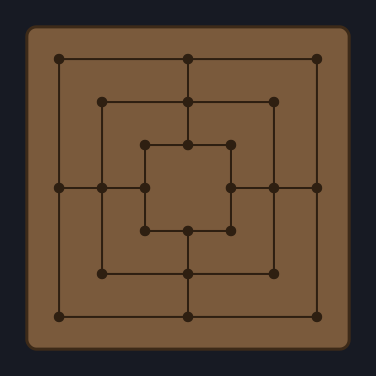
The answer is that the board costs nothing. Sixteen straight lines. No grid to measure, no squares to colour, no dice to make, no cards to print. Anyone with a blade and ten minutes can produce a playable board on any flat surface, and the pieces can be pebbles, coins, beans or bottle caps — nine of one kind, nine of another.
Compare that with chess, which needs thirty-two distinguishable carved pieces and a chequered grid, and which for most of its history was therefore a game for people with money. Morris was the game you could always have.
The second reason is that it is genuinely good. It has a real strategic idea at its centre — the double mill, a formation that lets you capture a piece every second move — and it takes about five minutes to explain and a long time to play well.
1993: the last chapter
Games this old rarely get an ending. This one did.
In October 1993, Ralph Gasser at ETH Zurich solved Nine Men's Morris. Not "built a strong program" — solved: he computed the outcome of every reachable position with perfect play from both sides. His program was called Bushy, and it was for a while the strongest player in the world, though there was no longer much sport in that.
The answer is a draw. Play perfectly from the start and neither side can force a win.
That result sits oddly beside everything above. Two thousand years of soldiers, sailors, monks and villagers cutting this pattern into whatever was to hand, and the conclusion is that if all of them had played flawlessly, none of them would ever have won.
Which is, of course, entirely beside the point. Nobody plays flawlessly. The draw is a fact about the game tree, not about an evening. Checkers is solved too; people still play checkers. Knowing the theoretical result of Nine Men's Morris changes a game between two humans exactly as much as knowing that the house wins changes a hand of cards — which is to say, not at all, unless you were expecting to be the house.
Where to see one
You do not have to take any of this on trust. Cloister boards are visible today at several English cathedrals, and museum collections across northern Europe hold Roman and medieval examples. The Gokstad find is in Oslo with the ship.
And if you want one of your own, the cheapest route is the one people have used for two thousand years: cut the lines into something flat. Our printable Nine Men's Morris board skips the blade — board, nine men a side and the rules on three sheets, with a cloister-stone style that is a fair imitation of the bench at Canterbury.
Or just play it here against the computer or a friend, which is the one thing the monks could not do.
Common questions
How old is Nine Men's Morris? Firmly attested under the Roman Empire, so around two thousand years. Claims of 1400 BC rest on carvings at the temple of Kurna in Egypt whose date cannot be established — the roof can be dated, the scratches on it cannot.
Is it older than chess? Yes, comfortably. Chess reaches India around the sixth century AD; Morris boards were being cut into Roman stone centuries before that.
Did Vikings play Nine Men's Morris? A board with the pattern was recovered from the Gokstad ship burial in Norway, dated to around AD 900. The Norse also played hnefatafl, a quite different game, and the two turn up in similar contexts.
What does "morris" mean? Almost certainly nothing to do with Morris dancing. The likely root is the Latin merellus, a gaming counter — the same root as Merels and mérelles.
Is Nine Men's Morris solved? Yes. Ralph Gasser solved it in October 1993; the game is a draw with perfect play from both sides.
Why is it called a mill? The German name Mühle refers to the three-in-a-row that lets you grind a piece off your opponent's side each time you open and close it. English keeps the sense in "mills" as a name for the game.