
Most lists of dice games tell you a game exists and leave it there. This one answers the question underneath: is there anything to decide, or are you just reading out numbers?
For two of them we can answer that exactly. Pig is small enough to solve completely, and so is Shut the Box — so the advice below is computed, not repeated.
- 53.06 % — how often the first player wins Pig, both sides perfect
- 21 the right moment to stop at level scores, not the 20 everyone says
- 49 the right moment when you are eighty points behind
- 1 die is all the best of these games needs
What dice games can two people play?
| Game | Dice | A decision each turn? | Where the skill is |
|---|---|---|---|
| Pig | 1 | Yes, every roll | When to stop |
| Shut the Box | 2 | Yes, most rolls | Which numbers to close |
| Farkle | 6 | Yes, every roll | What to bank, what to re-roll |
| Yatzy | 5 | Yes, twice a turn | Which dice to keep, which row to fill |
| Liar's Dice | 5 each | Yes | Reading the other person |
| Going to Boston | 3 | No | — |
| Drop Dead | 5 | No | — |
The last two are on the list because they are genuinely popular and genuinely fun with a child. They are also, mechanically, coin-flipping with extra steps — worth knowing before you sit down expecting a contest.
How do you play Pig?
The whole game in four lines, which is most of its appeal.
- Roll one die and add it to your turn total. Keep rolling as long as you like.
- Roll a 1 and you lose everything from this turn and hand the die over.
- Stop whenever you want and your turn total is added to your score.
- First to 100 wins.
That is it. One die, no board, no pencil if you can both count. And it has a real decision in it every single roll: the pot grows, and so does the chance of losing it.
When should you stop rolling in Pig?
Pig has about a million positions — your score, their score, and the points riding on this turn. That is small enough to evaluate every one of them rather than play sample games, so this is not an estimate:
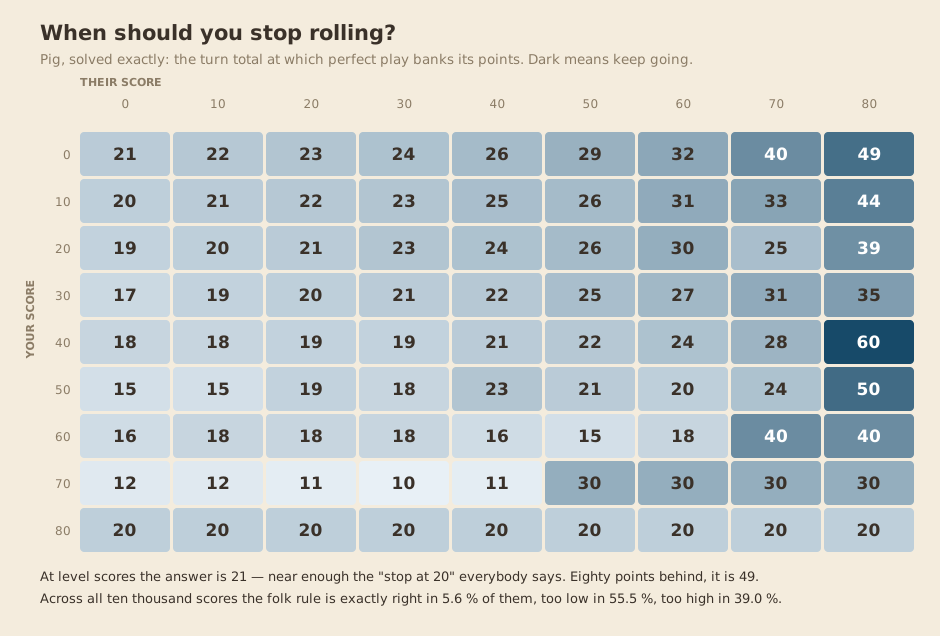
Three things fall out of it, and the second is the useful one.
At level scores the answer really is about 20. The exact figure is 21, so the folk rule is close enough that nobody at a kitchen table is losing sleep.
And when you are well ahead, stop earlier than feels right. At 70 against 40 the correct stopping point is 11. Banking small and often is how a lead is converted; the player who keeps chasing 20 from in front is the one who loses it.
Is "stop at 20" actually a good rule?
Against a specific opponent, you can test it by playing it out. Here is every fixed stopping point against a player who always stops at 20:
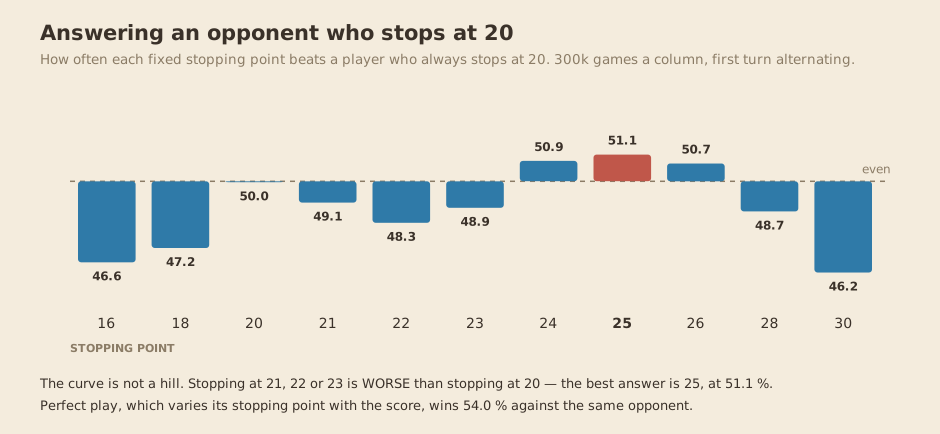
The shape is the surprise. Stopping a little later than your opponent — 21, 22, 23 — loses more often than copying them exactly. Only from 24 upwards does it turn, and the best fixed answer is 25.
Perfect play, which changes its stopping point with the score, wins 54.0 % against that same opponent. That is the honest size of the prize: this is a game where thinking is worth about four percentage points, and the dice have the rest.
What is Shut the Box?
Nine numbers, two dice, and you close any combination adding up to what you roll. When nothing covers your roll, the numbers left standing are your score and low wins.
It is the other game here we solved exactly, and the answer is almost the opposite of Pig's: the obvious rule is nearly perfect. Always closing the biggest number you can averages 11.37 points against 11.16 for flawless play — a fifth of a point. The mistake that costs is the opposite habit, closing as many small numbers as possible, which more than doubles your score.
You can play Shut the Box here against the computer or a friend over the internet, or print the Shut the Box sheets and use a pencil.
What makes Farkle different from Pig?
The same question — bank or keep going — asked with six dice instead of one, which turns one decision into two.
Roll six. Any 1 scores 100, any 5 scores 50, three of a kind scores a hundred times the number (three 4s are 400, three 1s are a special 1,000). You must set aside at least one scoring die, then choose: bank what you have, or re-roll everything you did not set aside. Roll nothing that scores and you farkle — the whole turn is gone, exactly like Pig's 1.
The extra decision is which dice to keep. Setting aside a lone 5 for 50 points keeps five dice in your hand and a good chance of scoring again; setting aside three of a kind banks more but leaves three dice and a farkle waiting. That trade is the game, and it is why Farkle survives a whole evening where Pig starts to feel thin after twenty minutes.
The scoring table is the one thing worth having in front of you rather than in your head — it is printed on the Farkle score sheet, along with the running total to 10,000.
How do you play Liar's Dice with two players?
Five dice each, rolled under a cup and kept hidden. You take turns making a claim about all ten dice on the table — "four fives" means there are at least four 5s between the two hands. Each claim must be higher than the last: more dice, or the same number of a higher face. Ones are usually wild and count as anything.
At any point instead of raising you can call the other person a liar. Everyone lifts their cup and counts. If the claim was true, the challenger loses a die; if it was false, the claimer does. Play until somebody has none left.
This is the only game on the page where the useful information is not on the dice. With two players you know five of the ten faces, so every claim is half arithmetic and half a read on the person opposite. That makes it the worst of the seven to analyse and, with the right opponent, the best of them to play — the calculation is small enough that bluffing is the whole content.
Which dice games need no decisions at all?
Going to Boston. Roll three dice, keep the highest, roll the remaining two, keep the highest, roll the last one. Your score is the three kept dice. There is nothing to choose at any point — but it is excellent with a six-year-old, because the shape of a turn is obvious and the arithmetic is small.
Drop Dead. Roll five dice. Any 2 or 5 scores nothing and is removed; everything else adds up. Keep going with what is left until no dice remain. Again: no choices, and a tense little curve as the handful shrinks.
Both are worth an evening. Neither is worth an argument about who is better at it.
Which is the best two-player dice game?
Pig, on the evidence. It needs one die, the rules take twenty seconds, and it has a genuine decision on every roll whose right answer changes with the score — which is exactly what the map above shows and what almost nobody playing it knows. It is playable here against three computer levels or a friend, and it will show you the solved answer as you go.
Shut the Box if you want something to look at. The box or the printed sheet gives the game a shape, and the arithmetic makes it the one to reach for with a child who is learning number bonds.
Farkle if you want a longer evening. Six dice and a scoring table, and the same push-your-luck decision as Pig but with more ways to express it. It is playable here against the computer or a friend, and the Farkle score sheet has the whole point table printed on it for a table with real dice.
What do you need?
Two dice covers six of the seven. Yatzy and Farkle want five and six respectively, and Liar's Dice wants five each plus something to hide them under. Everything else is scoring, and that is what the dice score sheet and the Farkle sheet are for — or a printed Shut the Box sheet, which is the game and the scoring in one.
If it is the paper rather than the dice you are after, the games you only need paper for are next door, and Yatzy is playable here against the computer or a friend.
Two-player dice games: questions people ask
What is the best dice game for two players? Pig, if you want a real contest from one die — the decision changes with the score, which is more than most dice games can say. Shut the Box if you want something physical on the table, and Farkle if you want a longer game.
Is Pig a game of skill or luck? Both, and now measurably. Perfect play beats the standard "stop at 20" rule 54 % of the time, so skill is worth about four percentage points and the dice decide the rest.
When should you stop rolling in Pig? About 21 at level scores. Much later when you are behind — 49 when you are eighty points down — and much earlier when you are ahead, as low as 11 with a solid lead.
Which dice games can you play with one die? Pig is the main one, and it is the best of them. Most other dice games want at least two, and the classic scorecard games want five or six.
What two-player dice games are good for children? Going to Boston and Drop Dead need no decisions and no reading, and Shut the Box is straightforward addition dressed up as a game. Pig works from about seven, once "I could lose all of this" is a thought worth having.
Do you need a board? No. Six of these seven need only dice and a way to keep score. Shut the Box wants nine numbers in front of you, and a printed sheet does that as well as the wooden box does.