
Score & Play
Farkle Score Sheet
Bank a turn, and the sheet keeps the running total and the distance to 10,000. Or print blank pads with the scoring table on them.
Players
Winner
Pages
Paper
Each cell takes the points banked this turn. Scores stay on this device and survive a reload. For a PDF, pick Save as PDF in the print dialog.
| Turn | ||||
|---|---|---|---|---|
| 1 | ||||
| 2 | ||||
| 3 | ||||
| 4 | ||||
| 5 | ||||
| 6 | ||||
| 7 | ||||
| 8 | ||||
| Total | 0of 10,000 | 0of 10,000 | 0of 10,000 | 0of 10,000 |
What is on the Farkle score sheet?
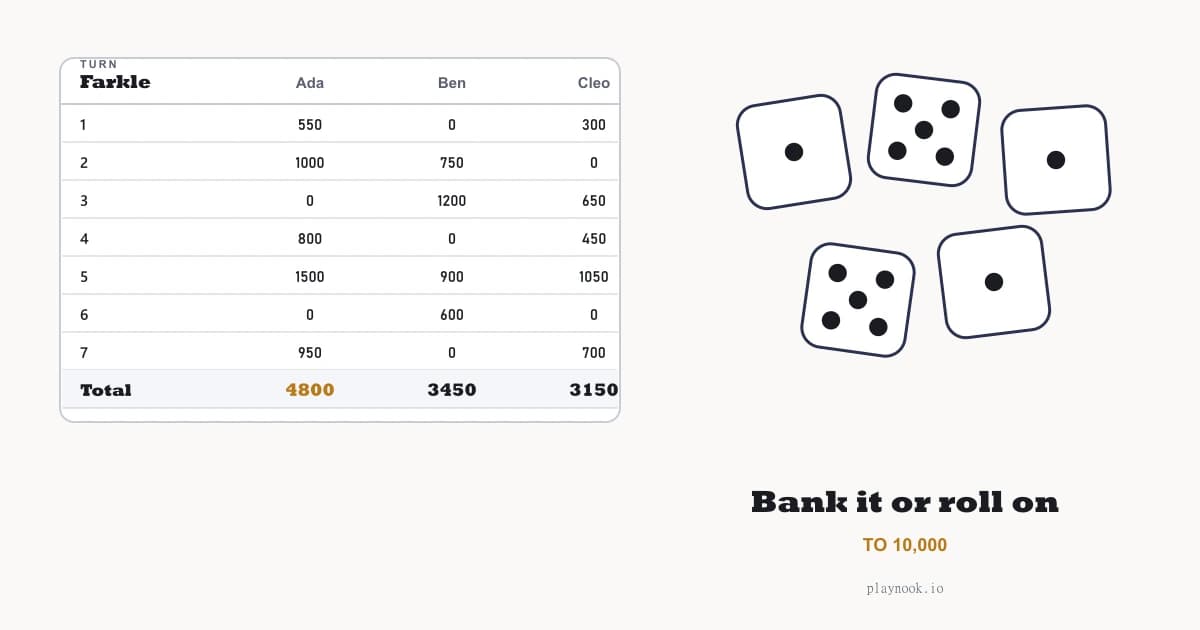
One line per turn, one column per player, and a total that counts against 10,000 as it grows. Write only what a player banks — the sheet does the adding, which in a game of five-digit totals is the part that goes wrong on paper.
The table grows as you play. It starts at eight turns and adds more as the columns fill, so you are neither staring at a page of empty lines nor running out of room in a long game.
Prefer a screen? Farkle is playable here against three computer levels or a friend over the internet — with the same scoring table, and the bank-or-roll decision worked out exactly.
What scores in Farkle? The full table
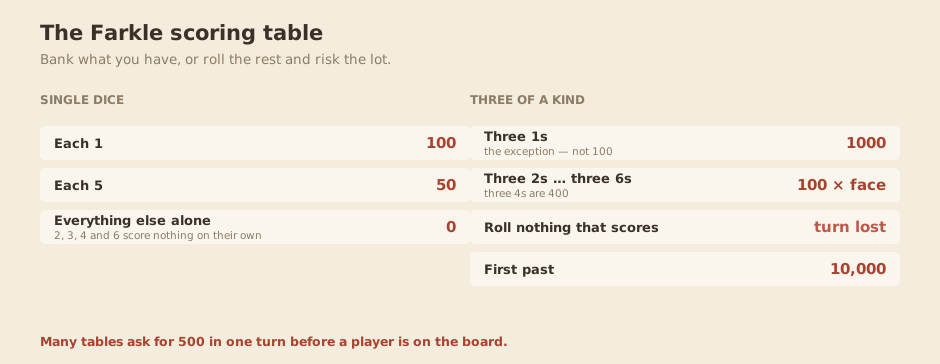
A single 1 is 100 and a single 5 is 50 — those two are the whole reason a turn can continue. Three of a kind is a hundred times the face, so three 4s are 400, with three 1s the exception at 1,000. Beyond that the rules drift from table to table: a straight is usually 1,000 and six of a kind usually 1,500, but ask before you assume.
When should you bank in Farkle?
Every turn is the same question: bank what you have, or roll the dice you did not keep. A roll with nothing scoring is a farkle, and it takes the entire turn with it — not just the last roll.
Which is why writing the number down matters more than it looks. With two dice left and 650 on the table, the odds of farkling are worse than even. The player who banks early and often loses slowly; the player who never banks loses quickly. The sheet does not have an opinion, but the running total makes the choice visible to everyone at the table.
Farkle house rules worth agreeing first
Farkle has no single rulebook, and the three arguments are always the same: 500 to get on the board or not, whether three farkles in a row costs you points, and whether everyone gets a last turn after somebody passes 10,000. Settle them before the first roll and the pad stays peaceful.
Farkle scoring: questions people ask
What scores in Farkle? A single 1 is 100 and a single 5 is 50. Three of a kind is a hundred times the face, except three 1s which are 1,000. Beyond that the rules genuinely vary; the table used across this site is 1,000 for four of a kind, 2,000 for five, 3,000 for six, 1,500 for a straight, 1,500 for three pairs and 2,500 for two triplets.
What is a farkle? A roll with nothing that scores. The whole turn is lost, including everything set aside but not yet banked — which is the decision the game is built around: roll again for more, or write down what you have.
Do I need 500 to get on the board? At many tables, yes: your first entry has to be 500 or more in a single turn, and anything less is not written down. Plenty of families play without it. Agree before the first roll.
How does the game end? Someone passes 10,000. Most tables then give everyone one final turn to beat them, which is what makes the last round worth playing. The sheet counts each column against 10,000 as you go.
Where do my scores go? Into your own browser and nowhere else. A reload will not lose the game, and pressing New game twice clears the pad.
Can I print blank pads? Yes — sixteen turns, six player columns, and the scoring summary printed underneath, on A4 or US Letter.
Also here: a sheet for five-dice games with thirteen boxes, Mexican Train and Rummy — plus six printable boards for when the dice go back in the cup.