PlayNook

Dice Game · Dice Game

Play Farkle Online — Free, vs Computer or Friend

Six dice, and one question asked over and over: bank what you have, or roll the rest and risk the lot. Roll nothing that scores and the whole turn is gone.

Six dice, and one question asked over and over: bank what you have, or roll the rest? Every extra roll is worth about a hundred points and carries a chance of losing everything on the table.

  • 2.31 % of six-dice rolls score nothing at all
  • 601 points is what a perfectly played turn is worth
  • 300 is the right banking point with exactly two dice — and no others
  • 10,000 to win, then one last turn for everybody else

What scores in Farkle?

Each 1100
Each 550
Three of a kind100 × the face — three 4s are 400
Three 1s1,000
Four / five / six of a kind1,000 / 2,000 / 3,000
Straight 1-6 · three pairs1,500 each
Two triplets2,500

Nothing else scores on its own: a lone 2, 3, 4 or 6 is dead weight. The upper half of that table is the part that varies from kitchen to kitchen — this page fixes one set and the Farkle score sheet prints the same one.

How do you play Farkle?

  1. Roll six dice.
  2. Set aside at least one die that scores. You choose which — and that choice matters more than it looks.
  3. Bank, or roll what is left. Banking adds your turn total to your score and ends the turn.
  4. Roll nothing that scores and you farkle — the whole turn is gone, including everything set aside.
  5. Set aside all six and you roll all six again, keeping the total. There is no limit on how far one turn can run.

First past 10,000 wins, and everyone else gets one last turn to overtake.

When should you bank in Farkle?

Everybody says "bank at 300". The decision has only two inputs — how many dice are left and how much is riding on the turn — so it can be solved completely rather than argued about.
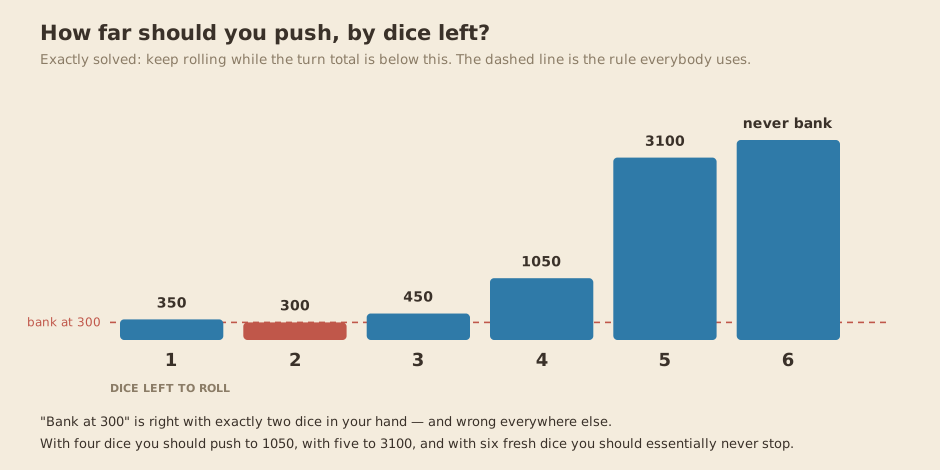
Bar chart of how far to push in Farkle by dice remaining. With one die left the answer is 350, with two 300, with three 450, with four 1050, with five 3100, and with six fresh dice you should never bank. A dashed line marks the common rule of banking at 300, which only matches the two-dice bar.
Keep rolling while your turn total is below the bar. The dashed line is the rule everybody uses.

What are the odds of a farkle?

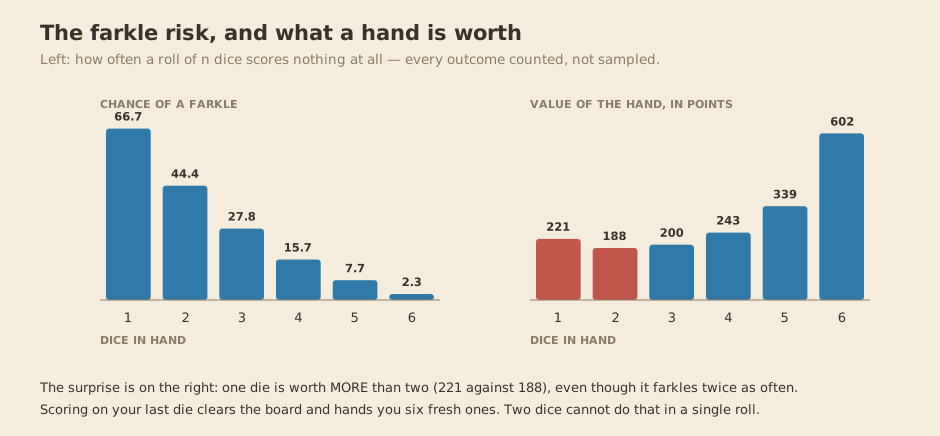
Two bar charts. Left: the chance of a farkle by dice in hand — 66.7 per cent with one die, 44.4 with two, 27.8 with three, 15.7 with four, 7.7 with five and 2.3 with six. Right: what each hand is worth in points — 221, 188, 200, 243, 339 and 602.
Counted over every outcome, not sampled. The right-hand chart holds the surprise.

The risk roughly doubles with each die you give up. What is not obvious is the right-hand chart: one die is worth more than two — 221 points against 188 — even though it farkles two-thirds of the time against four-ninths.

The reason is hot dice. Scoring on your last die clears the board and hands you six fresh ones; two dice cannot do that in a single roll. It is the one place in Farkle where the worse-looking position is the better one.

How strong is the computer?

The levels differ in what they can see, not in how far they look ahead — searching deeper is meaningless when the dice reshuffle everything each roll.

LevelHow it playsPoints a turn
Easytakes some legal combination, not the best325
Mediumthe table rule: biggest score, bank at 300460
Hardthe exact value of every position571

Over 20,000 games hard beats medium 72.1 % of the time and easy 95.8 %. That is a much bigger gap than most dice games manage — in Shut the Box the same comparison is nearly a coin toss, because there the obvious move is almost always the right one. Farkle punishes the obvious move twice a turn.

Which dice should you set aside?

This is the decision nobody talks about and where most points quietly go.

Take a roll of 1-1-5-2-3-4. The greedy answer is 1-1-5 for 250, leaving three dice. But 1-1 for 200 leaves four dice, and four dice in hand are worth more than the fifty points you gave up — 243 against 200 by the table above. The hard level makes that trade constantly; the medium level never does, and that alone is most of the gap between them.

What does the 500-to-start rule change?

With the switch on, your first entry has to be 500 or more in a single turn — anything under it is not written down at all. It sounds like a small house rule and it changes the opening completely.

Until you are on the board, banking 300 is worth exactly nothing. The turn is therefore not a bank-or-roll decision at all: you have to keep going to 500 whatever the dice look like, which means pushing through positions you would never push through later in the game. A player who is on the board and one who is not are playing two different games at the same table.

Turn it off and the opening becomes the same problem as every other turn. Both are played; the switch is there because neither is wrong.

What are hot dice?

Set aside all six dice in one turn and you pick all six up again, keeping everything you have collected. There is no cap: a turn can run through two or three sets of hot dice and put four figures on the board in one go.

That is also why the game rewards keeping dice in your hand rather than points on the table. Every set-aside that leaves you one die short of clearing the board is a set-aside that gave up the chance of six fresh ones — and six fresh dice are worth 602 points, more than any single scoring combination in the table above except six of a kind.

Where does Farkle come from?

A North American folk game of the push-your-luck family, closely related to a long line of dice games that ask the same question — roll again or write it down. It has been sold under a dozen trade names, which is why the scoring table beyond three of a kind never settled: every box printed its own.

The game is uncopyrightable and the rules are common property, which is why you will find it under a different name every few years.

More dice here

The Farkle score sheet prints the same table for a table with real dice. Shut the Box and Yatzy are playable here too, and dice games for two players compares seven of them by how much skill is actually in each.
Frequently asked questions

+ How do you play Farkle?

Roll six dice. Set aside at least one die that scores, then choose: bank what you have, or roll the dice you did not set aside. Roll nothing that scores at all and you farkle — the whole turn is lost, including everything set aside but not yet banked. Set aside all six and you roll all six again with the total intact. First past 10,000 wins, and everybody else gets one last turn.

+ What scores in Farkle?

Each 1 is 100 and each 5 is 50; nothing else scores on its own. Three of a kind is a hundred times the face, so three 4s are 400, with three 1s the exception at 1,000. This site uses 1,000 for four of a kind, 2,000 for five, 3,000 for six, 1,500 for a straight, 1,500 for three pairs and 2,500 for two triplets. That upper part genuinely varies from table to table — agree on it before the first roll.

+ When should you bank in Farkle?

It depends almost entirely on how many dice are left, and the common rule of banking at 300 is right in only one case. Solved exactly: with two dice left, bank at 300. With three, push to 450. With four, 1,050. With five, 3,100. With six fresh dice you should essentially never bank, because a roll of six farkles only 2.31 % of the time.

+ What are the odds of a farkle?

With six dice, 2.31 % — one roll in forty-three. It climbs steeply as the dice go: 7.72 % with five, 15.74 % with four, 27.78 % with three, 44.44 % with two and 66.67 % with a single die. Those are exact figures from counting every outcome, not estimates.

+ Is it better to have one die left or two?

One, and this surprises everybody. A single die is worth 221 points against 188 for two, even though it farkles twice as often. The reason is hot dice: scoring on your last die clears the board and hands you six fresh ones, and two dice cannot do that in a single roll.

+ What is the 500 to start rule?

At many tables your first entry has to be 500 or more in a single turn — anything less is not written down. It is a switch on this page because plenty of families play without it. With it on, the opening of the game is a genuinely different problem.

+ How do the three computer levels differ?

Not by searching deeper — the dice reshuffle everything each roll. Easy sets aside some legal combination rather than the best one, which is what a beginner does with the 1s and 5s that catch the eye first. Medium plays the table rule: biggest score, bank at 300. Hard holds the exact value of every position and uses it for both decisions. Over 20,000 games hard beats medium 72.1 % of the time and easy 95.8 %.

+ Can I play Farkle with a friend online?

Yes. Choose 'With a friend online', press Open a table and send the four-letter code. No account and no sign-up. The server throws the dice rather than either browser, so you both see exactly the same roll, and there is a chat window.

+ Is it free?

Yes, free and with no sign-up. Nothing is saved; close the tab and start fresh.

More games like this

Pig — screenshot of the browser gameDice Game
Dice Game2 Players

Pig

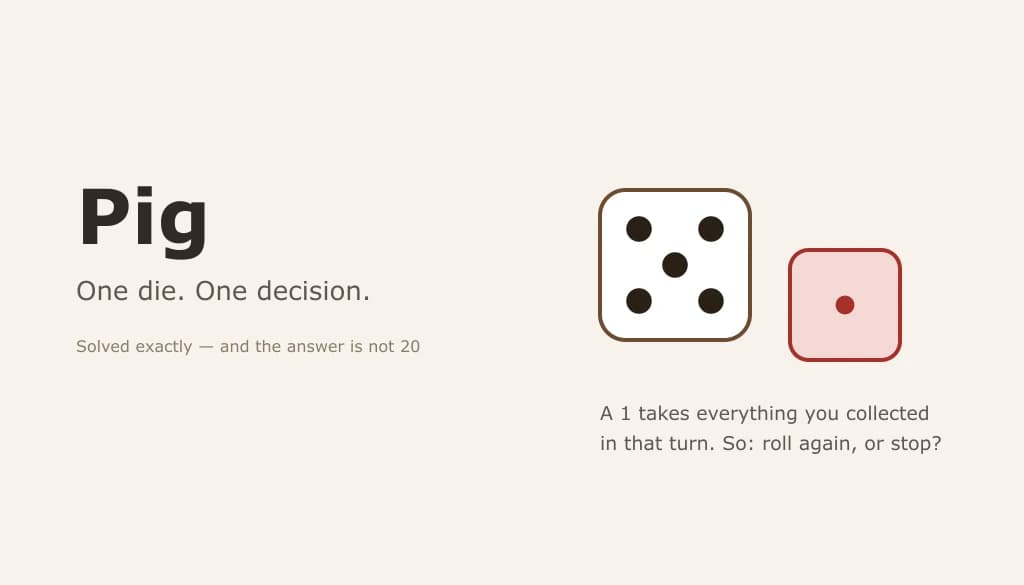
Roll one die and keep adding. Roll a 1 and the whole turn is gone. Stop whenever you like — and knowing when is the entire game.

  • Every one of the million positions solved — the game can show you the right answer
  • Play a friend over the internet, a four-letter code, no sign-up
  • Three computer levels; the strongest plays the exact solution
Play Pig
Shut the Box — screenshot of the browser gameDice Game
Dice Game2 Players

Shut the Box

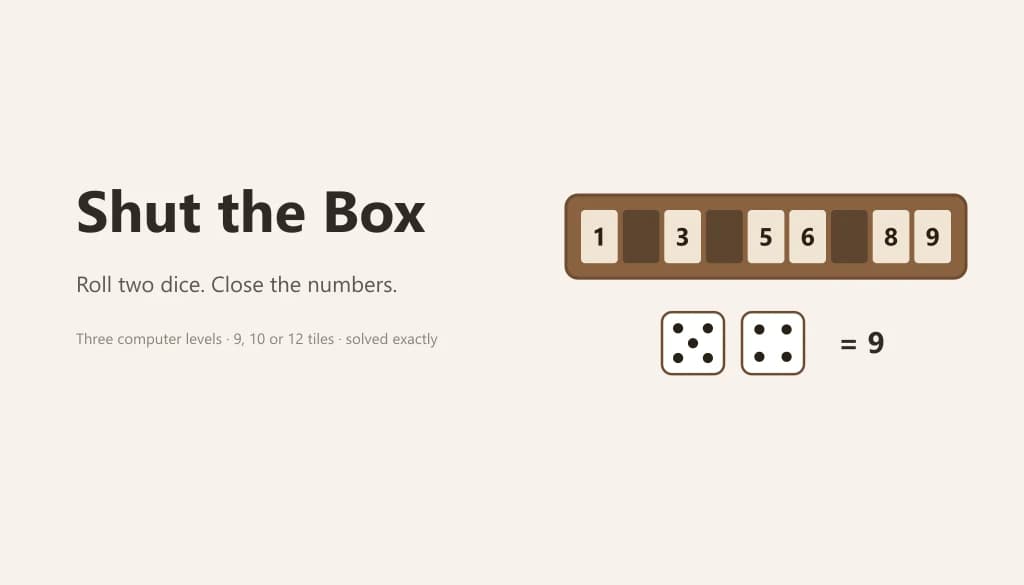
Roll two dice, close any open numbers adding up to the total, and keep going until nothing covers your roll. What is left standing is your score, and low wins.

  • Nine, ten or twelve numbers — the count changes the game completely
  • Every position solved exactly, so the odds on this page are computed, not guessed
  • Play a friend over the internet — a four-letter code, no sign-up
Play Shut the Box
Yatzy — screenshot of the browser gameDice Game
Dice Game2 Players

Yatzy

Five dice, three rolls a turn, fifteen categories to fill. Two extra rows Yahtzee doesn't have, and several categories that score differently even where the names match.

  • The real Scandinavian scorecard — fifteen categories, not Yahtzee's thirteen
  • One Pair, Two Pairs, and a Full House that scores nothing for five of a kind
  • Against the computer, a friend online, or two players on one device
Play Yatzy
Dominoes — screenshot of the browser gameBoard Game
Tile Matching2 Players

Dominoes

Double-six set, 28 tiles, seven to a hand. Match a tile to either open end of the line, or draw when nothing fits — the first to empty a hand wins.

  • Real hidden hands — the computer, and your online opponent, can't see your tiles
  • Draw dominoes: no forced passing while the boneyard still has tiles
  • Against the computer, a friend online, or two players on one device
Play Dominoes