Double-six set, 28 tiles, seven to a hand. Match a tile to either open end of the line, or draw when nothing fits — first to empty a hand wins, and unlike everything else on this site, your opponent genuinely can't see what you're holding.
How to play Dominoes
Two players, a double-six set of 28 tiles. Seven tiles dealt to each hand, the other fourteen face down in the boneyard. Play one tile a turn, and be first to empty your hand.
How do you set up a game of Dominoes?
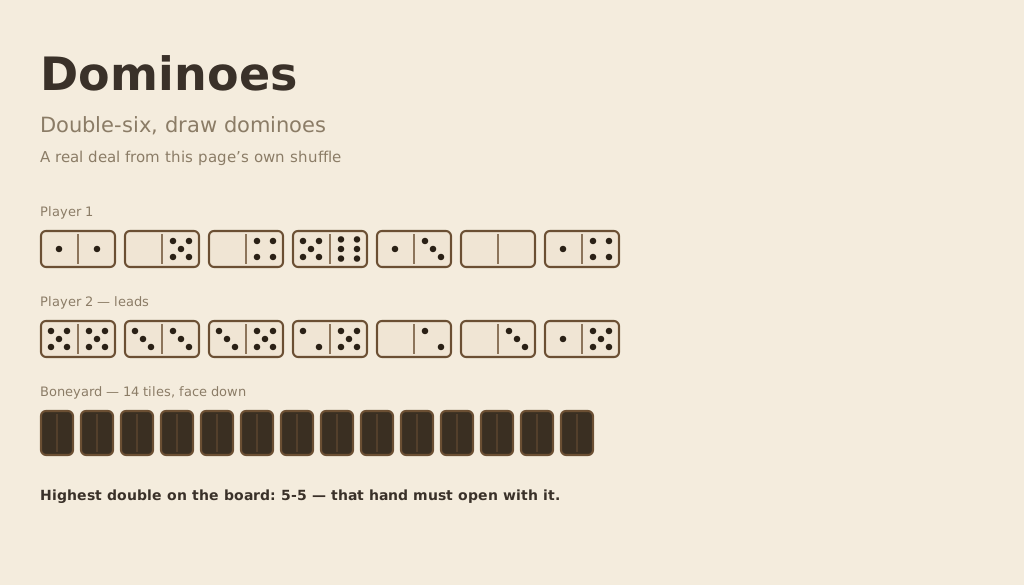
The deal is the whole setup: no board to arrange, just seven tiles each and the rest hidden. Whoever holds the single highest double across both hands leads, and has to open with that exact tile — a 6-6 beats a 5-5 no matter whose hand it's in. If neither hand holds any double at all, because both live in the boneyard, the first player opens freely instead; this page checks that before either side has moved, the same way a real double-six set gets checked at a real table.
Moving: match an open end, or draw
Play a tile from your hand against either open end of the line — the line always has exactly two ends once it's started, and the matching pip has to touch the end it extends.
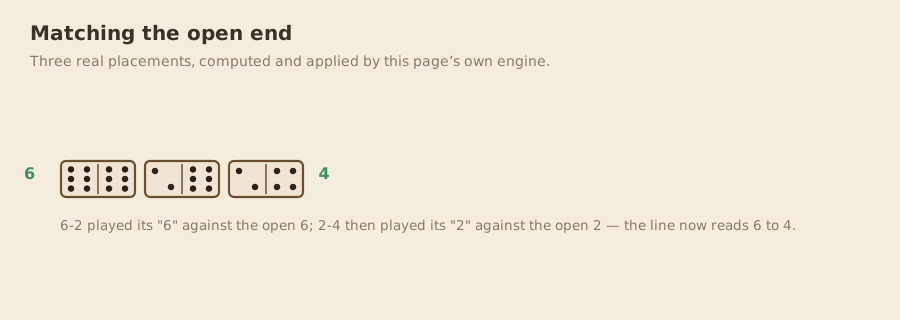
If nothing in your hand matches either end, draw from the boneyard — one tile at a time. Drawing does not end your turn: keep drawing until you draw something you can actually play, or the boneyard runs dry, whichever happens first. Only with an empty boneyard and still nothing playable does a pass ever become necessary, and this page shows that as the only option right on the boneyard itself.
When one tile fits both ends at once
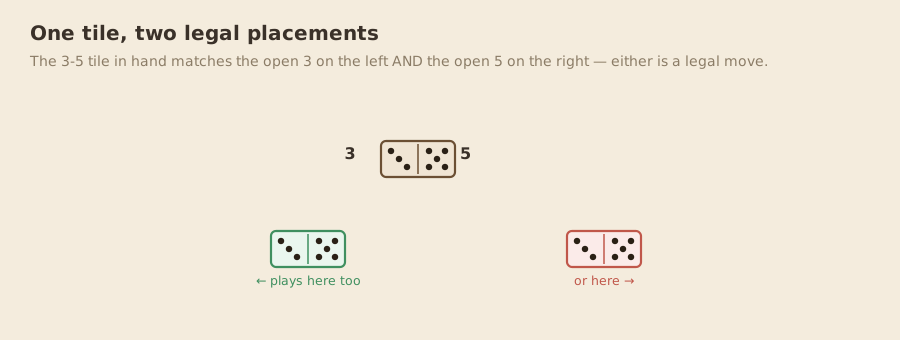
Occasionally a tile's two pip values happen to match both open ends of the line at once. When that happens here, the choice is put to you directly instead of being decided for you — pick either end, and the line grows from that side.
How do you win at Dominoes?
Play your very last tile and the game ends immediately, in your favour. If the boneyard empties and both sides get stuck with nothing playable, the game is blocked instead: whoever's holding fewer total pips across the tiles left in hand wins that round; matching totals are a draw.
Dominoes strategy
What's the best way to play your opening tiles?
Get rid of your heaviest tiles and your doubles early, before the line gives you a real choice about it. A double is the least flexible tile in the entire set — it only ever matches one pip value, never two — so the longer one sits in your hand, the more turns it can strand you on. Heavy tiles carry the same risk for a blunter reason: if the game ends blocked instead of won outright, whatever's still in your hand counts against you, pip for pip.
Why watching the discards matters more than it looks like it should
Nobody can see your opponent's hand, but the line itself is a running public record of every tile that's been played — and by elimination, of what's left unaccounted for, split only between the boneyard and whatever's still in the other hand. Keeping a rough count of which pip values have mostly been played out is legitimate information, not a guess, and it's exactly what this page's hardest computer level does instead of anything resembling a peek at your tiles.
When holding a tile back is correct
Not every legal play is a good one. If you're holding the only tile in your hand that matches a pip value your opponent looks likely to run out of first, playing something else and holding onto it can force them into a draw they'd rather have avoided — the domino equivalent of holding a card back rather than leading with it the moment you're able to.
Playing against the computer
Can the computer see my hand?
No — and that's not a courtesy setting, it's a real constraint on what the opponent is allowed to look at. Every other computer opponent on this site gets to peek one move ahead at the full board, because every other game here has nothing hidden to peek at. Dominoes does, so this one plays differently: it only ever reasons about its own tiles and the public line, the same information a human across the table actually has.
How do the three computer levels differ?
Mostly in how good the judgement is, since there's no opponent hand to calculate against. All three levels prefer shedding heavier tiles and doubles early — both get harder to place the longer they sit in a hand — and prefer whatever placement keeps the most of the remaining hand still playable next turn. The hard level adds a legitimate extra trick: counting which pip values have already turned up in its own hand and on the line, the same bookkeeping a careful player does by watching what's been played, to guess which values are still likely hiding in the boneyard or your hand.
How long does a game of Dominoes take?
Short, by the standards of this site — we measured matched AI games against themselves and most finish in well under 35 plies total, both hands combined. Twenty-eight tiles split three ways doesn't leave room for a long manoeuvring game the way board games with an actual board tend to.
The history of Dominoes
The earliest written record of anything resembling dominoes comes from 13th-century China. What reached Europe centuries later, though, is usually treated as a separate invention rather than a direct descendant: European dominoes first turn up in mid-18th-century France, and historians generally find no confirmed link connecting the two — the game may simply have been invented twice, on different continents, four hundred years apart.
The two traditions also look structurally different for a reason. Chinese sets run to 32 tiles with no blanks, because they were built to represent every possible roll of two dice — including the duplicates a pair of dice naturally produces. The Western double-six set traded that logic for variety instead: 28 unique tiles, blanks included, no two alike. This page uses the Western double-six set, which is also the one still sold in almost every toy shop today.
Where does the name "domino" come from?
Most likely a Venetian carnival costume — a black hooded robe worn with a plain white mask. The connection isn't just linguistic: turn a domino tile with a double-one on its side, and the two lone pips against the dark background look uncannily like the eyeholes of that same mask. Nobody can prove the name jumped from the costume to the game with total certainty, but it's the leading explanation, and the resemblance is hard to unsee once it's been pointed out.
If you like this one
- Sea Battle — the only other game on this site built around genuinely hidden information, not just an unknown strategy
- Reversi — the computer opponent's move-scoring approach, on a game where everything is visible instead
- Mancala — another set of small pieces counted and redistributed by hand, with its own centuries-old lineage
- Senet — a board game old enough that nobody agrees on its exact original rules either