Sea battle is the game everybody has played on the back of a school exercise book: two grids, a hidden fleet, and one square a turn until somebody's ships are all gone. It needs no board, no pieces and no luck beyond the arrangement you chose before the first shot.
What it does need is a way of thinking, and that turns out to be the same thinking twice over — once when you hide, once when you look.
How to play sea battle
Each player gets a ten-by-ten grid, lettered A to J across and numbered 1 to 10 down. You place your ships on it: straight, across or down, never off the edge, never overlapping. Your opponent does the same on a grid you cannot see.
Then you take turns calling a square. Miss and it is marked with a pale dot; hit and it is marked with a red cross. When every square of a ship has been hit, it sinks and you are told which one it was. First to sink the whole enemy fleet wins.
That is the entire game. Everything else is a question of where.
Where should you shoot first?
The middle — and not because the middle feels lucky. Count it.
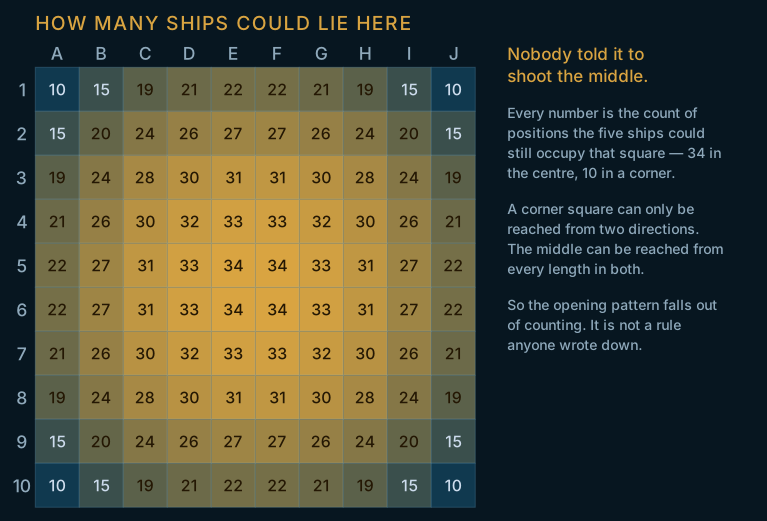
Every number on that grid is the count of ways the five classic ships could still be lying across that square on an empty board. A corner square can be reached by only ten of them — a ship touching a corner has to run in one of two directions, and only one end can be there. A central square can be reached by 34. More than three times as likely, before a single shot is fired.
So a good first shot is a central one, and after a miss the same count runs again with that square removed. Do it repeatedly and the search spreads itself into the diagonal pattern that experienced players draw from memory — spacing the shots so that no ship of the smallest length can slip between them.
Once you have a hit, stop searching. Shoot the four squares around it until one of them hits too, and now you know the ship's direction: follow that line to both ends before you go back to hunting.
Where should you hide your ships?
Everybody has an opinion about this and almost nobody has a number. So we measured it: 300 games for each arrangement, all of them against the strongest opponent on this page, counting how many shots it took to clear the fleet.
| Arrangement | Classic | Russian |
|---|---|---|
| Pushed to the edges | 52.1 | 69.9 |
| Crammed into a corner | 50.9 | 65.2 |
| Random | 44.6 | 55.9 |
| Kept to the middle | 40.9 | 55.0 |
| Spread evenly | 38.5 | 52.9 |
Seventeen shots would be a perfect game under classic rules, twenty under Russian. The edges win, clearly — which is the same fact as the diagram above, seen from the other side. If the centre is where the most ship positions live, the centre is where the searching happens, and you would rather not be there.
The worst arrangement is the one that sounds most sensible: ships spread evenly across the board, which is exactly the shape a counting opponent searches for. Keeping them all in the middle is barely better.
One honest caveat: that opponent counts positions and has no idea what people tend to do. A human who has read the same advice will start at the edges, and against them the sensible move is to break your own pattern. A study at Yale put both sides of that into a model and found no dominant strategy at all — only an equilibrium in which you sometimes hug the edge and sometimes do not. There is no arrangement that is good against everyone, which is exactly why the game survives.
Classic, Russian or German rules?
They share the grid and very little else.
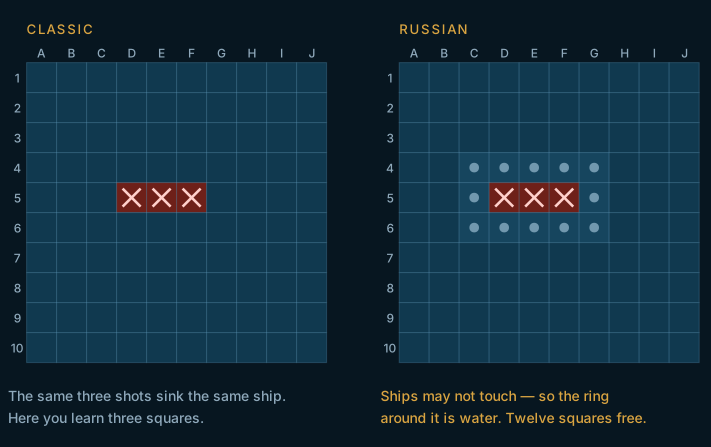
Classic is the fleet of the boxed game: five ships, seventeen squares, and they are allowed to sit side by side. That last part matters more than it sounds — two ships flush against each other look exactly like one longer ship until you have shot past both ends of it.
Russian is ten ships, twenty squares, and no two of them may touch, not even diagonally. A hit gives you another shot straight away, so a good run can cascade. And because ships cannot touch, sinking one tells you that every square around it is water — twelve squares handed over for free around a three-square ship. It is the sharpest of the three, and it is what is still played in Russia today. The full rules are here.
German is the fleet drawn on squared paper across the German-speaking world: one of five, two of four, three of three and four of two — ten ships and thirty squares, again with no touching. Once the compulsory water around each ship is counted, ninety-four of the hundred squares are spoken for, which makes it the least wasteful game of the three: the strong opponent clears those thirty squares in 48 shots, where it needs 44 for the classic seventeen.
Playing the computer
The opponent here sees precisely what you see: the squares it has called and how many ships are still afloat. It never reads your fleet — not as a courtesy, but because a program that peeks turns the game into nothing.
What it does instead is the counting from the diagram, redone before every single shot. Ships still afloat, positions still consistent with every hit and miss so far, one number per square, shoot the highest. Positions covering a hit that has not yet sunk count for far more, which is why it chases a wounded ship down its line without needing a separate rule to tell it to.
The hard setting adds one thing on top: while no hit is open, it only fires on a lattice spaced by the shortest ship still afloat. A two-square ship cannot slip between two squares two apart, so the skipped squares cost nothing — and under classic rules that alone is worth just over a shot a game. Under Russian rules it almost never applies, because four of the ten ships are a single square and nothing can be spaced around those.
Measured over 300 games at each setting, where seventeen shots is perfect under classic rules and twenty under Russian:
| Opponent | Classic | Russian |
|---|---|---|
| Shooting at random | 95.4 | 75.0 |
| Easy | 62.0 | 62.1 |
| Medium | 55.3 | 58.6 |
| Hard | 44.2 | 55.3 |
Hard is a hard game. Most people land near medium, and beating the strong setting takes a genuinely good arrangement as much as good searching.
Playing a friend online
Choose With a friend online under the board and press Open a table. You get a four-character code — send it to whoever you want to play, they type it in and press Join. There is a chat window in the corner.
Both of you arrange your fleets at the same time; there is no waiting for your turn to place. And because neither browser is ever sent the other fleet, there is nothing to find by opening the developer console — the only thing that crosses the wire about your ships is where the other player has already shot.
No accounts, no downloads, nothing installed.
Away from a screen
The game was born on paper and still works best there when there are two of you in the same room. There is a printable sea battle grid in the tools — two grids to a sheet, one for your fleet and one to track your shots, free and without a sign-up.
Where it came from
This is the pencil-and-paper game, not the boxed product — Battleship is a trademark of its owner and this is not that. The game itself is much older than the box: it was written about in Russia in 1907 and sold as pads of paper from 1931, and Milton Bradley's plastic edition did not arrive until 1967. That is sixty years of history before the trademark, and it is why the versions played around the world disagree about the fleet.
How a computer hunts your ships
Not at random. The Battleship algorithm works through the parity trick and the probability map that let a good player finish in about half the shots of a naive one — and shows why "spread the fleet out evenly" is the worst arrangement you can choose.