
Play with a pencil
Printable Sea Battle Grids
Hide your ships, call a square, listen for the answer. One sheet per player, three sizes, and nothing else needed but a pencil.
Size
The usual sea: five ships, seventeen squares to find.
Style
Pale blue rules on warm paper — what the game looks like in a school exercise book.
Paper
Sheets
For a PDF, pick Save as PDF as the printer in the print dialog.
Quick rules
- Set up. Each player takes a sheet and keeps it hidden. Draw your ships on the upper grid, along rows or columns, never diagonally and never touching or overlapping.
- Firing. Call a square — B7. Your opponent answers hit or miss. Record it on your lower grid: a cross for a hit, a dot for a miss, so you never fire at the same square twice.
- Sinking. When every square of a ship has been hit, its owner says which ship went down. Tick it off the fleet list — knowing what is left is half the game.
- Winning. Sink the whole fleet. One shot per turn is the standard game; some tables let a hit earn another shot, which makes it much faster.
- Where to hide them. Edges and corners feel safe and are searched last, but a ship along an edge has fewer squares around it to give it away. The two-square ship is the one that decides long games.
playnook.io
What you get
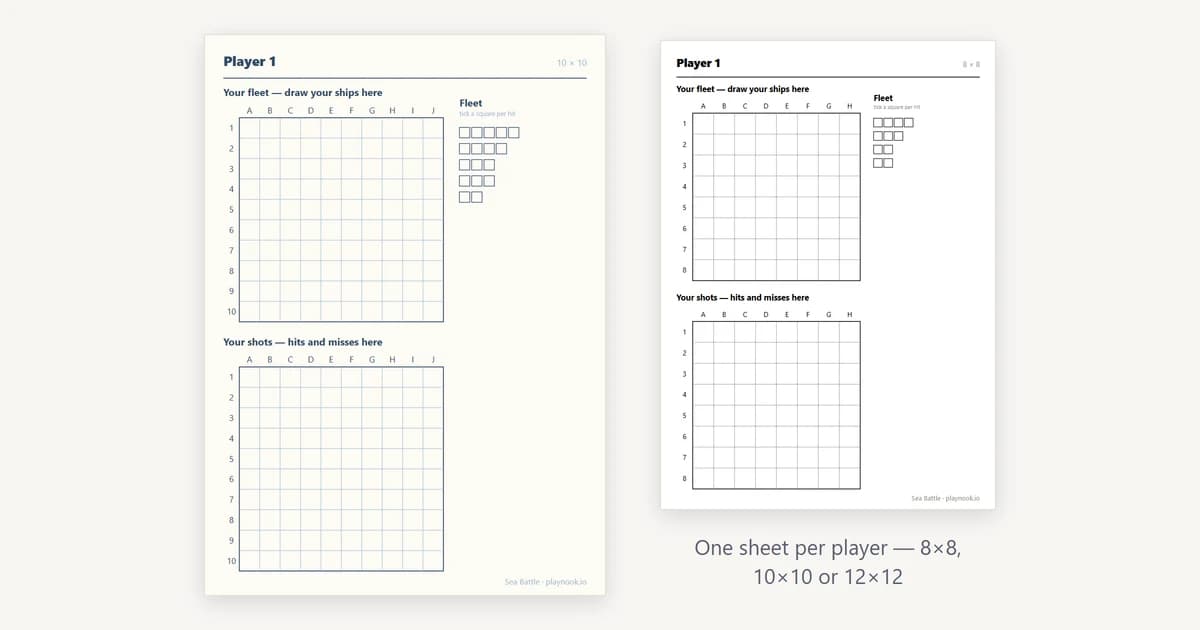
Each player gets a sheet with two lettered and numbered grids — one for their own fleet, one for tracking shots — and a fleet checklist with a box per ship square, so you always know how much of each ship is still floating. Print two sheets and you have a game.
The game is older than the box it comes in
This is a pencil-and-paper game that has been played since at least the First World War, decades before anyone sold it as a plastic set with pegs. That is why it needs nothing: two sheets of squared paper and two people who cannot see each other’s writing. The board game version is somebody’s product; the game itself belongs to everyone, which is why you can print it here.
Three sizes, and why they differ
The 8×8 quick game has four ships in sixty-four squares and takes about ten minutes — the right size for a break or for young children. 10×10 is the standard everyone knows: five ships, seventeen squares to find. 12×12 adds two more ships and a lot more searching, which turns it from a guessing game into a proper deduction problem.
The ship count rises with the board on purpose. Keeping roughly the same proportion of occupied squares keeps the difficulty comparable — a big empty sea is not a harder game, just a slower one.
How to actually get better at it
Random firing finds a two-square ship in about fifty shots. Two habits beat it. First, fire in a checkerboard pattern — since every ship is at least two squares long, it must cross a square of one colour, so you can cover the whole sea with half the shots. Second, once you score a hit, finish the ship before going back to searching: the squares around a hit are the most informative on the board.
Hiding is the mirror image. Most people avoid the edges and cluster ships in the middle, so the edges are quietly safer for the first half of the game — and the corner is the last place anyone looks.
For teachers and long journeys
This is the printable to keep a stack of. It needs no equipment, no explanation beyond a minute, and it works for any two people who can write. In a classroom it doubles as practice in coordinates: reading B7 off two axes is exactly the skill a graph asks for, and children who groan at a worksheet will do fifty of them to sink a ship.
The sheets you print are yours to use, in class or commercially.
Frequently asked questions
Why two grids per player? The upper one is your own sea, where you draw your ships and record the hits your opponent scores. The lower one is a map of theirs: you mark every square you have called, so you never waste a turn firing at the same place twice. Playing with one grid is possible but you will lose track by the twentieth shot.
What ships do I get? The 10×10 sheet gives five ships of five, four, three, three and two squares — seventeen squares to find in a hundred. The 8×8 sheet has four ships and the 12×12 has seven, so the density of the sea stays roughly the same whichever size you print.
Can ships touch each other? In the standard game, no: ships may not overlap or sit next to each other, not even diagonally. That is what makes deduction possible — a hit tells you something about the squares around it. Some households allow touching ships, which makes the game harder in a way most people do not enjoy.
Does a hit earn another shot? That is the most common house rule and it makes the game much faster, because a good run can sink a ship in one turn. The rules sheet prints the plain version — one shot per turn — so decide before you start.
Where should I hide the ships? Not in the middle, which is where beginners search first, and not all along the edges, which is where experienced players search once the middle is empty. The two-square ship is the one that decides long games: put it somewhere your opponent has already fired near and missed.
How do I get it as a PDF? Press Print, then choose “Save as PDF” as the printer in the print dialog. Every browser has that option built in.
Printing more than one thing? The paper games pack puts this sheet and seven other games into a single print job.
No paper to hand? Sea Battle in the browser plays the same game against a computer opponent or a friend online, with the ten-ship Russian fleet as well as the classic five.
While you are here, print a Dots and Boxes grid — the other game that needs nothing but paper — or one of the printable boards if you would rather cut out some pieces.