
Play with a pencil
Printable Dots and Boxes
Draw one line, close a box, take another turn. Three grid sizes with a score line, and a sheet of four small grids for quick games.
Size
The usual size. Long enough for chains to matter.
Style
Pale blue rules on warm paper — what the game looks like in a school exercise book.
Paper
Sheets
For a PDF, pick Save as PDF as the printer in the print dialog.
Quick rules
- Set up. A grid of dots and two players. Nothing to cut out, one pencil each if you have two colours, otherwise take turns with the same one.
- Move. On your turn draw one line between two dots that are next to each other, up, down, left or right. Never diagonally.
- Closing a box. If your line completes the fourth side of a box, write your initial in it and take another turn immediately. Several boxes can close at once, and you still go again.
- Winning. The game ends when every line is drawn. Whoever has claimed more boxes wins.
- The whole strategy in one line. Never be the player who draws the third side of a box. Late in the game the board becomes chains of boxes, and the trick is to hand your opponent a short chain so they are forced to open a long one for you.
playnook.io
What you get
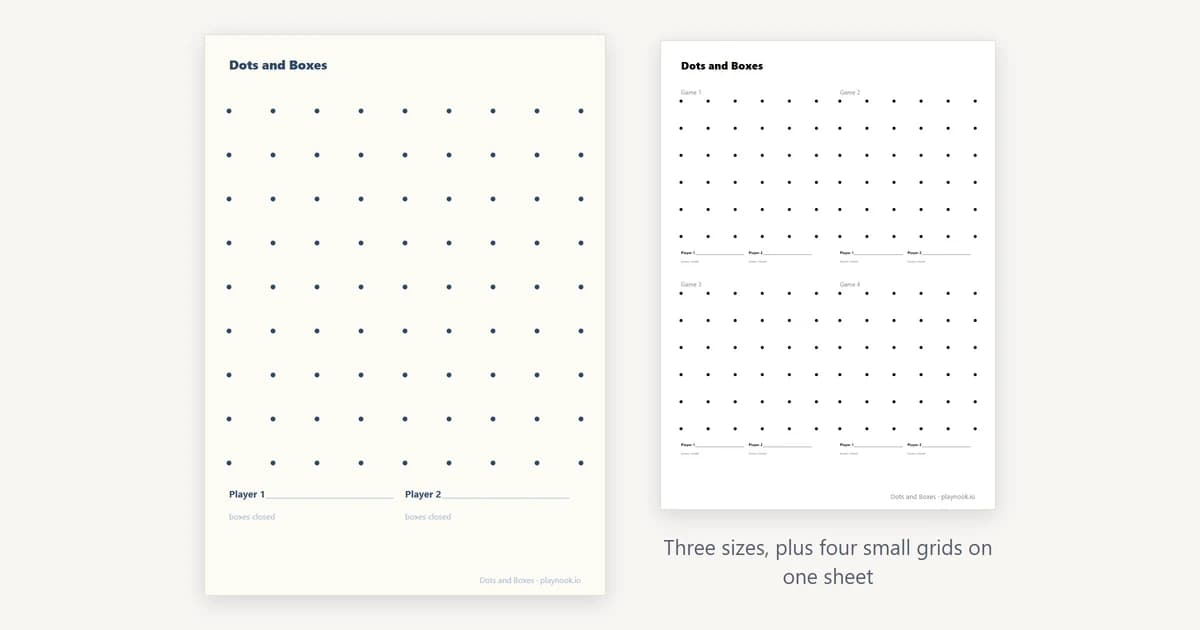
A full-page grid of evenly spaced dots with a score line underneath for both players, in three sizes. The second sheet holds four small grids, which is the one to print for a classroom or for a best-of-four.
The simplest deep game there is
Dots and boxes has two rules and no equipment, and it was described by a mathematician in 1889. It has been studied seriously ever since, because underneath the doodle is a genuine combinatorial problem — the kind that fills a book. You can teach it in twenty seconds and still be learning it years later.
The idea that turns it into a real game
Beginners play greedily: take every box you can, and never draw the third side of one. That works until the board fills up, and then something strange happens. Every remaining move opens a box for the opponent, and the board has become a set of chains — runs of boxes that all fall together once anyone opens them.
From that point the game is about who is forced to open which chain. The winning move is often to hand your opponent a short chain deliberately — taking fewer boxes than you could, so that they must open the long one for you. Once a player sees that for the first time, the game stops being a doodle.
Two sizes, two different games
On a 5×5 grid the chains barely form and the game is mostly about not making the last careless move — right for young children. 8×8 is where the chain endgame appears properly. On 11×11 the middle game genuinely matters: you are shaping the board twenty moves before it pays off.
For teachers
Few printables do this much with so little. It costs one sheet, needs no explanation, and quietly teaches parity, counting ahead and the idea that giving something up can be the strongest move available. The four-grid sheet runs a whole round-robin on one page.
The sheets you print are yours to use, in class or commercially.
Frequently asked questions
What size grid should I print? 5×5 boxes for a five-minute game or for young children. 8×8 is the usual size and long enough for chains to matter. 11×11 makes a proper game of it, where the endgame is a real puzzle rather than a scramble. There is also a sheet with four small grids for a class or a series.
Do I need two colours? It helps but it is not required. With two pencils you can see at a glance who drew what; with one, each player writes their initial in the boxes they close and that is enough. The lines themselves do not need to be distinguishable.
Do you really go again after closing a box? Yes, and it is the rule that makes the game interesting. Closing a box earns another turn immediately, and if that turn closes another box you go again, which is how a single move can take a whole chain of boxes at once.
Is there a winning strategy? There is a strategic idea that beats beginners every time: count the chains. Late in the game the board becomes a set of chains of boxes, and whoever is forced to open the first one usually loses. Good players deliberately give away a short chain to avoid opening a long one — a move that looks like a mistake and is not.
What ages is it good for? Five and up can play it properly. The rules take twenty seconds and the first strategy — do not draw the third side of a box — is something a child works out on their own, usually with some indignation, around the third game.
How do I get it as a PDF? Press Print, then choose “Save as PDF” as the printer in the print dialog. Every browser has that option built in.
Printing more than one thing? The paper games pack puts this grid and seven other games into a single print job.
No printer to hand? You can play dots and boxes online against three levels of computer opponent or with a friend on the same device — and that page has the numbers from solving the small boards outright, including how often taking an offered box is the losing move.
While you are here, print Sea Battle grids — the other game that needs nothing but paper — or try Nine Men’s Morris online if you want something to play right now.