
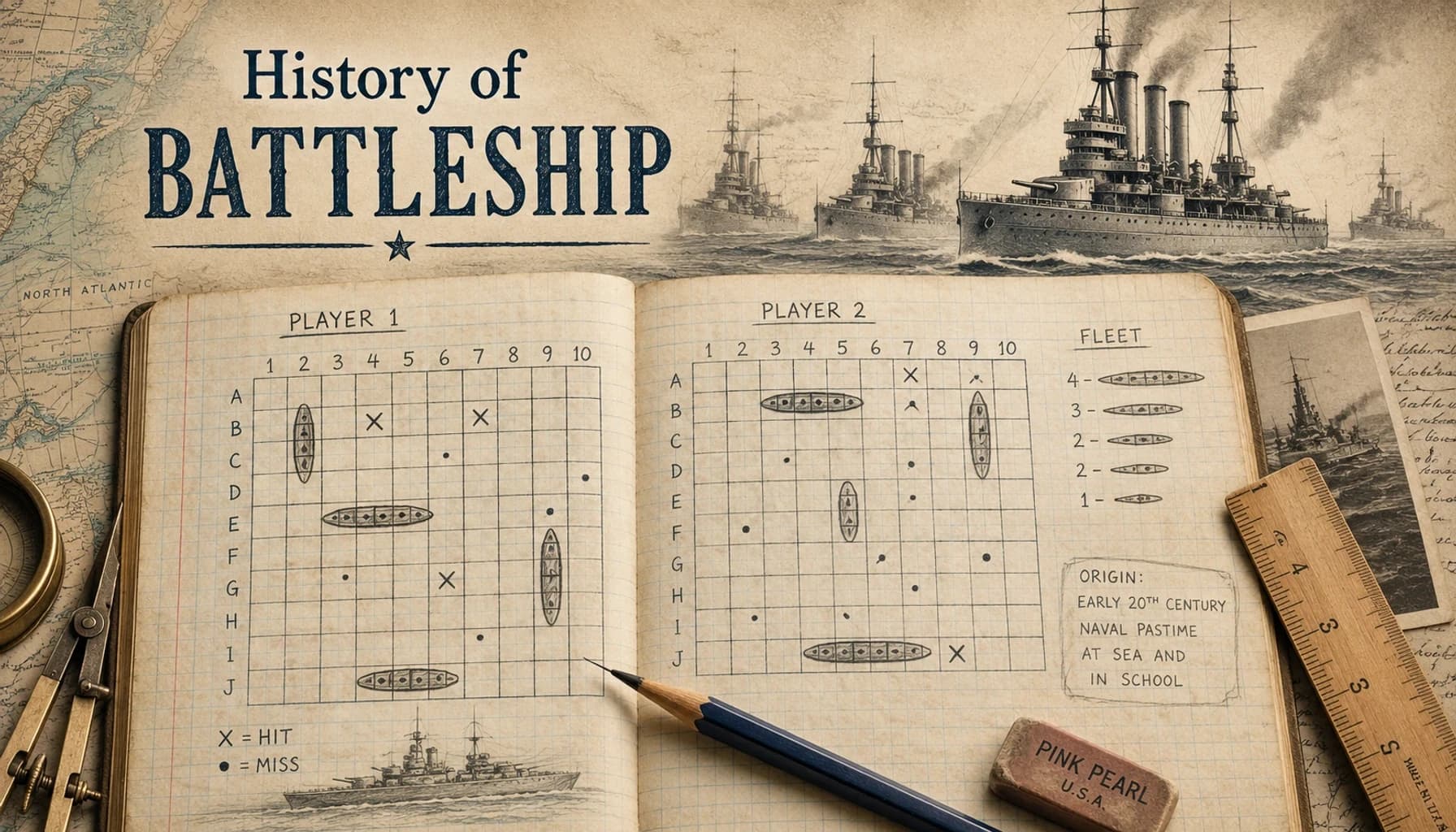
Ask when Battleship was invented and the usual answer is 1967, the year Milton Bradley put it in a box with plastic pegs. That is the year it got a trademark, not the year it got invented. By then people had been playing it on squared paper for at least sixty years, in at least three countries, under at least four names.
The game needs nothing. Two grids, a pencil, and someone who will not look. That is exactly why its early history is so thin: nobody patents a thing that costs nothing, and nobody writes down a game everyone already knows.
The first written trace is a diary, not a rulebook
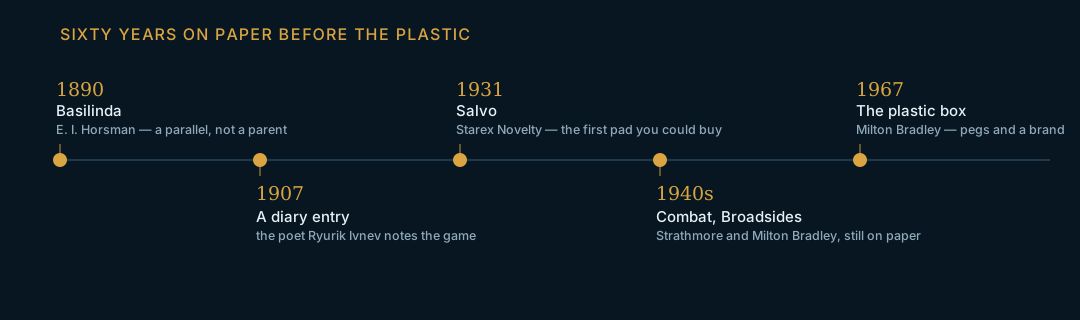
The earliest firm date anyone has is 1907, and it is not a patent or an advertisement. It is a diary. The Russian poet Ryurik Ivnev noted that he had been playing a game called Морской бой — Morskoi Boi, sea battle — and that entry is the reason we can say with confidence that the game existed before the First World War.
The context that usually comes with it is that Russian naval officers played it to pass time. That part is plausible and repeated everywhere, but it rests on much softer ground than the diary does. Treat the diary as the fact and the officers as the story.
What the diary does establish is important on its own: by 1907 the game was established enough to be worth mentioning by name, without explanation, in a private note. Games do not reach that state in a season.
It was invented more than once
The tidy version of history has one inventor. This game does not have one, because it did not need one. The same idea turned up wherever there was squared paper and a war in the newspapers:
- Russia — Морской бой, sea battle
- France — Bataille navale
- Germany — Schiffe versenken, "sink the ships"
These are not translations of one another. As the rules that go with each fleet show, the versions disagree about how many ships you get, how long they are, and whether they may touch — which is precisely what you would expect from a game that was reinvented in parallel rather than exported from one place.
A frequently cited relative is Basilinda, published by E. I. Horsman in 1890. It is a genuine antecedent in spirit — hidden positions, called coordinates — but calling it the ancestor of Battleship overstates the case. The more honest description is a parallel: the same idea, arrived at earlier, in a form that did not survive.
The first ones you could buy were pads of paper
The commercial history begins in 1931, when the Starex Novelty Company published Salvo. The product was not a board. It was a pad — pre-printed grids, tear off two sheets, play, tear off two more. You were buying the stationery, because the game itself was free and always had been.
Through the 1930s and 1940s the same idea was sold repeatedly under different names:
| Year | Name | Publisher |
|---|---|---|
| 1931 | Salvo | Starex Novelty |
| 1930s–40s | Combat: The Battleship Game | Strathmore |
| 1930s–40s | Broadsides: A Game of Naval Strategy | Milton Bradley |
| 1930s–40s | Warfare Naval Combat | Maurice L. Freedman |
Note the third line. Milton Bradley was selling a paper version decades before the plastic one, and under a different name — which makes the 1967 box a re-release of their own product rather than a new invention.
Salvo also left behind a rule that outlived it. In the salvo variant you do not fire one shot a turn; you fire as many shots as you have ships still afloat, all at once, and you are told how many hit but not which. It is a harder, colder game, and it is still the standard variant name for firing in volleys.
What 1967 actually changed
Milton Bradley's plastic edition arrived in 1967 with a hinged case, a vertical screen, and pegs — red for hits, white for misses. In 1977 came Electronic Battleship, with a microprocessor that made explosion noises.
What the box changed:
- A fixed fleet. The paper game had no canonical fleet; every region had its own. The box declared one and, being the version most of the English-speaking world met first, made it feel official. The 1990 rules name it: Carrier 5, Battleship 4, Cruiser 3, Submarine 3, Destroyer 2 — seventeen squares.
- Ships may touch. The boxed fleet allows ships flush against each other, a choice the Russian and German paper versions both reject.
- A name somebody owns. Battleship is a trademark. Sea battle, bataille navale and Schiffe versenken are descriptions, and nobody owns those.
What the box did not change: the game. Two grids, hidden ships, one square a turn.
Why the paper version is still the interesting one
Because it kept evolving and the box did not. A boxed game is frozen the day it ships; a paper game changes wherever it is played, and the changes are honest because nobody had to sell them.
The Russian fleet grew to ten ships that may not touch, and added an extra shot for every hit — which turns a search into a chase. The German fleet went the other way and got bigger: thirty squares of the hundred, so nearly a third of the sea is fleet. Both are more interesting than seventeen squares with no extra shots, and neither was ever in a box in the English-speaking world.
You can play all three in the browser, against a computer opponent or a friend online, and the difference between them is not subtle.
The name to search for
If you are looking for the pencil-and-paper game rather than the product, the useful search terms are the descriptive ones — sea battle, sink the ships, bataille navale. Searching the trademark mostly finds the trademark.
And if you want it the way it was in 1907, there is a printable sea battle grid here: two grids to a sheet, one for your fleet and one to record your shots. Free, no sign-up, and about as close to the original product as it is possible to get — since the original product was a piece of paper.
Related reading
- The rules that go with each fleet — why the Russian version has ten ships that may not touch, and what that changes.
- How a computer plays sea battle — the counting method, and where the best hiding places actually are.
- Reversi and Othello — the same story with a different ending: an old public game, a trademark, and which name won.