
The short answer
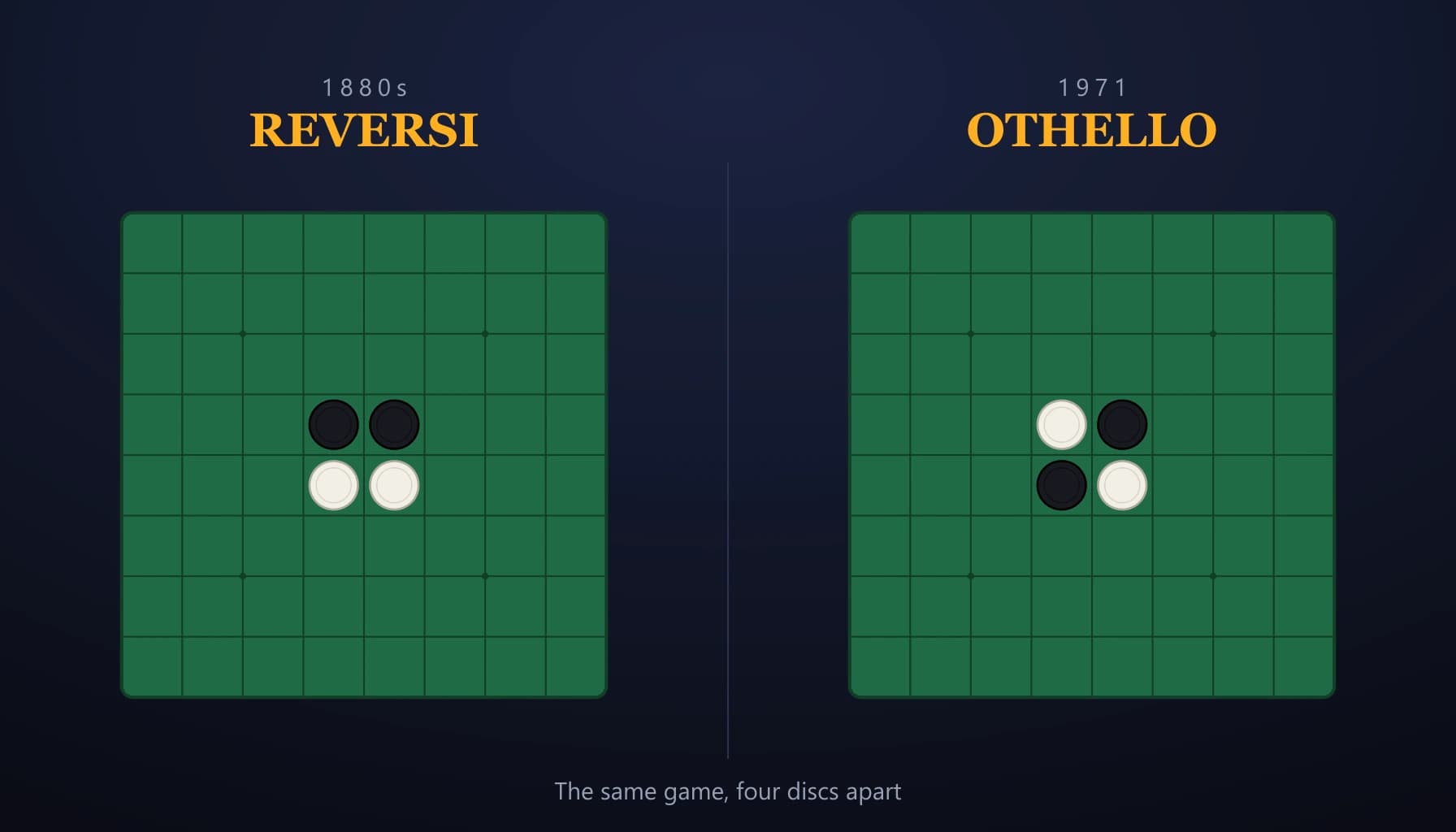
Yes — Othello is Reversi with the rules tidied up and a new name. The move, the flip, the board and the goal are identical. Othello, registered in Japan in 1971, fixed two things the Victorian game left open: where the first four discs go, and who owns them. Every modern set and every website plays the Othello rules, whichever of the two names is printed on the box.
If you have ever wondered why the game you downloaded is called Reversi and the one in the shop is called Othello, the answer is not about the rules at all. It is about a trademark, and we will get to it.
What changed in 1971
| Reversi (1880s) | Othello (1971) | |
|---|---|---|
| Opening four discs | Players place them into the centre themselves | Fixed: white d4 and e5, black e4 and d5 |
| Discs | 32 each, your own | 64 shared, taken from a common pool |
| Running out of discs | Possible — you simply stop placing | Cannot happen |
| Board | 8×8 (Waterman's version) | 8×8 |
| The move, the flip, the goal | Identical | Identical |
Everything in the bottom row is why people say they are the same game. Everything in the top three rows is why they are not quite.
The opening four discs
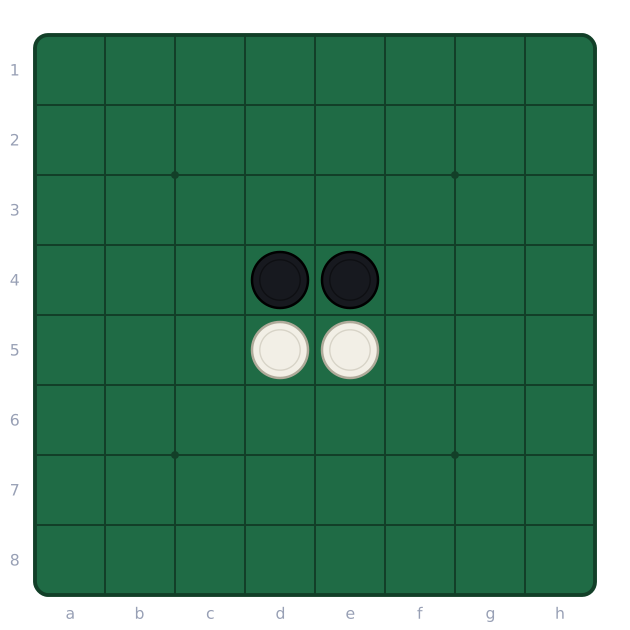
In the old game the players took turns dropping their first two discs into the four middle squares, and they could end up in any arrangement — including the parallel one above, with both black discs side by side.
That is a genuinely different game from move one. From the parallel opening Black has four legal moves — c6, d6, e6 and f6 — but they are two different ideas, each available in mirror image: a straight capture down the file, or a diagonal one. From the Othello opening Black also has four moves, and all four are the same move rotated four ways. The Victorian game had a real first decision. The modern one does not.
Othello removed the choice. The four centre discs start on a diagonal, white on d4 and e5, black on e4 and d5, and the game begins with Black to move.
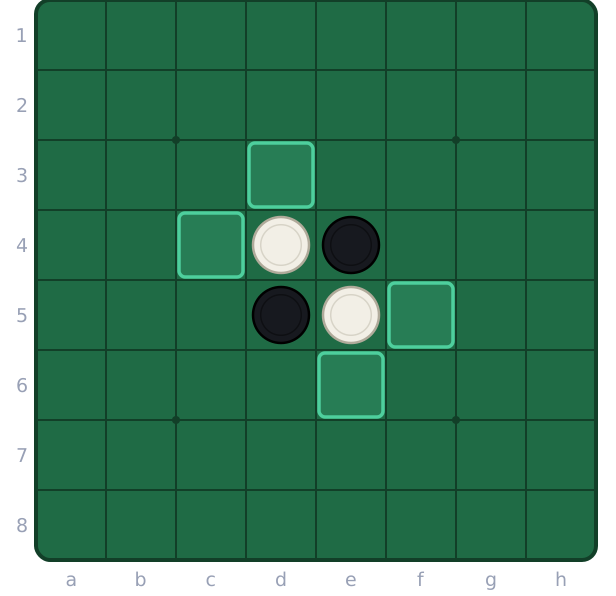
That single change is what made opening theory possible. Because every game now begins from the same position, openings can be named, studied and argued about — which is exactly what competitive players spent the following fifty years doing. It also means there are only three openings worth the name, and the geometry says why.
Whose discs are whose
Victorian Reversi gave each player thirty-two discs of their own colour. Run out, and you stopped placing while your opponent carried on. Othello pooled all sixty-four: you take whatever is left, and since there are exactly as many discs as squares, nobody can ever run short.
It sounds like bookkeeping. It is not — it removes an entire way of losing that had nothing to do with the position on the board.
Why almost every app calls it Reversi
Here is the part the rulebooks do not explain. Othello is a registered trademark. Reversi is not.
Reversi is a Victorian game name, long out of copyright and free for anyone to use. Othello was registered in 1971 and has been defended ever since. So a developer who writes the game for a phone, a browser or a games console has two choices: license the name, or use the older one that belongs to nobody.
Almost all of them choose the older one. That is the whole reason your app store is full of Reversi and your toy shop is full of Othello, and it is why this site calls it Reversi too.
Two Englishmen and an argument
The usual account runs like this. In 1870 John W. Mollett published a flipping game called The Game of Annexation, played on a cross-shaped board. In 1883 Lewis Waterman published Reversi on a plain 8×8 board. Each accused the other of taking his idea, both kept publishing, and Waterman's version — sold through Jaques of London, the firm that also gave us the modern croquet set — is the one that survived.
Nobody has ever settled it, and at this distance nobody will. What is clear is that the board we play on is Waterman's.
Where "Othello" comes from
The Japanese name was registered by Goro Hasegawa, and it is a better name than most. Shakespeare's Othello is a drama of black and white in which the advantage changes hands repeatedly and almost nothing is settled until the end — which is an unusually accurate description of a game where the player holding more discs in the middle is usually losing.
If that claim surprises you, it is the single most important idea in the game, and the full Reversi and Othello guide explains why in detail.
Does the difference matter when you play?
Almost never. Unless you are playing with a set made before 1971, or with someone using a very old rulebook, you are playing Othello rules and calling them whatever you like.
Two things are worth knowing anyway:
- The board is symmetric, so a mirrored starting diagram is not a mistake. Some sets show white on e4 and d5 instead. It is the same game reflected.
- You cannot pass by choice. If you have a legal move anywhere, you must play it. Passing happens automatically, and only when you have nothing.
Common questions
Is Othello harder than Reversi? No — they are the same game to play. The fixed opening arguably makes Othello deeper, because a shared starting position lets theory accumulate, but nothing about a single game is harder.
Which name is correct? Both. Use Othello for the branded set, Reversi for the game in general. Tournament play is organised under the name Othello.
Can I play Othello with a Reversi set? Yes, and this is the only practical difference you will ever meet: an old set has two piles of thirty-two discs instead of one pile of sixty-four. Put them in one pile and play.
Is the 8×8 board original? Waterman's was. Mollett's cross-shaped board did not survive, and the 10×10 and other sizes you occasionally see are modern variants.
Has the game been solved? Yes, in 2023. With perfect play by both sides, 8×8 Othello is a draw — neither the first nor the second player has a winning advantage.
Want to try it? Play Reversi here — against four levels of computer opponent, or against a friend online: open a table, send them the four-character code, and there is a chat window while you play. If you are after the rules and the strategy rather than the history, the complete guide is next door.