
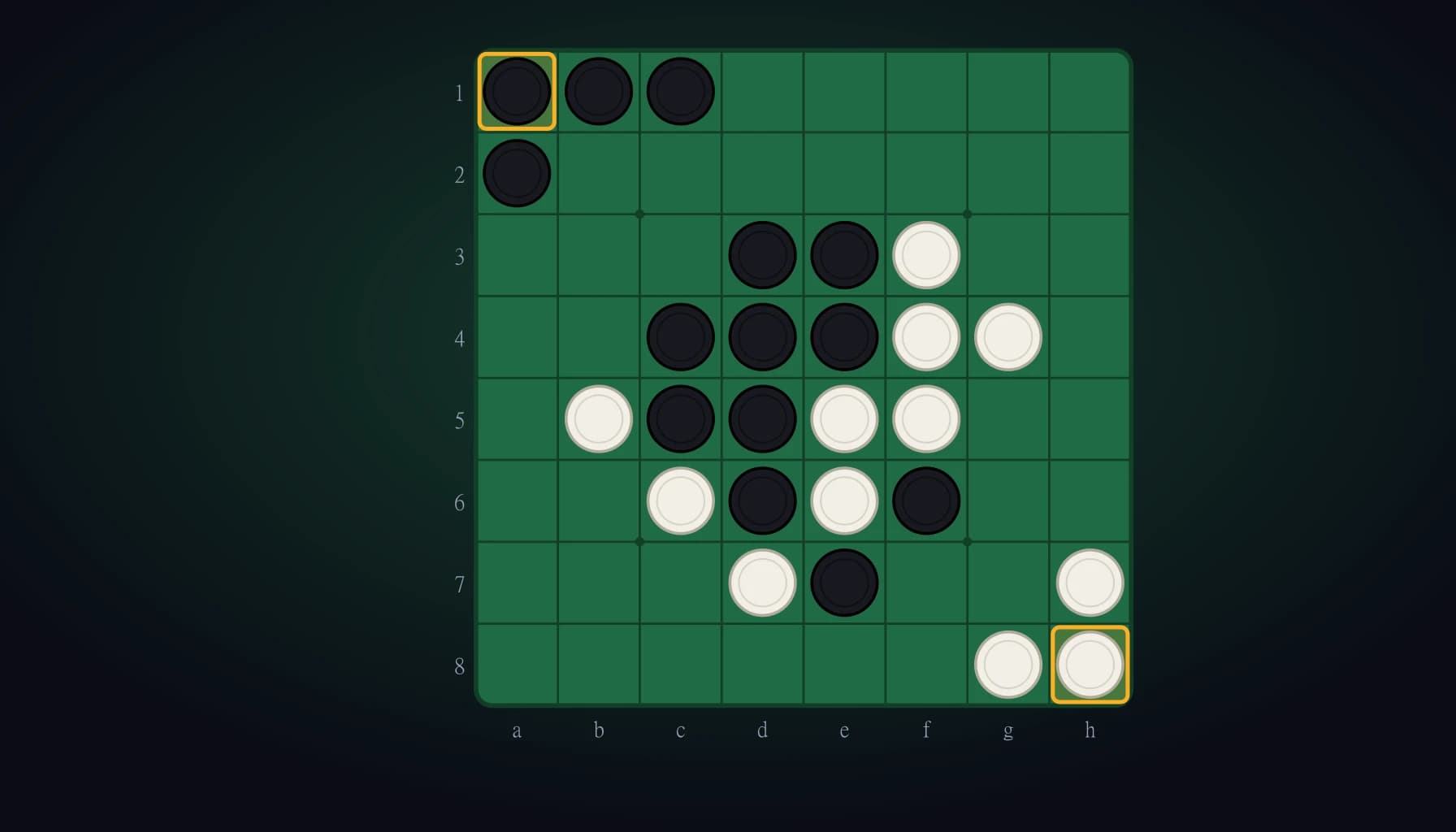
Reversi takes about a minute to explain. Place a disc so that it traps a line of your opponent's between the one you just played and another of yours, and every disc in that line turns over to your colour.
That single rule produces a game in which the player who is winning is usually losing. Nowhere else does a beginner's instinct fail so completely: taking as many discs as possible is, for the first fifty moves, close to the worst thing you can do.
Two names, one game
Reversi appeared in England in the 1880s. Othello is the same game with the rules tidied and a new name, registered in Japan in 1971 — it fixed the opening four discs in the diagonal everyone now uses and pooled all sixty-four discs instead of giving each player their own thirty-two.
Everything below describes the Othello rules, because that is what every modern set and every website plays, whichever name is on the box. If you want the rest of that story — the two Victorian inventors who each accused the other of theft, and why almost every app calls it Reversi — it has an article of its own.
The board and the opening four
Eight by eight, sixty-four squares, and four discs already down in the middle: two black and two white, each colour on a diagonal. Black moves first.
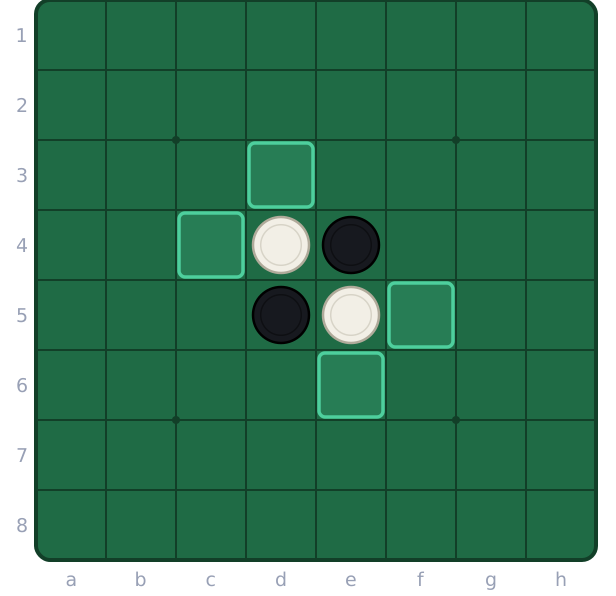
Some sets show the mirror image of this arrangement. It makes no difference: the board is symmetric, so the two are the same game reflected. Likewise, all four of Black's opening moves are rotations of one another, which means every game of Reversi starts the same way. The interesting decisions begin on move two, where White has exactly three replies and not one more.
How a move works
A legal move must outflank. Place your disc so that, in a straight line — across, down or diagonally — there is an unbroken run of enemy discs between it and another disc of your own. Every disc in that run turns over.
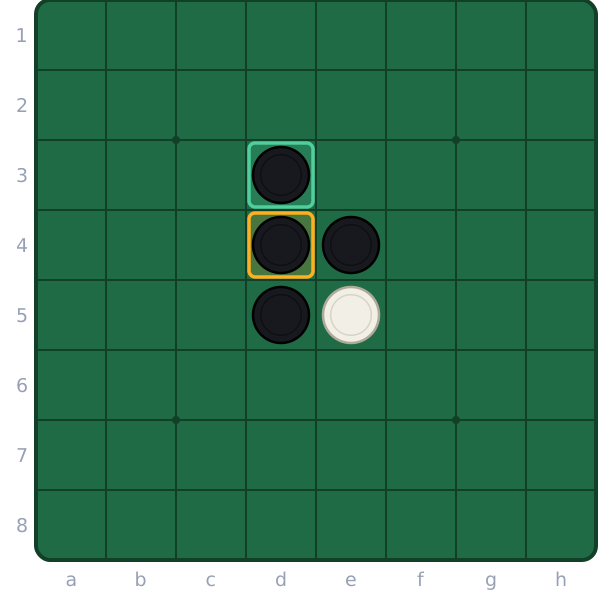
Three things trip people up:
- One move can flip in several directions at once. If a disc outflanks along a row and a diagonal, both runs turn.
- Gaps do not count. An empty square anywhere in the line stops it. The run between your two discs has to be solid enemy discs and nothing else.
- You cannot pass if you have a legal move. If any square on the board outflanks something, you must play one of them, even when every option is terrible. Being forced to move is the engine of the whole strategy.
If you genuinely have no legal move, you pass and your opponent goes again. When neither player can move — usually when the board is full — the game ends and the majority of discs wins.
The counterintuitive part: the lead is a trap
Here is the thing that separates a beginner from someone who has played twenty games. Having more discs in the middle game is bad, and the bigger your lead, the worse your position usually is.
The reason is that your discs are what your opponent plays against. A legal move has to outflank an enemy disc, so every disc of yours sitting next to an empty square is a target — an invitation. Flip twelve discs in one glorious move and you have just handed your opponent a dozen new places to play, while shrinking your own options.
What you actually want mid-game is mobility: more legal moves available to you than to your opponent. The strongest players routinely sit at ten discs against fifty in the middle game and win comfortably, because the player with fifty runs out of safe moves first and has to start giving away corners.
A useful habit: when choosing between two moves, prefer the one that flips fewer discs. It is right more often than it has any business being.
Corners cannot be flipped
A disc in a corner can never be outflanked, because outflanking needs a disc on both sides and a corner has no other side. Corners are permanent, and everything else in the game bends around that fact.
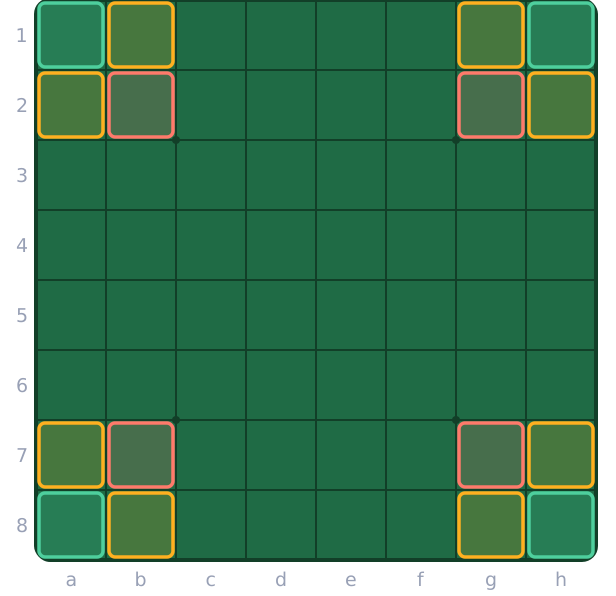
The four squares diagonally next to a corner — b2, g2, b7, g7, marked red — are called X-squares, and they are the most dangerous squares on the board. Put a disc there and you have opened the diagonal to the corner; your opponent takes it, and the corner is theirs forever. Avoid them until the corner next to them is already settled.
The eight squares along the edges next to a corner — a2, b1 and their counterparts, marked amber — are C-squares. Less lethal than the X-squares but still where most corners are lost. Play them only when you can see what happens next.
Stable discs are the real currency
A disc is stable when there is no possible future in which it flips. Corners are stable by definition, and stability spreads outward from them: a disc is stable when every line through it is blocked at one end by a stable disc or an edge.
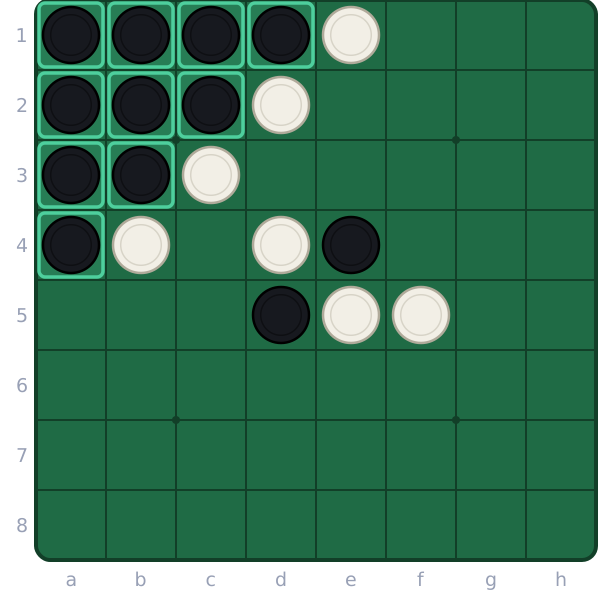
This is why counting discs mid-game tells you nothing and counting stable discs tells you a great deal. Fifty unstable discs are a liability. Ten stable ones are ten points already in the bank.
Parity: who plays last
There are sixty empty squares at the start, so a game without passes runs sixty moves. Black plays the odd-numbered ones and White the even — which means White plays the sixtieth and final move.
That matters more than it sounds. The player who moves last into an empty region of the board flips discs that nobody can answer. Strong players think about parity constantly: leaving an even number of empty squares in each isolated region so that the last move in each falls to them. It is the reason a game can swing by twenty discs in the final four moves — and the reason you should never concede before the board is full.
What beginners get wrong
- Grabbing discs. The most common losing habit, and the hardest to unlearn. Flipping a lot feels like progress and is usually a gift.
- Taking edges early. Edge discs look safe because they can only be attacked along one line, but an unsupported edge disc is a lever your opponent uses to reach the corner.
- Playing X-squares to reach something. No short-term gain is worth a corner. If a move puts you on b2, look at it twice.
- Counting at move forty. The score at move forty is close to meaningless. Count stable discs instead, and only start counting the rest when the board is nearly full.
- Conceding. A twenty-disc deficit with six squares empty is not a loss. It is not even unusual.
Three habits that win games
- Play the smallest move. When in doubt, take the option that flips fewest discs and leaves your position compact.
- Count your opponent's moves, not your discs. If they have three legal moves and you have nine, you are winning regardless of the score.
- Take a corner when it is free — but only then. Corners are worth having, not worth chasing. Manoeuvring to force one is what the middle game is for.
The game is solved, and it is a draw
In 2023 the Japanese researcher Hiroki Takizawa published a computational proof that 8×8 Othello is weakly solved: with perfect play from the standard opening, the game ends 32–32, a draw. Smaller boards had fallen decades earlier — 4×4 and 6×6 are both wins for the second player — but the full board held out until then.
For players this changes nothing at all. Perfect play means searching a tree that no human holds in their head, and the proof does not hand anybody a winning recipe. It puts Reversi in the same company as draughts: settled in theory, undiminished at the table.
Common questions
Is Reversi the same as Othello? Effectively yes. Othello is the standardised 1971 version with a fixed opening and shared discs; Reversi is the 1880s original that allowed a free opening. Everyone today plays the Othello rules, whichever name is on the box — the full comparison is here.
What if I run out of discs of my colour? In the modern game you cannot — all sixty-four are shared, and you simply take one of whatever is left. Only the Victorian version gave each player their own thirty-two.
Can the game end before the board is full? Yes, and it happens more than people expect. If neither player has a legal move the game stops there, and the empty squares are ignored. A player who loses every disc on the board loses immediately.
Is going first an advantage? Marginally, and less than intuition suggests — White gets the last move, which is worth something in return. With perfect play it balances out exactly.
How long does a game take? Ten minutes at a leisurely pace. Sixty moves, and most of them are quick until the endgame, where the good players slow right down.
Ready to try it? Play Reversi here — four difficulty levels, a live disc counter and an undo button for the move you regret immediately, or open a table and play a friend online with a chat window beside the board. If the flipping appeals but you want something to place rather than turn, Gomoku and Nine Men's Morris are next door. Away from a screen, the printable Reversi board gives you the board, all sixty-four discs and the rules on three sheets.