Senet is a race. Both players line five pieces up on a board of thirty squares, throw four flat sticks instead of dice, and try to get everybody round the board and off before the other one does. The rules take two minutes. What takes longer is learning that a piece standing on its own is not yours — it is an offer.
It is also the oldest board game we have physical evidence for. Boards turn up in Egyptian burials from around 3100 BC, and people were still playing it two and a half thousand years later.
How the board is set up
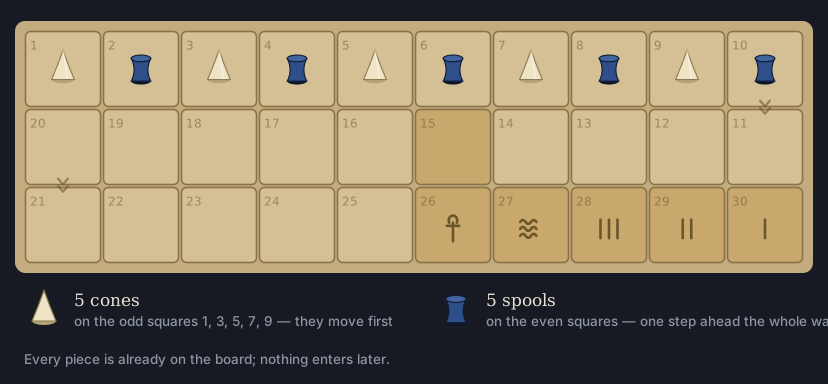
Ten pieces sit on the first ten squares from the start, alternating: cones on the odd squares, spools on the even ones. Nothing enters the board later and nothing is ever taken off it except by finishing.
You play the cones and move first. The spools therefore start one square ahead of you everywhere — which is exactly as much of a handicap as moving first is an advantage, and the measurements at the bottom of this page bear that out.
The path: thirty squares, three rows, one direction
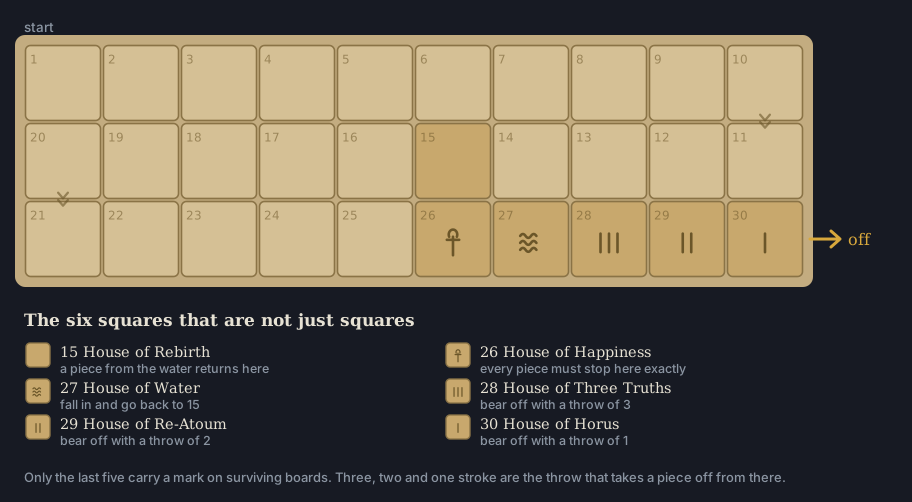
The path runs boustrophedon — "as the ox ploughs". Right along the top row, back leftwards along the middle, right again along the bottom, and off past square 30. Two turns, and both of them catch beginners once.
Six squares matter more than the rest:
| Square | Name | What it does |
|---|---|---|
| 15 | House of Rebirth | Where a piece that falls in the water comes back |
| 26 | House of Happiness | Every piece must stop here exactly |
| 27 | House of Water | Fall in and go back to 15 |
| 28 | House of Three Truths | Bear off with a throw of 3 |
| 29 | House of Re-Atoum | Bear off with a throw of 2 |
| 30 | House of Horus | Bear off with a throw of 1 |
The marks on 28, 29 and 30 are three, two and one stroke — and that is not decoration. The number of strokes is the throw you need to take a piece off from that square. The rule is written on the board.
How to play Senet
Throwing the sticks
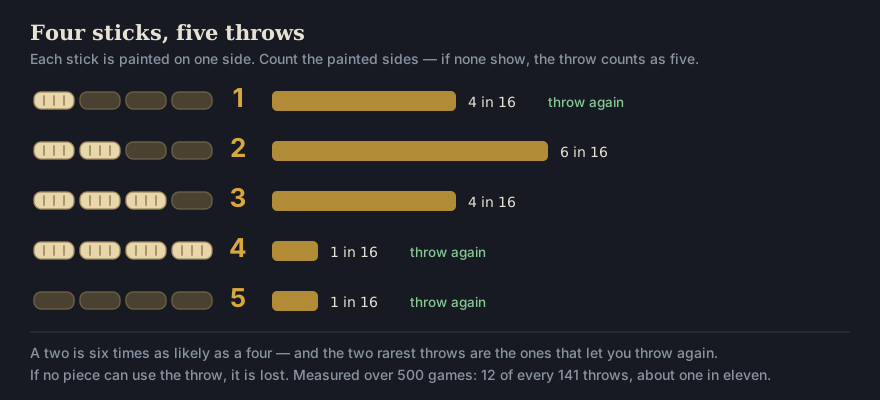
Four flat sticks, each painted on one side. Throw all four and count the painted sides showing. If none show, the throw counts as five.
That produces odds nothing like a die. A two turns up six times in sixteen; a four or a five, once in sixteen. And the three rare-to-middling throws — 1, 4 and 5 — let you throw again, so a good throw compounds.
If no piece of yours can use the throw, the throw is lost and your opponent takes over. Measured over 500 games, that happens to about one throw in eleven. It is part of the game, not bad luck.
The Royal Game of Ur uses four binary lots too, and gets the identical odds — but leaves the blank throw blank instead of turning it into a five. The two games compared.
Moving
Click a piece that lights up. There is no choosing how far to go — the throw decides that — so a click on the piece is the whole move.
- You may never land on your own piece.
- You may not move a piece past square 26 without stopping on it.
- You may not move through three enemy pieces standing in a row.
Swapping, protection and blockades
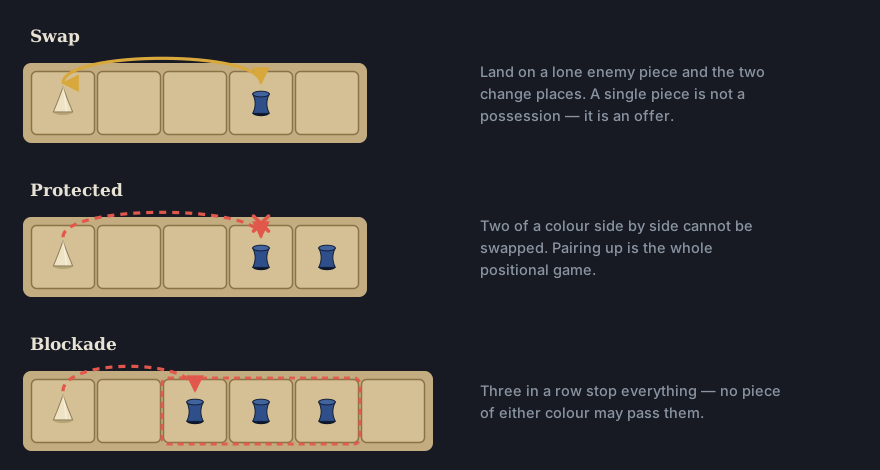
- Swap. Land on a single enemy piece and the two change places. Nothing is captured, nothing leaves the board — but a piece can be sent a long way backwards.
- Protection. Two pieces of the same colour standing side by side cannot be swapped. Pairing up is the whole positional game.
- Blockade. Three of a colour in a row stop everybody — neither side may pass them.
How much does this matter? Measured over 500 games: when both sides play the position, there are about 16 swaps a game. When both sides only race and ignore protection, that more than doubles to 36 — and the games run 25 moves longer, because everyone keeps getting thrown backwards.
The last five squares
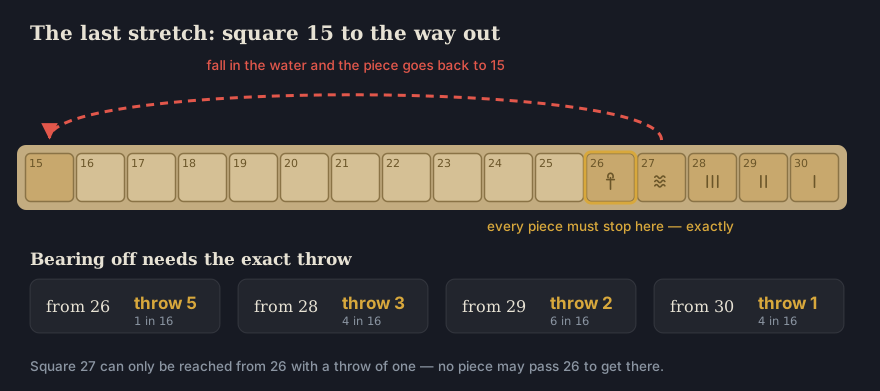
Square 26 is a mandatory stop. No piece may pass it, so pieces queue up in front of it and the endgame turns into a traffic problem rather than a race.
From square 26 the throws split brutally:
- A five takes the piece straight off the board — one chance in sixteen.
- A one drops it into the House of Water on 27, and it goes all the way back to square 15 — four chances in sixteen.
- A two, three or four moves it to 28, 29 or 30, where it needs exactly 3, 2 or 1 to get out.
Falling in the water is rarer than it sounds — about once a game — because you usually have a better move available. But it is the single biggest swing on the board.
Those five squares are the only ones on the board with names, and the marks on 28, 29 and 30 are the throw you need as well as a piece of theology — what the senet board means goes through all of them.
Winning
The first player to bear off all five pieces wins. A typical game runs about 129 moves; the shortest of 500 measured games took 91 half-moves, the longest 196.
Away from a screen: the printable Senet board prints the whole game on a page, with the four throwing sticks to cut out and fold.
What actually wins games
- Pair up. A lone piece within range of an enemy is a piece you might lose twenty squares of progress on. Two together are untouchable.
- A three-chain is worth more than it looks — especially placed just in front of the enemy's lead pieces, where it stops them dead.
- Do not rush to square 26 unless you can leave it again. A piece parked on 26 has a four-in-sixteen chance every turn of being thrown back to 15.
- Spend the rare throws well. A four or a five is worth a whole extra turn as well as the distance. Wasting one on a step you could have made with a two is the most common quiet mistake.
Which rules are these?
No Egyptian rulebook survives. That is the honest starting point, and every site that states the rules of Senet as fact is telling you something nobody knows.
What does survive is plentiful but silent: hundreds of boards, several with their pieces, tomb paintings of people playing, and religious texts from the New Kingdom that use Senet as a metaphor for the passage through the afterlife. None of it explains how a turn worked.
The modern game is a reconstruction, built from the board itself, the number of pieces found with it, and hints in the Great Game Text — a New Kingdom document that names some squares. The two names attached to it are Timothy Kendall (1978) and Peter Piccione (1980), both building on earlier work by R. C. Bell. They disagree on details, including how many pieces each side has.
This board plays the five-piece version used by museums and school sets. Kendall's seven-piece layout, with pieces on squares 1 to 14, is in the settings below the board — it makes the traffic in front of square 26 much worse, which is either more interesting or more frustrating depending on your temperament.
The full story — the first boards, Tutankhamun's four sets, Nefertari at the board, and how three twentieth-century scholars got from a pile of boards to a playable game — is in the history of Senet.
How strong is the computer?
Three levels, and they were measured against each other rather than guessed — 400 games each, with sides swapped so that the first move never decides a series:
| Match | Result |
|---|---|
| Hard vs random play | 74.5% |
| Hard vs Easy | 68.5% |
| Hard vs Medium | 60.5% |
| Medium vs random play | 65.2% |
Medium only races: it counts progress and pieces borne off, and ignores swaps, protection and blockades entirely. That is not an artificial handicap — it is exactly how somebody plays who has not yet noticed the positional rules. Hard adds them, and also averages over all five possible replies before choosing a move.
Notice the ceiling. Even the strongest level only wins three games in four against a player who moves at random, because the sticks decide a great deal. That is Senet, not a weak program: with these odds, a run of fours and fives beats good judgement more often than it should.
There is no first-player advantage. Over 4,000 games of random play it measured 50.1%, and over 600 games at the top level, 49.5%. The spools' one square head start and the cones' first move cancel almost exactly — which is a quiet point in favour of this particular reconstruction being a reasonable one.
Playing a friend online
Pick With a friend online under the board and press Open a table. You get a four-character code; whoever you send it to types it in and presses Join. No account, no download, and there is a chat window in the corner.
One thing works differently online: the server throws the sticks. If each browser threw its own, the two of you would see different sticks and there would be no honest way to decide whose were real. So the throw arrives with the board, and your move is choosing the piece — which is what your move always was. If a throw comes up that nobody can use, the server says so and passes, and both screens show it.
Is Senet the oldest board game?
It is the usual answer, and it is defensible, but the honest version has more in it than a date. The oldest board game in the world sets Senet against the Royal Game of Ur and the other candidates, and separates what is actually dated from what is repeated.