
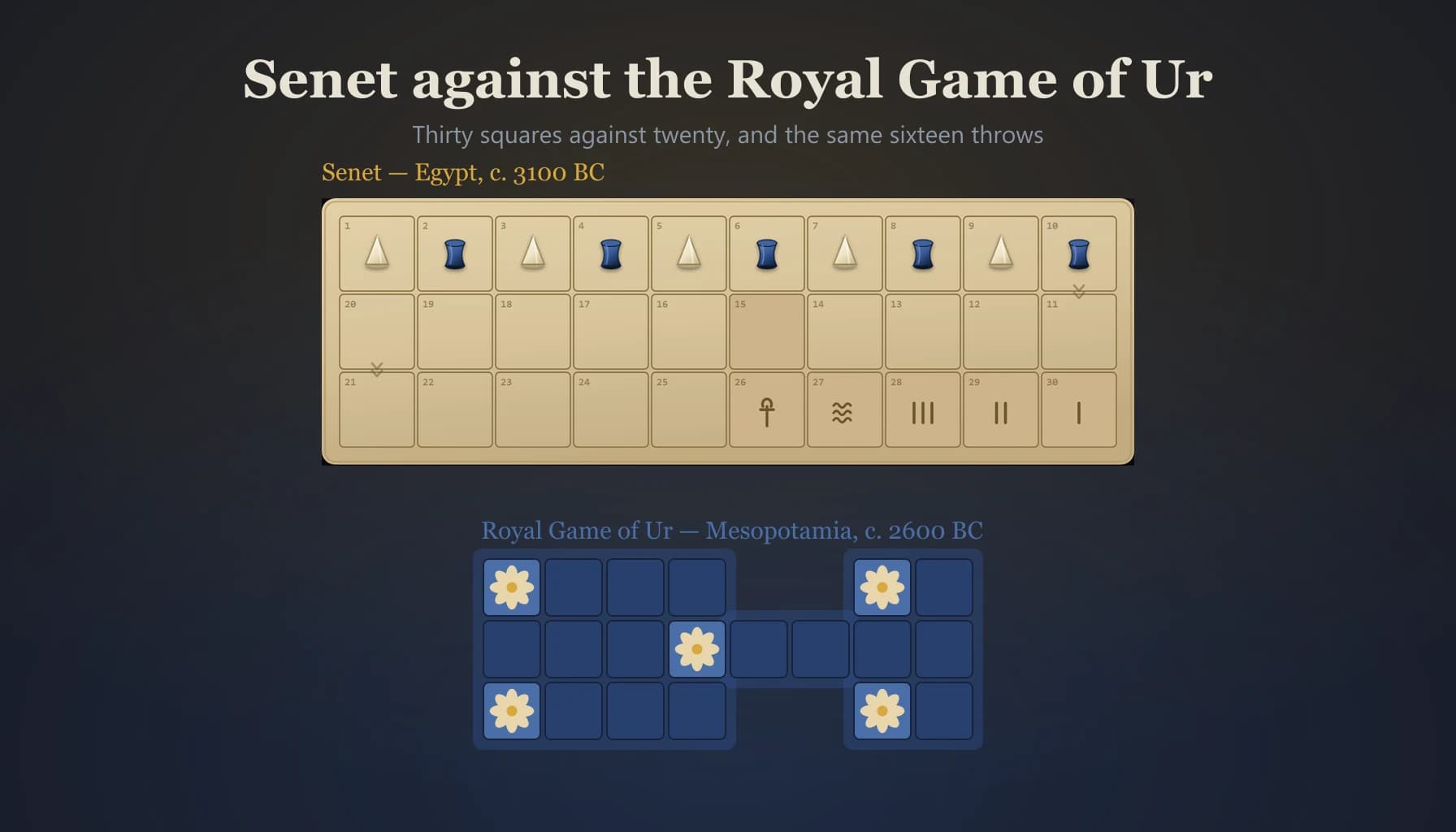
Two race games, five hundred years and a thousand kilometres apart. Egypt made one, Mesopotamia the other. Both were buried with the rich, both were thrown with four binary lots rather than dice, and both make you land on the last squares with an exact number.
One of them we can play as it was actually played. The other we can only guess at.
The boards
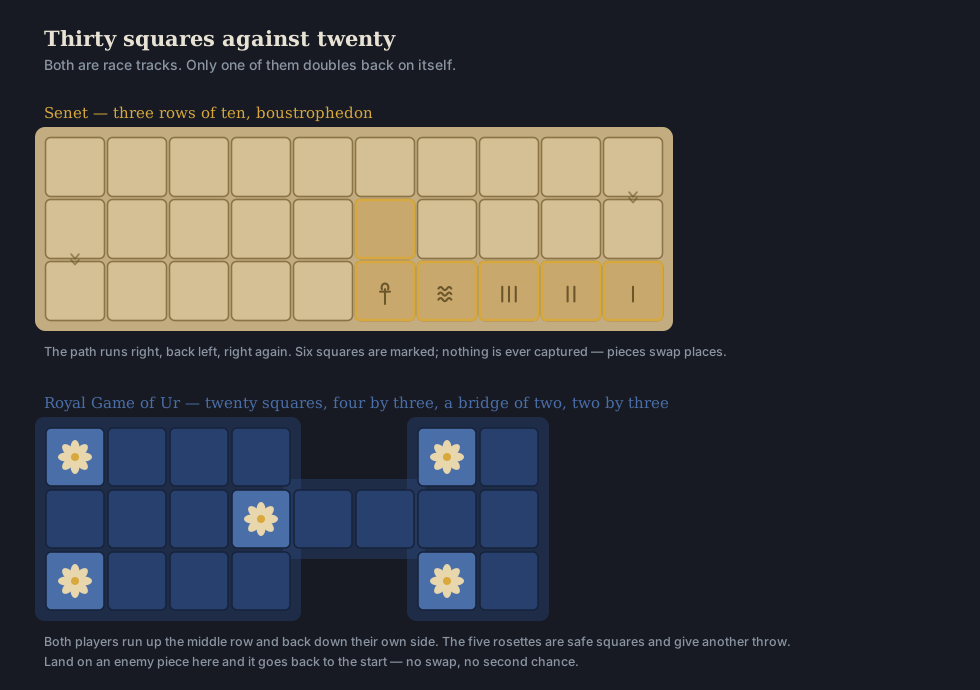
Senet is a rectangle of thirty squares, three rows of ten, and the track runs boustrophedon: right along the top, back leftwards along the middle, right again along the bottom. The shape tells you nothing; the numbering does the work.
Ur is the opposite. Its silhouette is the track — a block of twelve, a bridge of two, a block of six. Both players run up the shared middle row and peel off onto their own side, which means the middle row is contested and the outer rows are safe. You can read the tactics off the shape.
The dice that are the same dice
This is the part almost nobody notices.
Ur is thrown with four tetrahedral dice, two corners of each marked. You count the marked corners that land up: 0, 1, 2, 3 or 4.
Senet is thrown with four flat sticks, one side of each painted. You count the painted sides that land up: 1, 2, 3, 4 — and if none show, the throw counts as five.
Four binary lots either way. Which means both games have exactly the same distribution: 1, 4, 6, 4 and 1 chances out of sixteen.
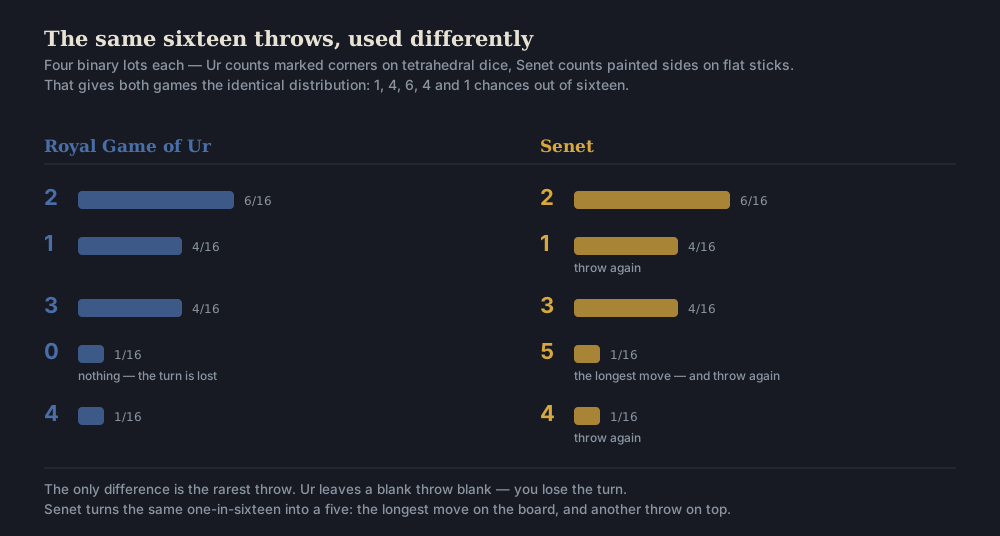
And then they part company on one square of that table.
Ur leaves the blank throw blank. All four dice land unmarked, you score zero, your turn is over. One time in sixteen, nothing happens.
Senet turns the same blank into a five — the longest move available, and it grants another throw on top. The worst physical result becomes the best outcome in the game.
That is not a small difference. It means a Senet player never has a dead throw from the sticks themselves; throws are only ever lost because no piece can use them. And it means the rarest event on the table is something you hope for rather than something you dread.
What happens when pieces meet
| Senet | Royal Game of Ur | |
|---|---|---|
| Landing on a lone enemy | you swap places | it goes back to the start |
| Protection | two of a colour side by side cannot be swapped | rosette squares are safe |
| Blocking | three in a row stop everybody | the safe squares cannot be entered |
| Extra turns | throws of 1, 4 and 5 | landing on a rosette |
| Bearing off | exact throw from 26, 28, 29, 30 | exact throw off the end |
The capture rule is the real character difference. In Ur, hitting an enemy piece undoes their progress — it goes home and starts again. In Senet nothing ever leaves the board: you and the piece you land on simply trade squares. If you are twenty squares ahead and swap with something at square five, you have just lost fifteen squares and given them to your opponent.
Ur punishes. Senet reverses. Ur is more brutal, Senet more treacherous.
Both are playable here, which is the only way to settle an argument like this: Senet and the Royal Game of Ur. The Ur page carries a measurement worth having before you sit down — across 98,319 captures, one single square on the shared row collects a quarter of them.
The one that matters: the rules
Here is where the two games stop being comparable.
Boards from the Royal Cemetery at Ur came out of the ground in the 1920s. Beautiful, mysterious, silent — exactly like the senet boards from Egypt. For sixty years both games were objects without instructions.
Then Irving Finkel at the British Museum read a Babylonian clay tablet dated 177 BC. It is a scribe's account of a game, and the game is this one: squares, throws, what the pieces do, what the rosettes are for. Not a complete modern rulebook — it is 2,400 years younger than the boards — but a genuine ancient description written by somebody who knew how it went.
Egypt produced nothing equivalent. Three thousand years of play, hundreds of boards, paintings, and religious texts that use the game as a metaphor for death itself — and not one line about how far a piece moves. What we play today is a twentieth-century reconstruction by Bell, Kendall and Piccione, and they disagree with each other. The whole story is in the history of Senet.
So when people ask which is the oldest board game in the world, the honest answer splits: Senet has the older board, Ur has the older rules.
Which is the better game?
An unfair question, because you are comparing a game to a reconstruction of a game. But playing both:
Ur is tighter. Twenty squares, a contested middle row, and a capture that sends you home. Games are short and vicious, and the rosettes give you something concrete to fight over.
Senet is longer and stranger. Thirty squares, a mandatory stop at square 26 that turns the endgame into a traffic jam, and the water square that can throw your leading piece fifteen squares backwards on a throw of one. The swap rule means you are never simply ahead — you are ahead of a piece that might become yours to push.
If you want a five-minute knife fight, Ur. If you want the queue in front of the House of Happiness and the possibility of losing it all at the last square, Senet.