
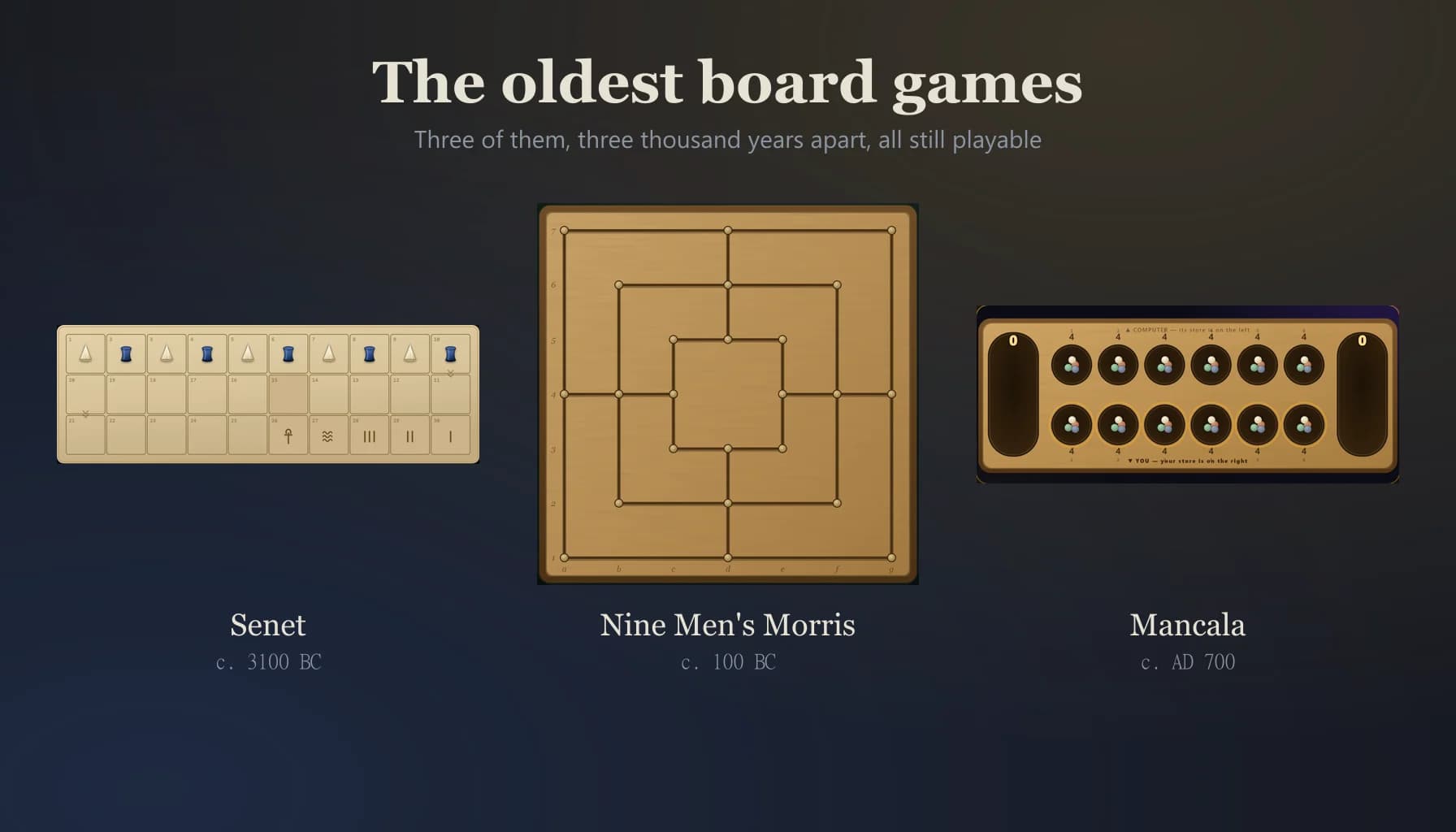
Ask which board game is the oldest and you will usually be told Senet, and that will be the end of it. It is a good answer to one question and the wrong answer to two others, and the difference matters more than the date does.
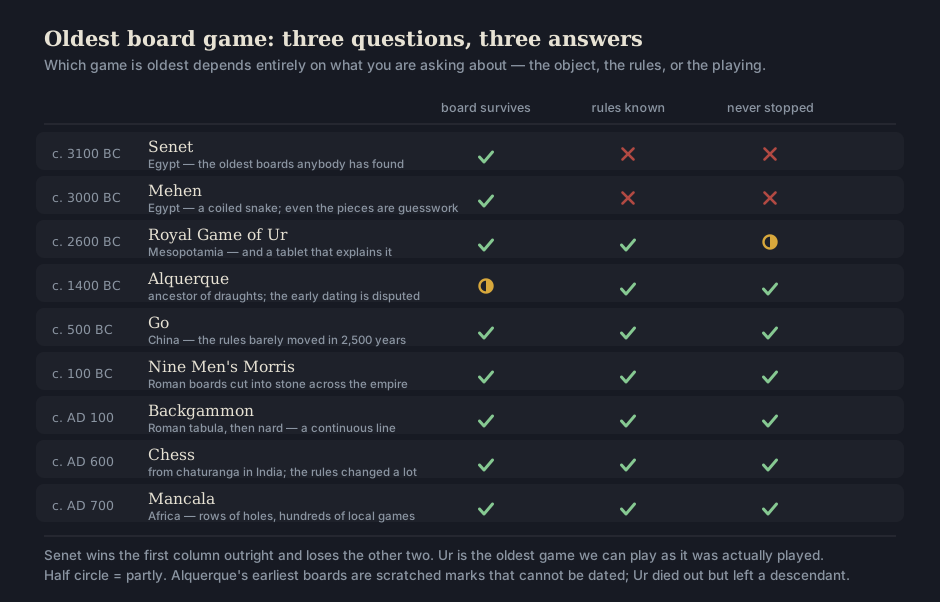
Here is the honest version: it depends entirely on whether you are asking about the object, the rules, or the playing.
- The oldest board ever found is Senet, about 3100 BC — but nobody wrote the rules down, so nobody today knows how it was played.
- The oldest game we can play as it was actually played is the Royal Game of Ur, about 2600 BC, because a clay tablet survived that explains it.
- The oldest game still played today, without a break, is Go, about 500 BC — the only one on this page that never had to be reconstructed.
Those are three different games and three different questions. Most lists give one answer and quietly drop the other two.
What is the oldest board game ever found?
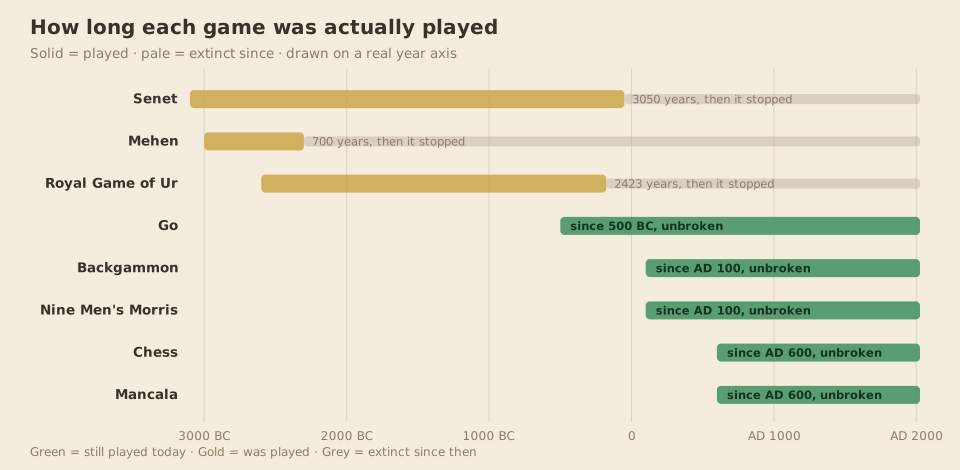
Senet, around 3100 BC. Grids of thirty squares in three rows turn up in Egyptian graves from the First Dynasty, and by around 2650 BC — the tomb of Hesy-Ra at Saqqara — there is no room for doubt about what they are. Egypt then went on playing senet for roughly three thousand years, and buried enough boards for us to be certain of it.
Why nobody can tell you how Senet was played
What Egypt never did was write down how it worked. Not one line, from anybody, across three millennia. Everything played today is a twentieth-century reconstruction, and the people who made those reconstructions disagree with each other about the details. That story is the history of Senet.
So Senet holds the record for the oldest board — and holds it while being a game nobody alive has actually played. That is not a technicality. A set of rules reconstructed in 1980 from tomb paintings is a modern game wearing an ancient board.
Mehen, the other Egyptian contender
One contemporary is worth naming: Mehen, the coiled-snake game, also Egyptian, from around 3000 BC and possibly earlier — close enough to Senet that which came first is not a settled question. It has the same problem twice over: nobody knows the rules, and nobody is entirely sure which of the objects found with the boards are the pieces.
Nor is Egypt the only contender. Boards and pieces turn up in Anatolia, Mesopotamia and eastern Iran inside the same few centuries, over 3,100 km, and their dating ranges overlap too thoroughly to be put in order — when was the first board game invented sets the six earliest finds side by side.
What is the oldest game whose rules we actually know?
The Royal Game of Ur, around 2600 BC. Five hundred years younger than Senet, and in a different league — and the one game on this list you can stop reading about and simply play.
Sir Leonard Woolley excavated boards from the Royal Cemetery at Ur in the 1920s: twenty squares in an unmistakable shape, inlaid with shell and lapis. For sixty years they were beautiful objects with no instructions — the same predicament as Senet.
Then Irving Finkel at the British Museum read a Babylonian clay tablet from 177 BC. It is a scribe's notes on a game, and the game is this one. Squares, throws, what the pieces do. It is not a complete rulebook and it comes from 2,400 years after the boards, but it is a real ancient description of how the game was played.
That makes Ur, not Senet, the oldest game we can play as it was actually played — the two are worth putting side by side, and Senet against the Royal Game of Ur does it board by board. The gap between "we have the board" and "we know the game" is the whole distinction, and almost every list on the internet collapses it.
Finkel also traced a descendant: a game still played in the twentieth century by the Jewish community of Kochi in southern India, whose track matches the Ur board. So the line did not quite break — it thinned out to a thread on the other side of the world.
What is the oldest game still played today?
Go, around 500 BC — if your question is which game has been played continuously, by the same rules, for longest, this is the answer, and it is the question most people actually mean.
Chinese texts refer to it by the fifth century BC. It has not been frozen — the board grew from 17×17 to 19×19, and the old Chinese game began with stones already placed — but nobody ever had to reconstruct it. The game was handed on, generation to generation, without a break, which is exactly what Senet and Ur could not manage.
Go is first of ten games with that unbroken record, and its lead over second place is six hundred years. The full ranking, with the test each game had to pass, is in oldest games still played today — eight of the ten are playable here.
Backgammon has a comparable claim through Roman tabula and Persian nard, though the rules did shift along the way. Chess is younger — sixth or seventh century AD, from chaturanga in India — and its rules changed enormously; the queen only became the strongest piece in the fifteenth century.
Oldest, or oldest still alive? The gap is two thousand years
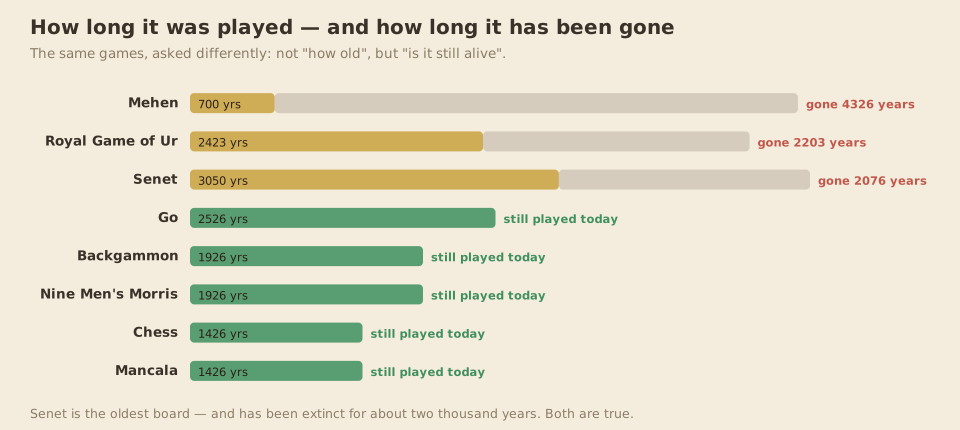
This is the whole argument in one picture. Senet was played for 3,050 years, longer than any other game on this page, and has been gone for roughly 2,000. Go has been going for about 2,500 years without a single break. Ask "which is older" and Senet wins by two and a half millennia; ask "which is the oldest game still played" and Senet is not in the running at all.
Where the claims go wrong
Three traps, and popular lists fall into all of them:
A scratch in an old stone is not an old scratch
You will read that a nine men's morris board cut into the roofing slabs of the temple at Kurna proves the game is 3,400 years old. It proves that somebody scratched a grid into a stone that has been standing since 1400 BC. The stone is dated; the scratches are not. The secure evidence for morris is Roman — still old, still impressive, and about 1,300 years later.
A grid is not necessarily a game
Rows of holes have been read as game boards, counting devices, calendars and tally systems, sometimes all four by different scholars looking at the same object. Mancala suffers badly from this: you will see dates of 5000 BC quoted from hole patterns in Jordan and Egypt, while the earliest finds anybody agrees are game boards are Aksumite, around the sixth or seventh century AD. That is a gap of more than five thousand years between the exciting number and the defensible one.
"Oldest" and "oldest still played" are different claims
Senet is older than Go by more than two thousand years and has been dead for nearly two thousand. Both facts are true; a list that gives only one of them is not answering the question you asked. This is the trap the two charts above exist to close.
The short version
| If you mean | The answer | Date |
|---|---|---|
| the oldest board anybody has found | Senet (and Mehen) | c. 3100 BC |
| the oldest game whose rules we know | Royal Game of Ur | c. 2600 BC |
| the oldest game never interrupted | Go | c. 500 BC |
| the oldest game most people have played | Backgammon or Chess | AD 100 / 600 |
Questions people actually ask
Is Senet the oldest board game in the world?
It is the oldest board anybody has dug up, yes — around 3100 BC. It is not the oldest game anybody can play, because the rules were never written down and every version sold or played today was reconstructed in the twentieth century.
What is the oldest game in the world that is still played?
Go, by about 2,500 years of unbroken play. The board changed size and the old Chinese version started with stones already placed, but the game was handed straight from one generation to the next and never had to be pieced back together from archaeology.
What is the oldest game you can actually play properly?
The Royal Game of Ur, around 2600 BC. A Babylonian tablet from 177 BC describes how it worked, which is why this one can be played roughly as it really was rather than as somebody guessed. You can play it here in the browser.
Is chess or backgammon older?
Backgammon, comfortably. Its line runs back through Persian nard and Roman tabula to around AD 100; chess appears in India as chaturanga in the sixth or seventh century. Both are young next to Go, and both changed their rules substantially along the way.
How old is mancala really?
Far younger than the numbers you will see quoted. Claims of 5000 BC rest on rows of holes that may not be game boards at all. The earliest finds scholars agree on are Aksumite, around the sixth or seventh century AD — which still makes mancala roughly 1,400 years old.
Old games you can play right now
Several of the games in that table are on this site, free and in the browser:
- Senet — the reconstruction, five pieces a side, with the provenance of every rule set out plainly
- Mancala and Oware — the sowing family, still played across Africa and the Caribbean
- Nine Men's Morris — the Roman one, cut into pavements from Britain to Syria
- Alquerque — the ancestor that draughts grew out of
- Hnefatafl — the Viking game, which has exactly the same problem as Senet: boards yes, rules no
- Pachisi — the Indian cross-and-circle race behind Ludo
The one thing they have in common is that somebody, at some point, decided a board and a handful of counters were worth carrying through a few thousand years. Most of them were right.