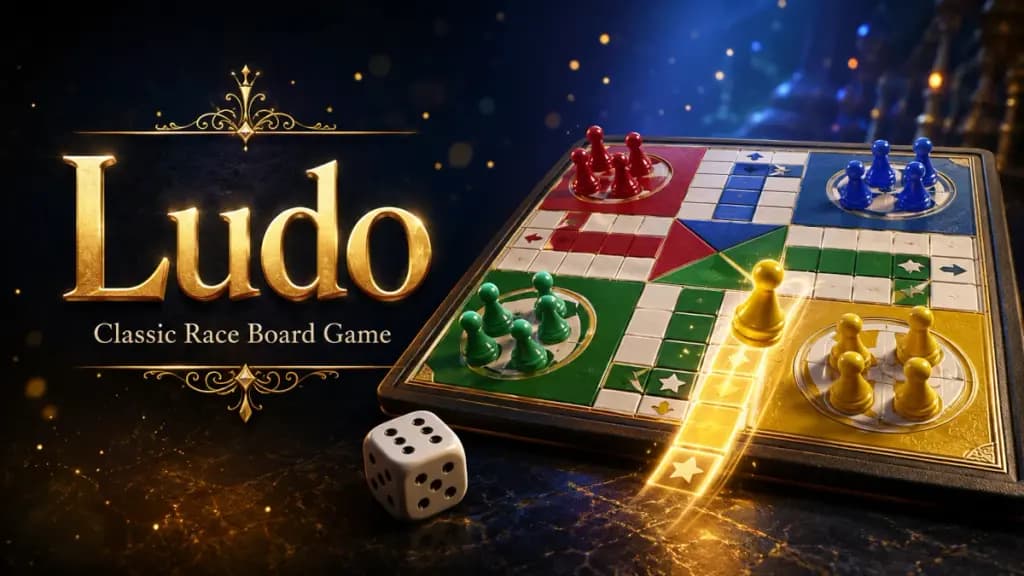
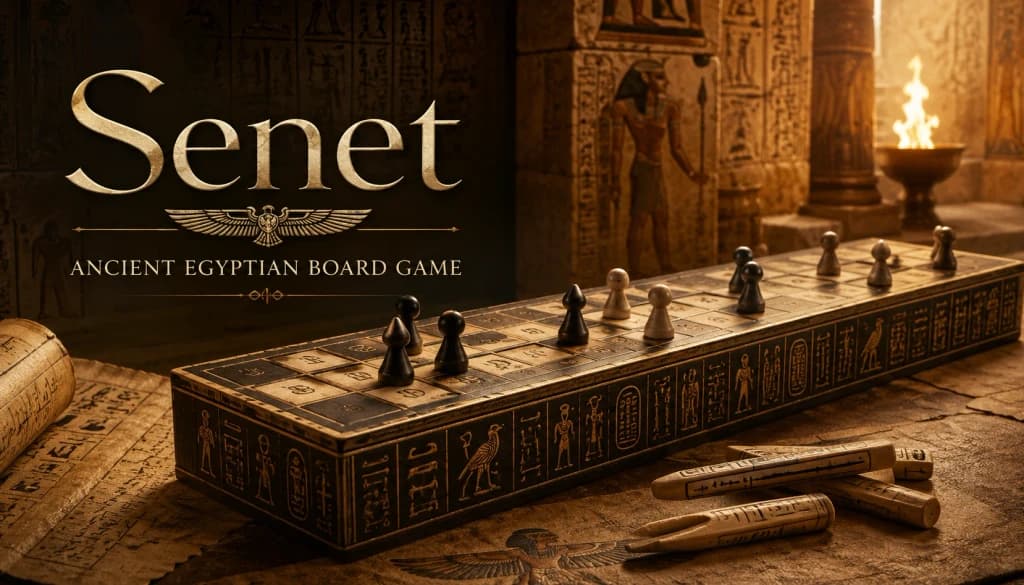
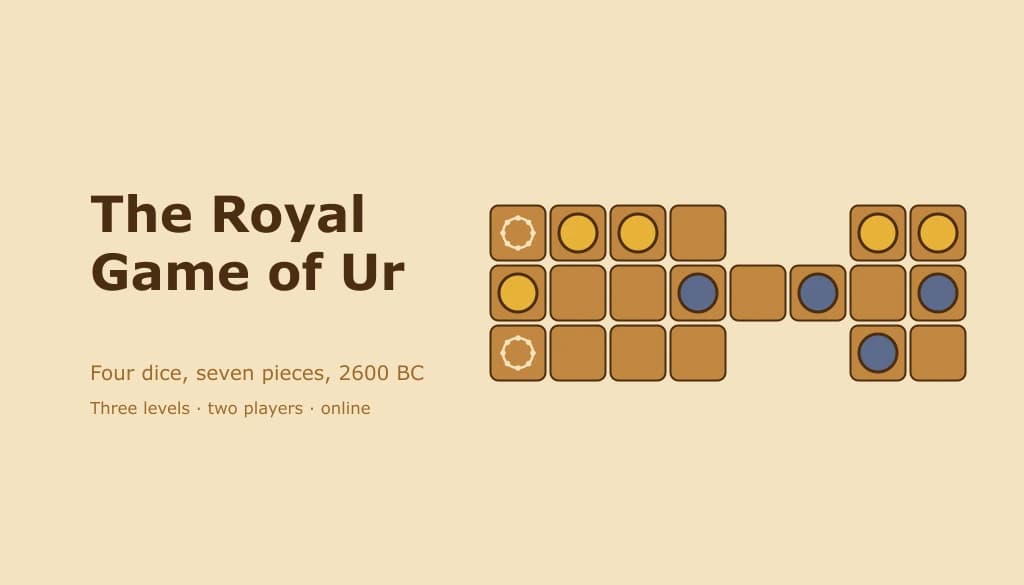
Pachisi is the board game the Mughal court played on courtyards of inlaid stone — the original that Ludo, Parcheesi and Mensch ärgere Dich nicht were all cut down from. You can play it here free, in your browser, with no download and no account — on your own against the computer, or with up to three friends at the same table by sending them a link, with a chat to argue in.
Everything below is on this page: the rules step by step, what the board means, playing with friends, the strategy that matters and where the game comes from.
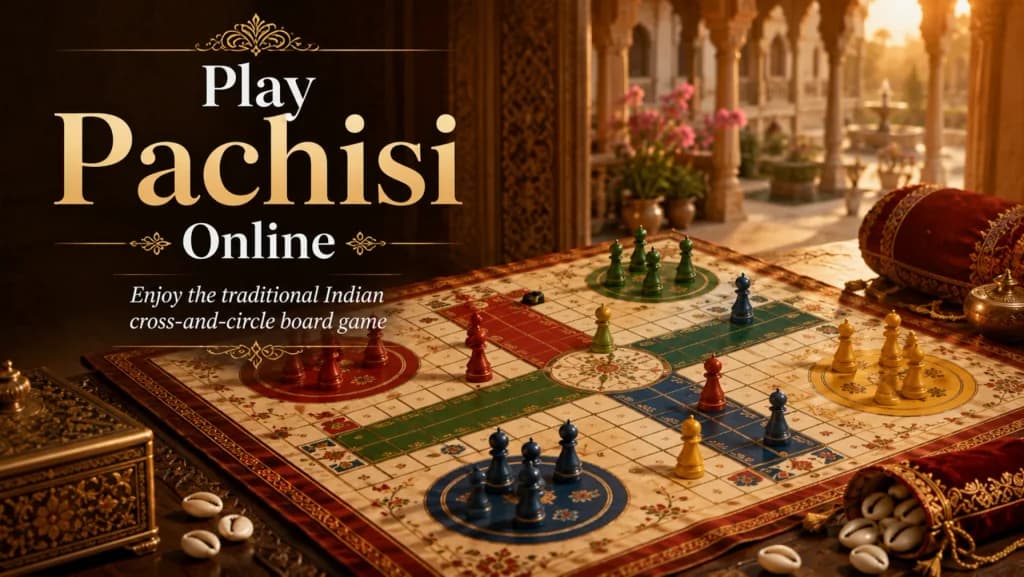
It is not Ludo with better graphics. The rules are genuinely different, and the differences are what make it worth the twenty minutes: pieces start in the middle of the board, movement comes from six cowrie shells rather than a die, four players form two partnerships, and no piece of yours may come home until your side has captured an enemy. A player who only runs away cannot win.
The goal
Race all four of your pieces out of the Charkoni in the middle of the cross, once around the board, and back into the Charkoni. In a four-player game you and the player opposite form a team, and you win together once all eight of your pieces are home.
How to play Pachisi: a turn, step by step
A turn is always the same two beats: throw, then move. Here is the whole thing in order.
1. Toss the six cowries
Press Toss the cowries. Six shells tumble and land either mouth-up (the slotted side with the little teeth) or mouth-down. What counts is how many land mouth-up:
| Mouths up | You move | |
|---|---|---|
| 0 | 25 | a grace — throw again |
| 1 | 10 | a grace — throw again |
| 2 | 2 | |
| 3 | 3 | |
| 4 | 4 | |
| 5 | 5 | |
| 6 | 6 | a grace — throw again |
Three things follow from that table, and they shape the entire game:
- There is no 1. The smallest move is 2. You cannot drift into the centre, you have to count your way in.
- There is no 7, 8 or 9 either. An enemy sitting exactly 7, 8 or 9 steps behind you can never reach you. Those are the safe gaps.
- A 25 is a quarter of the board and arrives once in 64 throws. It is what the game is named after: pachisi is Hindi for twenty-five.
A grace (a 6, a 10 or a 25) does two things at once: it lets a new piece leave the centre, and it earns you another throw immediately.
2. Bring a piece out of the Charkoni
All sixteen pieces begin in the Charkoni, the big square in the middle. Your first piece leaves it on any throw at all. Every piece after that needs a grace. So a game usually opens with one runner alone on the board and the rest waiting for a 6, a 10 or a 25.
3. Move — outward first, then round, then back in
This is the part that surprises everyone who comes from Ludo. A piece travels:
- Outward, down the middle column of your own arm, to the tip;
- then counter-clockwise around the outer columns of the other three arms;
- then back up your own middle column into the Charkoni it started from.
That is 84 steps for every single piece. The middle column of each arm is private — no foreign piece ever sets foot on it.
Pieces that can move are ringed in gold. Hover one (or tap it once on a phone) and a dotted trail shows exactly where it lands. Click again to move it. When only one move is legal the game plays it for you, so a turn only ever stops for a decision that is really yours.
4. Capture — and why you must
Land on a square holding a single enemy piece and it goes all the way back to the Charkoni. You get another throw for it straight away.
But capturing is not just an opportunity, it is a requirement: until your side has captured at least one enemy piece, the Charkoni stays closed to you. You cannot win by running away. Leaving the fight until three of your pieces are queued at your own doorstep is the classic way to lose a game that looked won.
Two places are safe from capture:
- The twelve castle squares, marked with a cross. Nobody can be taken there, and pieces of different colours may share one.
- Behind a blockade: two pieces of the same side on one square. Enemies can neither land on it nor pass it.
5. Come home — exactly
To enter the Charkoni you need the exact throw. Overshooting is not allowed; the piece simply stays where it is. The one concession: a piece standing on the very last square may come home on any throw, because the 1 it would need does not exist.
Win when all of your side's pieces are home — four in a two-handed game, eight across the partnership in a four-handed one.
The full rules with a diagram for every case are in Pachisi: Rules and Strategy.
The board
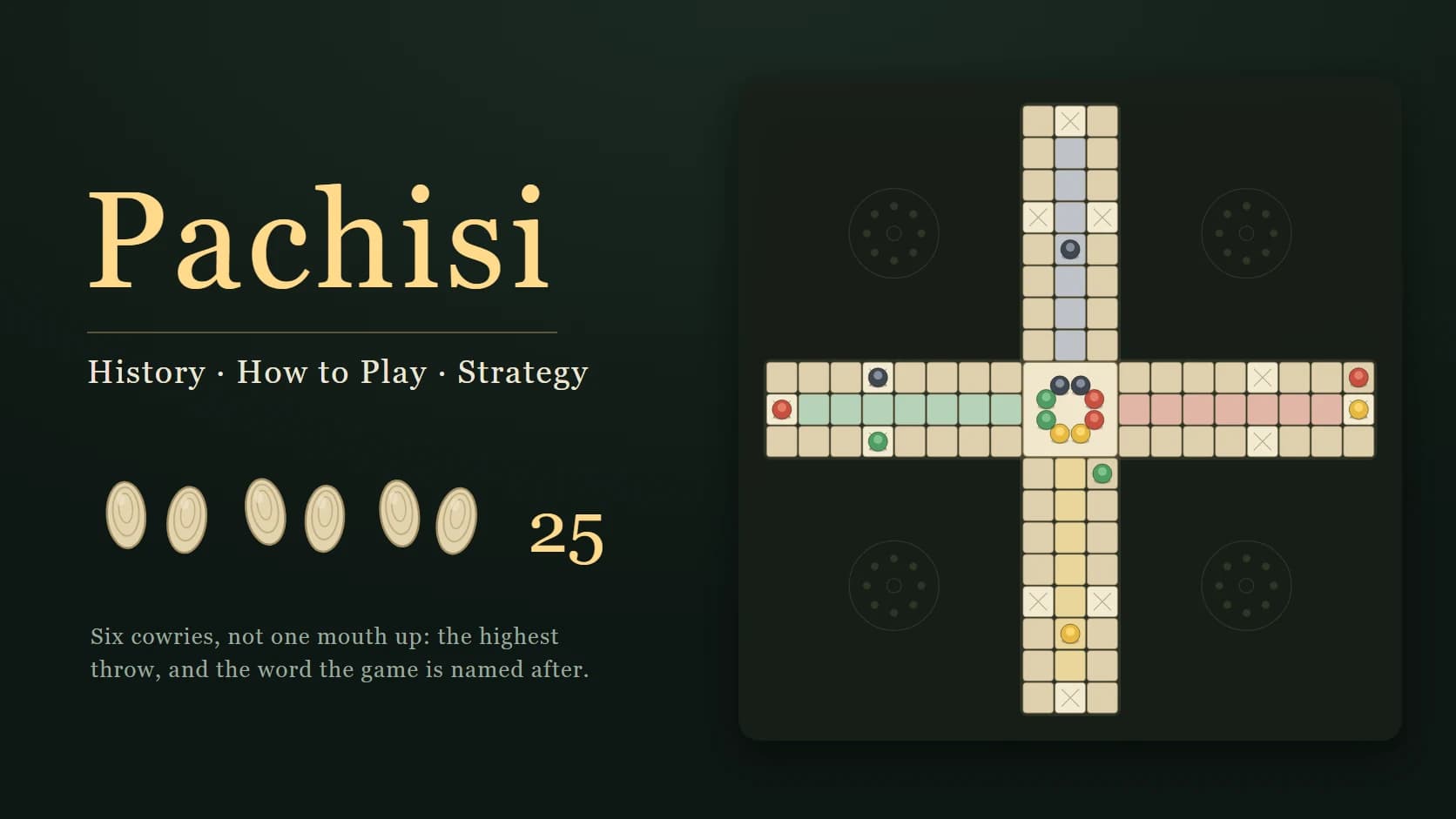
Four arms, each three columns wide and eight squares deep: 96 squares in all, plus the Charkoni in the middle. Twelve squares carry a cross — those are castles, where no piece can be captured and pieces of different colours may share the space. The middle column of each arm is private to the player who sits there; no foreign piece ever sets foot on it.
Every piece walks the same 84 steps: out along its own column, counter- clockwise around the other three arms, then back up its own column into the centre.
What everything on screen means
| What you see | What it means |
|---|---|
| Glowing button | It is your turn — toss the cowries and watch them tumble. |
| Gold pulsing ring | A piece you may move with this throw. Click it. |
| Green dotted trail | Hover a highlighted piece to trace exactly where it lands. |
| Red target ring | That move captures an enemy piece. |
| Squares with a cross | Castle squares — safe ground, nobody can be taken there. |
| New | A fresh game. At a table it means another game here, once this one is finished. |
| ↶ | Take back your last move (Ctrl+Z). Off while you are at a table — the others played their turns too. |
| Rules | The whole rule set in one panel, without leaving the board. |
| 💬 | The table chat. It only appears when you are playing with other people. |
You play Yellow from the bottom arm. The side panel carries the throw, whose turn it is, the running score, a log of what just happened, and the settings for opponents, game length, difficulty, sound and animation speed.
On a phone or tablet, tap a piece once to see where it would go, and tap it again to move it. Nothing happens until that second tap, so a mistimed finger costs you nothing. The fullscreen button under the board gives the game the whole screen — on iPhones and iPads, where browsers do not offer real fullscreen for an element, the game lays itself over the page instead, which comes to the same thing.
Play Pachisi online with friends
Press Open a table and the game creates one for you: a six-letter code and a link. Send that link to up to three friends — any messenger, any mail, it is an ordinary web address — and each of them takes a seat the moment they open it. No account, no sign-up, nothing to install on either end, on any device.
There is no waiting room. The table starts playing immediately, and every seat nobody has claimed yet is played by the computer. A friend who arrives ten minutes late simply takes over a seat mid-game. That way three people are never sitting around waiting for a fourth.
Four seats form two partnerships — Yellow with Black against Red with Green — so a table of two humans is already a real game, and a table of four is the game as the Mughal court played it. A fifth visitor with the link watches.
Everything a table can do:
| Names | Type yours in at the table and everyone sees who is who. It is remembered for next time; there is still no account. |
| Chat | A chat button sits on the board. Say something and it reaches everyone at the table. Watchers can read along but not write, and nothing is stored — the conversation dies with the table. |
| Another game | When a game ends, one tap on Another game — same table starts a fresh one for everybody, with the same seats and the same people. |
| Somebody drops out | A seat is held for three minutes. The computer covers it meanwhile, the table says who it is waiting for and counts the time down, and the seat is handed straight back on return. |
| Reload, sleep, tunnel | Your seat is remembered in your browser. Reload the page, lock the phone, lose the signal — you come back to the same chair. |
| Updates | Tables survive a deployment of the site, so a game in progress is not lost when we ship something. |
A table that has seen no move for three hours is forgotten, so an invitation sent last night will not still work tomorrow. If you open a link to a table that has gone, the game says so and offers to open a fresh one.
Playing on your own
| Setting | What you get |
|---|---|
| Partners — 4 seats | The full four-handed game. You play Yellow; the computer plays your partner Black and both opponents. |
| Head to head — 2 seats | Two seats, no partnerships. The shortest game. |
| Full game — 4 pieces each | The traditional length, around twenty minutes. |
| Short game — 2 pieces each | The same rules at half the distance, for about ten minutes. |
| Difficulty | Three levels. The hardest wins about two games in three against the middle setting, so there is room to grow into it. |
Your game is saved as you play: close the tab mid-throw, come back tomorrow and the position is still there. The last move can always be taken back with the ↶ button or Ctrl+Z — useful while you are still learning which throws exist.
Strategy
- Spend a 25 wisely. A grace can bring a fresh piece out or move a runner a quarter of the way round. Early on the new piece is usually worth more; late on, the distance is.
- Count the castles. They sit 4, 9 and 4 steps apart in a repeating pattern. From one castle a throw of 4 reaches the next — learn that rhythm and you can hop from safety to safety.
- Watch the gap behind you. An enemy 2, 3, 4, 5, 6, 10 or 25 steps back can take you. A gap of 7, 8 or 9 is perfectly safe, because no throw makes it.
- Capture early, not late. You cannot come home until you have taken somebody. Leaving that until three pieces are queued at your own doorstep is how comfortable-looking games are lost.
- Two pieces on one square is a wall. Nothing enemy passes it. Park a blockade in front of a rival about to reach their home column and it costs them far more than a capture would.
- Mind the last square. A piece one step from home needs a 1, which cannot be thrown — the game lets it in on anything, but a piece sitting there is a wasted turn away from finishing. Aim to land exactly.
Pachisi vs Ludo: what actually differs
If you know Ludo, this table is the whole learning curve.
| Ludo | Pachisi | |
|---|---|---|
| Board | Square, four corner yards | Cross of four arms |
| Pieces start | In the yards, off the track | In the centre, on the board |
| First move | Onto the circuit | Outward, then round, then back in |
| Randomiser | One die, 1–6 | Six cowrie shells: 2, 3, 4, 5, 6, 10, 25 |
| Players | Everyone for themselves | Two partnerships of two |
| Safe squares | A few stars | Twelve castles |
| Blocking | Varies | Two pieces of a side seal a square |
| Coming home | Exact throw | Exact throw and you must have captured |
Ludo is on this site too, and it is a fine game — quicker, lighter, easier to teach. Pachisi is the one with decisions in it. The long comparison, with both boards side by side and the numbers behind the shells, is in Pachisi vs Ludo.
Pachisi, Chaupar, Parcheesi: which is which
The names travel badly, so here is the short guide.
| Name | What it is |
|---|---|
| Pachisi (also Pachis, Twenty-Five) | The Indian original played here: cross-shaped cloth, six cowrie shells, partnerships. |
| Chaupar (also Chausar, Chaupad) | A close Indian relative on the same cross, played with three long dice instead of shells. Older sources often use the two names loosely. |
| Parcheesi | The American simplification, trademarked in 1874. Dice, no partnerships, no capture requirement. |
| Parchís | The Spanish descendant of Parcheesi, still widely played. |
| Ludo | The English simplification, patented in 1896 — the one most of the world grew up with. |
| Mensch ärgere Dich nicht | The German version, Munich 1914, cut down from the same root. |
If you searched for any of those and landed here, the game above is the one they all came from.
Play it away from the screen
Pachisi boards are not in the shops, which is the usual reason people end up drawing one on the back of something. The printable Pachisi board puts the full cross on one sheet — all twelve castle squares in their right places, the Charkoni in the middle — with sixteen pieces on a second and the rules on a third. Six cowrie shells are traditional; six coins counted heads-up behave exactly the same.
Where the game comes from
The oldest hard evidence for Pachisi is architectural: the giant Pachisi courts at Fatehpur Sikri and Agra, laid in stone in the sixteenth century under Emperor Akbar, big enough to walk across. The famous account of the emperor playing with living pieces on that pavement comes from a French traveller writing in 1876 — three hundred years after the fact — and is best treated as tradition rather than record.
Everything older is thinner than it is usually made to sound. The gambling scene in the Mahabharata is regularly cited as the first appearance of Pachisi; Irving Finkel, who knows the material as well as anyone, judges that the descriptions there do not match the game.
The board is a piece of embroidered cloth and the "dice" are sea shells — equipment that packs into a pocket. That is part of why the game travelled. British officers took it home, where it was simplified and marketed as Ludo in 1896; a parallel simplification became Parcheesi in the United States in 1874, and Mensch ärgere Dich nicht followed in Munich in 1914. All of them dropped the cowries, the partnerships and the rule that you must capture before you can win.
The long version, with the evidence attached, is in Pachisi: A History of India's Royal Game.
Play Pachisi online, free
No download, no account, no plugin, no advertising interruption. The game runs in any modern browser on desktop, tablet and phone, remembers your settings and your unfinished game between visits, and starts a new one in a single click.
If you have never played a cross-and-circle game before, take the yellow seat against the computer for a few throws — the shape of it becomes obvious faster than any rulebook can explain it. Once the no-1 and the safe gaps have clicked, open a table and send the link to somebody. That is the game as it was meant to be played: four people, two partnerships, and an argument about who should have blocked the arm.