
Print & Play
Printable Pachisi Board
The game Ludo was made from — four arms, twelve castles and the Charkoni in the middle. Board, pieces and rules on three sheets. Bring six shells or six coins.
Style
How the game was actually played: a cross sewn onto cloth, rolled up when the evening ends.
Paper
Sheets
For a PDF, pick Save as PDF as the printer in the print dialog.
Pachisi · 4 players in 2 partnerships · six cowrie shells · playnook.io
Pawns
Cut along the dashed lines — four pieces a colour, plus a spare each. Yellow and black play as one side, red and green as the other.
Pachisi · playnook.io
Pachisi — quick rules
Everyone starts in the Charkoni and travels out along their own arm.
- Set up. Four players in two partnerships, sitting opposite each other. Each side takes four pieces and starts them in the Charkoni, the square in the middle.
- Throwing. Toss six cowrie shells and count how many land mouth up: that is your move. Six shells give 6, 5, 4, 3, 2 — and then 10 for one shell and 25 for none. There is no 1, which is why the endgame is so awkward.
- Moving. Travel outward down the middle column of your own arm, anticlockwise around the whole cross, then back up your own middle column into the Charkoni. Your first piece leaves on any throw; each later one needs a 6, 10 or 25.
- Capturing. Land on a lone enemy piece and it goes all the way back to the Charkoni — the whole lap again. Your partner's pieces are friendly and share your squares.
- Castles. The twelve squares marked with a cross are safe ground: nobody can be taken there. Twenty-five is exactly the distance from the Charkoni to the castle on the next arm, which is not a coincidence.
- Winning. You need an exact throw to come home, and no piece of yours may finish until your side has captured at least one enemy. The first partnership to bring all eight pieces home wins.
Play online: playnook.io/games/pachisi
What you get
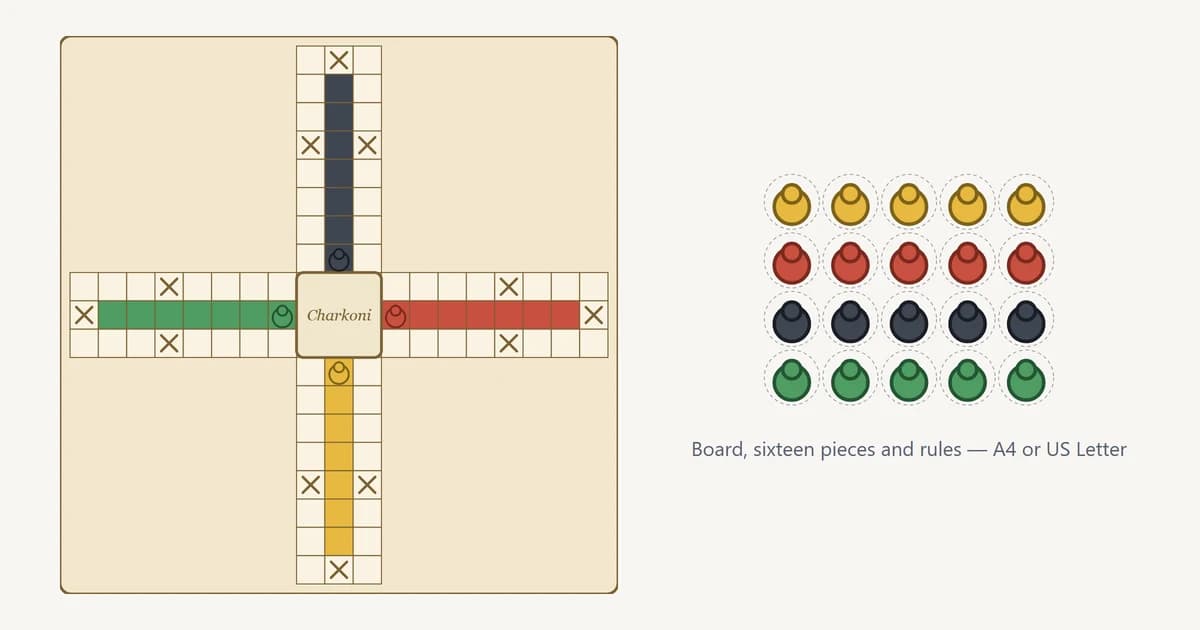
The boardis the full cross: four arms of twenty-four squares, the twelve castle squares marked with their crosses, each side’s private middle column in its own colour, and the Charkoni in the centre. The piece sheet prints four a colour plus a spare. The rules sheet covers throwing, capturing and the two rules that make Pachisi a different game from Ludo.
The board is a piece of mathematics
Pachisi means twenty-five, and twenty-five is the best throw: six cowrie shells landing with none of them mouth up. It is also, exactly, the distance from the Charkoni to the castle square on the next arm. That is not a coincidence — the board was laid out around its own luckiest number, so the reward for the rarest throw is a piece landing safely on the far side of the board.
The other number worth knowing is the one that is missing. Six shells can produce 2, 3, 4, 5, 6, 10 and 25 — but never a 1. A piece one square from home is in real trouble, and the whole endgame is shaped by that gap.
What makes it different from Ludo
Ludo took this board and made it simpler for a Victorian toy market: one die, four individual players, no partnerships. Pachisi keeps three things Ludo dropped, and each one changes the game. Players sit in two partnerships, so the piece you would rather not move might be your partner’s problem to solve. Pieces travel outward first along their own arm before going round. And nobody may come home until their side has captured an enemy, which means you cannot win by quietly running away — a rule that turns the whole thing from a race into a fight.
Three styles
Embroidered cloth is how the game was actually played for centuries: a cross sewn onto fabric, rolled up when the evening ended. Parchment keeps it light on the toner, and ink saver prints outlines only with each side marked by its initial, so a class set costs almost nothing.
For teachers and classrooms
Pachisi is a good history lesson that happens to be a good game. It is played across the Indian subcontinent, it appears in the Mahabharata tradition as the ancestor of the dice game that costs a kingdom, and the version most European children know arrived as a British simplification in 1896. Printing both boards and playing them back to back makes the point better than any worksheet.
The boards you print are yours to use, in class or commercially.
Frequently asked questions
What is Pachisi? The Indian cross-and-circle race game that Ludo was made from. Four players in two partnerships move sixteen pieces around a cross-shaped board, and the whole thing is at least six hundred years old. Ludo is the simplified Victorian version with dice.
What do I need besides the printout? Six cowrie shells and sixteen pieces. The second sheet prints the pieces. For the shells, six coins work: count heads as mouth-up. You can also use six small shells from a craft shop, which is closer to the real thing and more fun to throw.
How does the throwing work? Toss six cowries and count how many land mouth up: that number is your move, from 2 to 6. One mouth-up is worth 10 and none at all is worth 25. There is no throw of 1, and that single gap is what makes the endgame difficult.
What are the squares marked with a cross? Castles — safe squares where a piece cannot be captured. There are twelve, and the distance from the Charkoni to the castle on the next arm is exactly 25, the value of the biggest throw. The board is built around that number.
Can two or three people play? Two can play the partnership game with two colours each, which works well. Three is awkward because Pachisi is built around two sides of two. With three players, Ludo is the better printout.
How do I get it as a PDF? Press Print, then choose “Save as PDF” as the printer in the print dialog. Every browser has that option built in.
Rather play right now? Play Pachisi online — against the computer or with up to three friends at a shared table. The rules and strategy guide goes deeper, Pachisi vs Ludo lays out the differences, and if you want the simpler game, there is a printable Ludo board too.