
Print & Play
Printable Ludo Board
The whole game on three sheets: the board, sixteen pawns to cut out and the rules. All you have to find is a die.
Style
Red, green, yellow and blue — the board everybody already knows.
Paper
Sheets
For a PDF, pick Save as PDF as the printer in the print dialog.
Ludo · 2–4 players · one die · playnook.io
Pawns
Cut along the dashed lines — four pawns a colour, plus a spare each. Buttons, coins or Lego bricks work too; you need four of each in four colours.
Ludo · playnook.io
Ludo — quick rules
The start: four pawns per colour waiting in their own yard.
- Set up. Each player takes a colour and puts all four pawns in the matching yard. Youngest rolls first, then play passes to the left.
- Getting out. You need a six to move a pawn from the yard onto your coloured start square. A six also earns you another roll — but three sixes in a row cancel the whole turn.
- Moving. Move one pawn clockwise by the number rolled. If no legal move exists, the turn simply passes.
- Capturing. Land exactly on a square holding a single enemy pawn and it goes back to its yard. You cannot be captured on a starred square or on your own start.
- The home run. After a full lap your pawn turns into the five squares of its own colour. Nobody else may enter them, so a pawn in there is safe for good.
- Winning. The centre needs an exact roll — overshoot and the pawn stays put. First player with all four pawns in the centre wins.
Play online: playnook.io/games/ludo
What you get
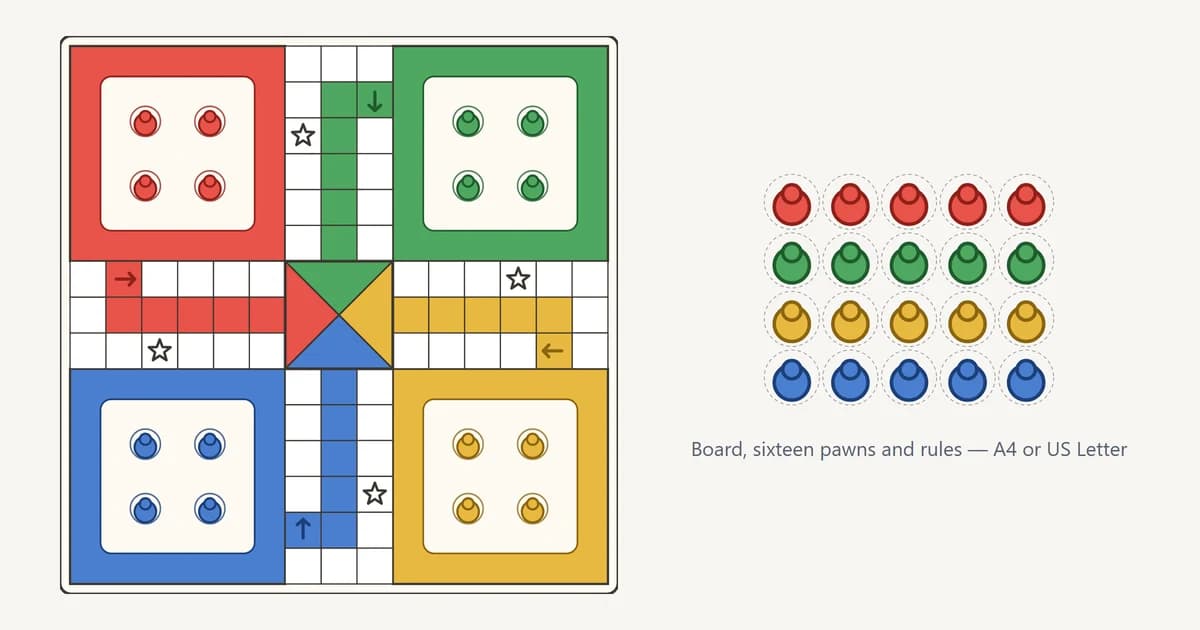
The board is a full-page cross: fifty-two shared squares around the outside, four yards, four coloured home runs and the centre. Start squares carry an arrow so nobody argues about which way round the board goes, and the safe squares are starred. The pawn sheet prints four a colour plus a spare. The rules sheet has the whole game on one side.
Why print a Ludo board
Ludo is the game most likely to be missing exactly one thing. The box is in the loft, the pawns went into the vacuum cleaner years ago, or there are five children and one board. Printing solves all three, and a paper board has one advantage over the cardboard one: you can make four of them and run a tournament.
It is also the right game for a very wide age range. A five-year-old can play it properly — the rules are roll, move, done — while the decisions underneath (which pawn to move, when to leave a safe square, whether to bring a fourth pawn out at all) are real enough that adults do not have to pretend.
Three styles
Classic colours is the board everyone recognises — red, green, yellow and blue. Muted prints the same layout in softer inks, which is easier on a colour cartridge and still perfectly clear. Ink saver drops the fills entirely: outlines only, with each side marked by its initial, so thirty boards for a classroom cost almost nothing in toner.
House rules worth agreeing first
Ludo has more household variants than almost any other board game, and every argument starts the same way — somebody assumes their version is the version. Settle these three before the first roll:
Getting out. A six only, or a one as well? Blocking. May two of your own pawns sit on the same square and bar the way, or not? Finishing. Exact roll into the centre, or is overshooting allowed? The rules sheet prints one consistent set — six to start, exact roll to finish — so you have a default to argue against.
For teachers and classrooms
A Ludo board is a surprisingly good first lesson in probability: one die, six outcomes, and a game that visibly rewards knowing that a six comes up about once every six rolls rather than when you need it. It also teaches taking turns, counting on, and losing gracefully — which is most of what a games lesson is for.
The boards you print are yours to use, in class or commercially.
Frequently asked questions
How many squares does a Ludo board have? Fifty-two on the main track that everyone shares, plus five private squares in each player's home run and the centre. Each colour enters the track at its own start square, so all four take exactly the same length of lap.
What do I need besides the printout? One die and sixteen pawns. The second sheet prints the pawns, four a colour plus a spare, but coins, buttons, bottle caps or Lego bricks all work — you just need four matching pieces per player.
Do you need a six to start? In the common rules, yes: a six moves one pawn out of the yard onto your start square, and it also earns another roll. Some families let you start on a one as well, which speeds up the beginning considerably. Agree before you roll.
What are the squares with stars? Safe squares. A pawn standing on one cannot be captured, and the four coloured start squares are safe too. They are spaced eight steps apart around the track, which gives a chased pawn something to run for.
Can two or three people play? Yes. With two, take opposite corners so the laps are symmetrical. With three, play as normal and leave one colour in its yard. The board is the same either way.
How do I get it as a PDF? Press Print, then choose “Save as PDF” as the printer in the print dialog. Every browser has that option built in.
Rather play right now? Play Ludo online against the computer, or read the rules and strategy guide. Ludo grew out of the far older Indian game of Pachisi, and the difference between the twois worth ten minutes of anyone’s time.