
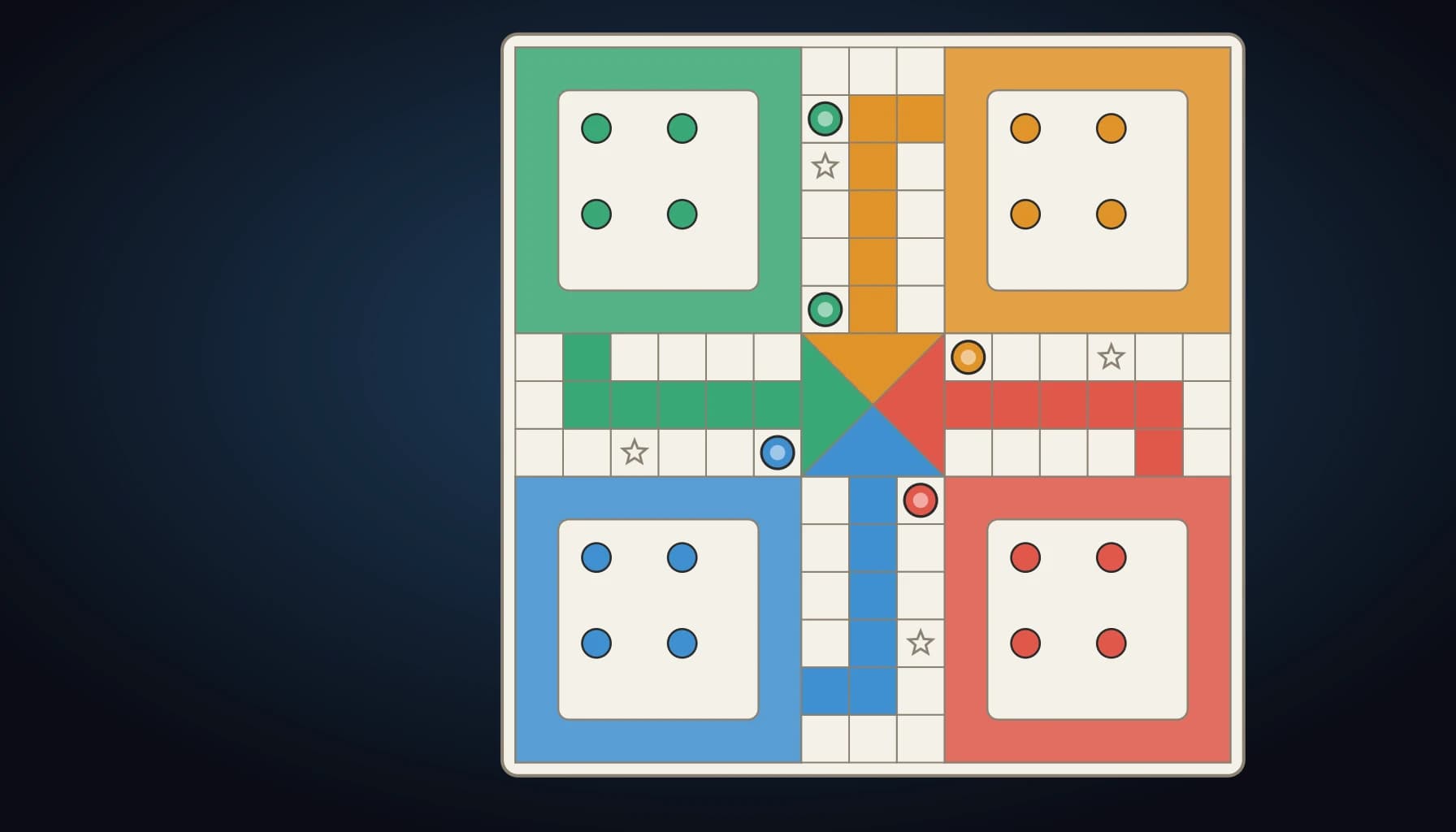
Ludo is usually described as a game of pure luck, and that is half right. The dice decide what you may do. What you actually do with a five when you have four tokens on the board is a choice, and it is the same choice, over and over, for the whole game.
There is one piece of arithmetic that turns those choices from guesswork into judgement. It concerns exactly six squares.
Where Ludo comes from, briefly
Ludo is the Victorian simplification of the Indian game Pachisi, patented in England in 1896 and named from the Latin ludo, "I play". The cowrie shells became a die, the cross-shaped cloth became a board, and the four-player team game became every-player-for-themselves.
That ancestry is worth a read of its own — we have written about what Ludo kept and what it threw away and about Pachisi's own rules. This guide stays with Ludo as it is played today.
The board
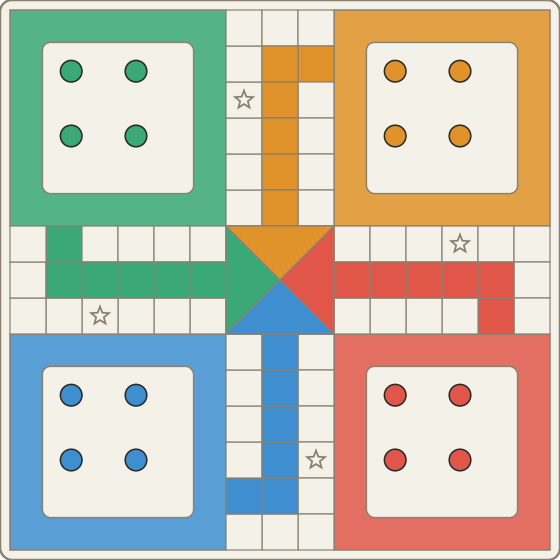
Four tokens per player wait in a yard. The track between the yards is a single shared loop of 52 squares, run clockwise. Each player joins it at their own coloured start square, laps the whole board, and then peels off into their private home column — the coloured run leading to the middle. Only your own tokens may enter your column, which is why the last stretch is safe and the first fifty squares are not.
The starred squares are safe: a token standing on one cannot be captured. Together with the four start squares they are the only permanent shelter on the board.
The rules
- Roll a 6 to bring a token out of the yard onto your start square.
- A 6 earns another roll. Three sixes in a row and most tables forfeit the whole turn — otherwise a lucky streak never ends.
- Move one token the number rolled. You may not split a roll between two tokens.
- Land exactly on an opponent and they go home — all the way back to their yard, to start again on a 6. You cannot capture on a safe square.
- Your own tokens may share a square. In many versions two of them form a block that nobody may pass.
- Finishing needs an exact roll. Overshoot the last cell of your home column and the move is simply not allowed.
- All four tokens home wins.
The rules people argue about are always the same three: whether a capture earns a bonus roll, whether blocks exist, and whether you must move if you can. Settle them before the first roll.
The six squares that decide everything
Here is the arithmetic. A token can only be captured by an enemy landing on it exactly. An enemy token six squares behind you needs a 6; one square behind needs a 1. An enemy seven squares behind cannot reach you at all this turn.
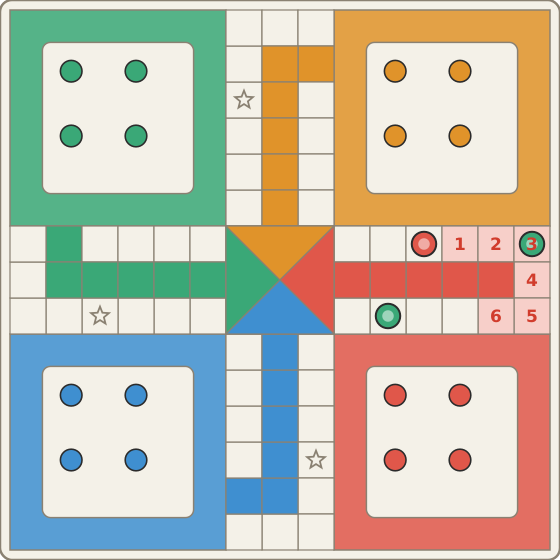
So the danger zone of any enemy token is exactly the six squares in front of it, each carrying a 1-in-6 chance per turn. Everywhere else on the board is safe from that token — including, and this surprises people, the square directly behind it. Nothing in Ludo moves backwards. Sitting on an enemy's tail is the safest unstarred place on the board, and you are the one doing the threatening.
Two enemy tokens covering you is not twice as bad, it is worse in a different way: the chance of surviving both is 5/6 × 5/6, about 69%. Three, and you are down to a coin flip.
This single picture is most of Ludo strategy. Before you commit a move, look at where the token lands and count backwards six squares. If an enemy sits in that stretch, you are offering them a 1-in-6 shot at undoing everything that token has done.
What the dice do to your opening
A 6 comes up once in six rolls, and you need one for every token you bring out. The consequences are worth stating plainly:
- After four turns, the chance you have rolled no six at all is (5/6)⁴ ≈ 48%. Roughly half of all games begin with a player sitting still for four turns. This is normal and not bad luck.
- Expect about six rolls to see your first six, and you need four of them over the game.
- Which is why the standard advice is to bring a token out whenever you can. A token in the yard does nothing at all, and the sixes to release it are the scarcest resource you have.
The same arithmetic bites at the other end. A token two squares short of home finishes only on an exact 2 — one roll in six, so about six turns of waiting. Plan the last few moves so your tokens arrive on numbers you can actually roll, rather than parking three of them one square short.
How to play it well
Spread out. Four tokens in a clump share one danger zone and block each other's useful moves. Four tokens spread around the lap mean nearly every roll has a good home.
Value a capture by how far it sends them. Knocking out a token that has travelled three squares costs your opponent three squares. Knocking one out at the mouth of their home column costs them the whole lap. The same capture is worth fifteen times as much depending on where it happens — so chase the runners, not the beginners.
Sit behind, not in front. If you have a choice of where to end a move, ending just behind an enemy token puts them in your zone and you in nobody's.
Do not race everything home. A token in the home column is safe and also useless — it can never capture anything again. Keeping one piece out on the track while the others finish is what stops your opponent from moving freely.
Take the safe squares when the board is busy. A starred square is worth a few squares of progress in the middle game, when three opponents are circling.
The same game under four names
Ludo travelled well and picked up rules everywhere it went:
- Mensch ärgere Dich nicht (Germany, 1907) — no safe squares at all, and you must capture if you can. Considerably more brutal, and the name translates as "don't get annoyed", which tells you everything.
- Parcheesi (United States) — two dice, blockades, and bonuses for capturing and for getting a token home. The closest of the modern versions to Pachisi.
- Uckers (Royal Navy) — blobs, huffs and a rule set defended with religious intensity by people who have played nothing else for thirty years.
- Ludo King and the app versions — mostly standard Ludo with a bonus roll for a capture and for reaching home.
None of them changes the six-square arithmetic. That part is the game.
Common questions
Do I have to move if I can? In most versions yes, and it matters — being forced to step into a danger zone is a real way to lose a token. Some house rules allow passing; agree beforehand.
Can I capture with a token that has just come out? Yes. Your start square is safe for you, but the moment you leave it you are playing like everyone else.
What happens if I roll a 6 with all four tokens already out? You move six squares with any token and roll again. The 6 is never wasted.
Can two of my tokens sit on one square? In most versions yes, and in many that stack blocks the square for everyone else. It is a strong tool where it is allowed — and the first rule people forget to agree on.
Is Ludo pure luck? The dice are, the decisions are not. Between two players who both understand the danger zone, luck decides individual games and judgement decides the series.
Ready to try it? Play Ludo against the computer — one to three opponents, safe squares, captures and the exact-roll finish. For where the game came from, read Pachisi versus Ludo, or play Pachisi itself and see what four hundred years of simplification removed.