
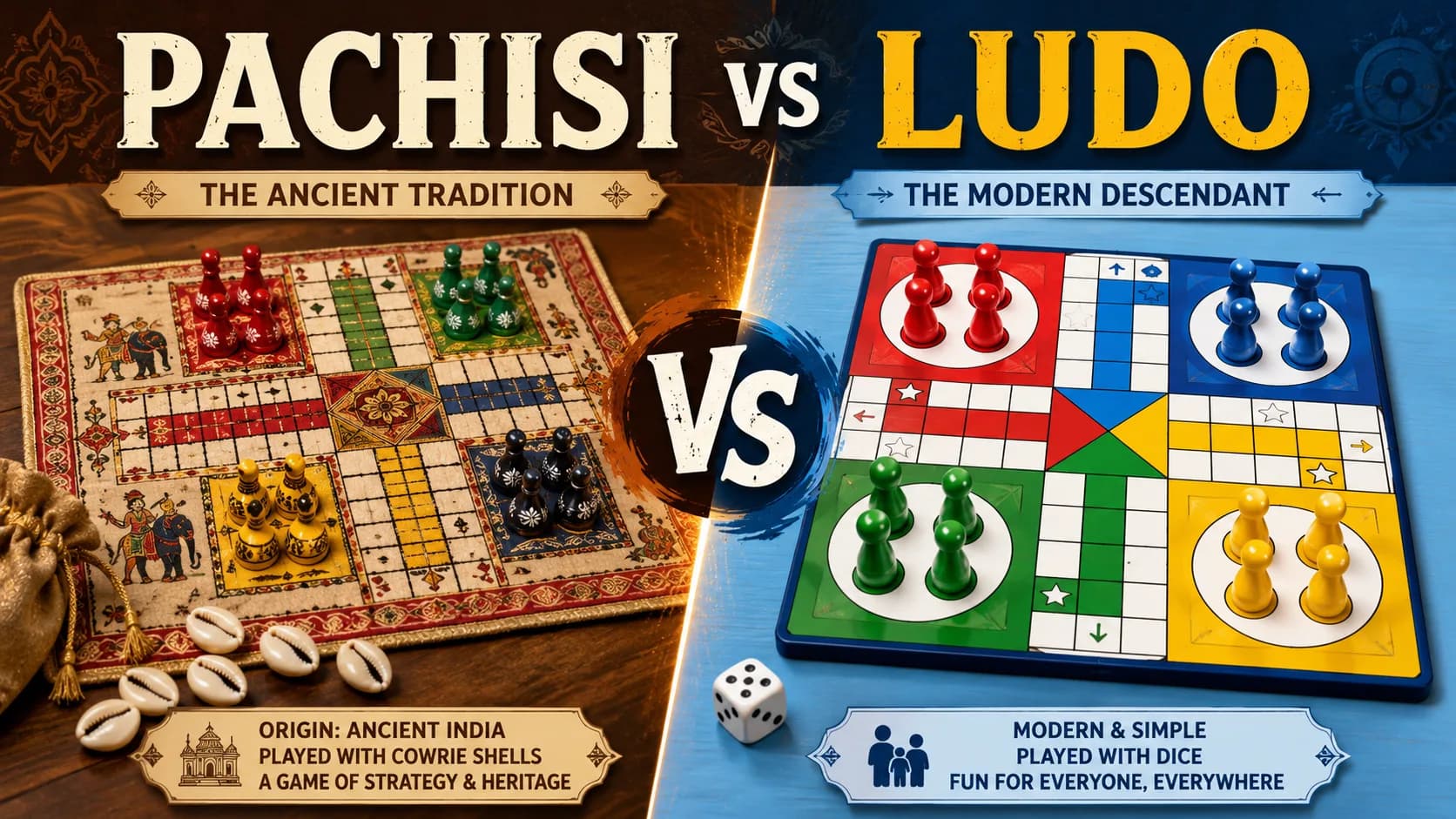
Ask what the difference is between Pachisi and Ludo and you usually get an answer about the board: one is a cross, the other is a square. That is the least of it. Ludo was patented in England in 1896 as a simplified Pachisi for a Victorian family market, and the simplification went deep. Four things were taken out, and each of them was doing work.
This is the comparison, with the reasons — not just what differs, but what the difference does to the game.
The short version
| Ludo | Pachisi | |
|---|---|---|
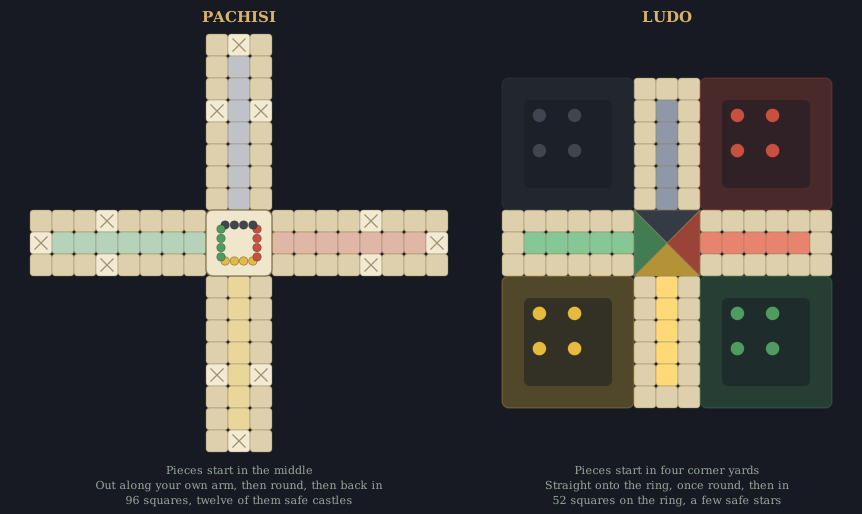
| Board | Square with four corner yards | Cross of four arms, 96 squares |
| Pieces start | In the yards, off the track | In the centre, on the board |
| First move | Onto the ring | Outward along your own arm, then round, then back |
| Randomiser | One die: 1–6 | Six cowrie shells: 2, 3, 4, 5, 6, 10, 25 |
| Getting out | Throw a 6 | Any throw for the first piece, a grace for the rest |
| Players | Everyone for themselves | Two partnerships of two |
| Safe squares | A few stars | Twelve castles |
| Blocking | Varies by house rule | Two pieces of a side seal a square |
| Coming home | Exact throw | Exact throw and you must have captured |
Everything below is one of those rows, explained.
1. You start in the middle, not in a corner
In Ludo your pieces sit in a yard beside the board. They are not in play, they cannot be taken, and nothing happens to them until you throw a six. The yard is a waiting room.
In Pachisi all sixteen pieces stand together in the Charkoni, the big square in the centre — on the board, in the middle of everyone's route. From there each piece travels outward down the middle column of its own arm, turns counter-clockwise around the outer columns of the cross, and finally comes back up its own middle column into the Charkoni it left. That is 84 steps for every single piece.
The consequence is not decorative. Because everybody starts and finishes in the same square, the middle of the board is the busiest place on it, and your own doorstep is a place your enemies walk past. In Ludo the equivalent space is empty.
2. Cowrie shells are not a die
This is the difference people underestimate most, so here it is in numbers.
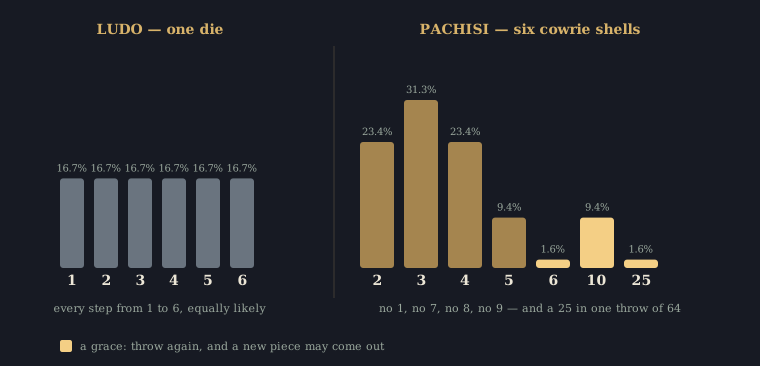
Six shells are tossed and you count how many land mouth-up. Two through five count as their face value. Six shells up is worth 6, one shell up is worth 10, and none up is worth 25. Those last three are graces: they earn another throw straight away and let a new piece into play.
Three things follow.
There is no 1. The smallest move in the game is 2. That single absence rewrites the endgame: a piece one step from home cannot get there by throwing a 1, because no such throw exists. (The rule that saves it: from the very last square, any throw will do.)
There is no 7, 8 or 9 either. Which means an enemy piece sitting exactly 7, 8 or 9 steps behind you cannot reach you — ever. In Ludo every gap from 1 to 6 is dangerous and everything beyond 6 is safe. In Pachisi safety comes in patches, and knowing where they are is most of the tactical game.
A 25 is a quarter of the board in one throw. It arrives once in 64 throws, and it is exactly the distance from the Charkoni to the castle square on the next arm. The game is named after it: pachisi is Hindi for twenty-five.
3. Four players, two teams
Ludo is every player for themselves. Pachisi is played two against two, with partners sitting opposite: Yellow with Black against Red with Green. You win together, once all eight of your side's pieces are home.
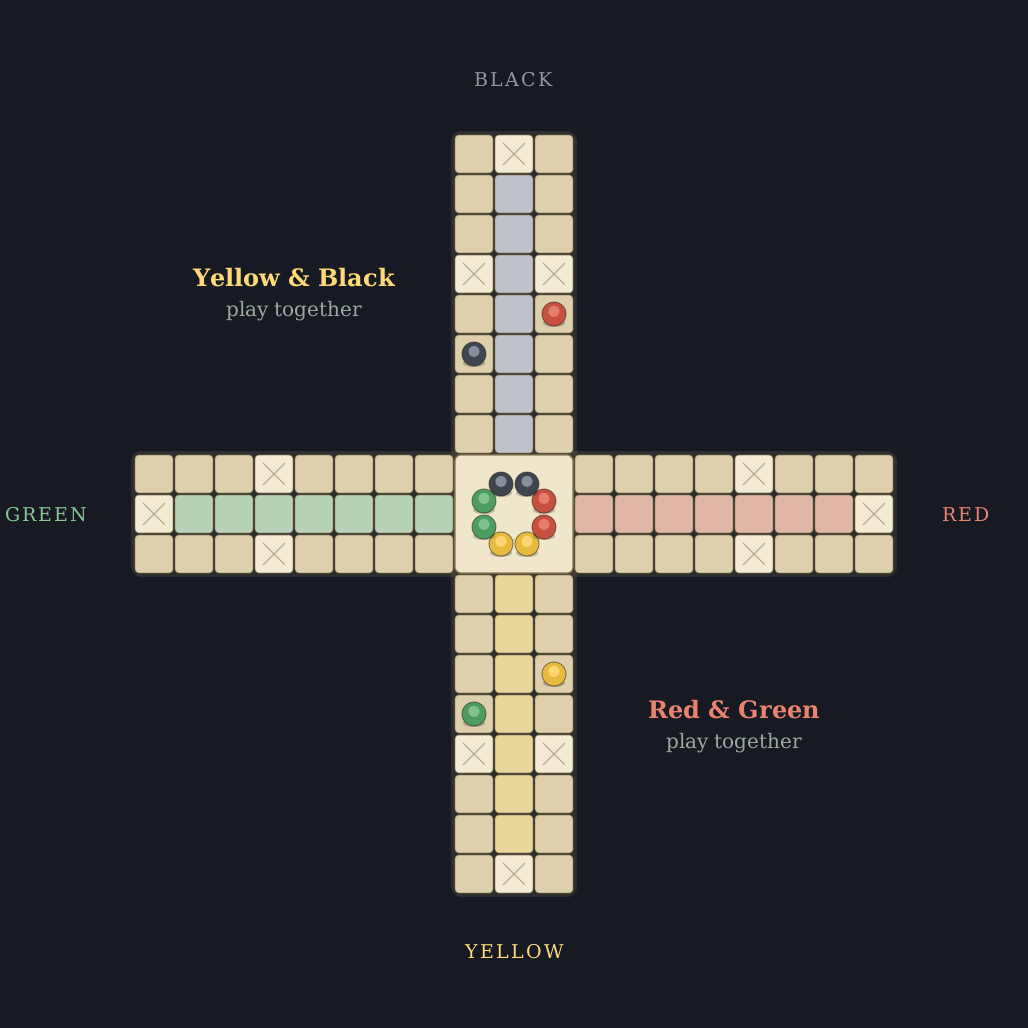
That turns the whole middle game into something Ludo does not have. A capture that gains you nothing may be exactly right if it clears your partner's path. A piece you leave standing in a bad place for yourself can be a wall your partner needs. And when your own pieces are home you are not finished — you keep playing for the side.
4. You cannot win by running away
The rule that most people are surprised by: no piece of yours may enter the Charkoni until your side has captured at least one enemy piece.
In Ludo you can play a pure race. Throw well, avoid trouble, go home. In Pachisi that is not a strategy, it is a dead end: four pieces queue at your own doorstep and none of them may step in. The fighting is not optional, and leaving it late is how comfortable-looking games are lost.
Capturing is worth having anyway — land on a lone enemy and it goes all the way back to the Charkoni, and you get another throw for it. But the twelve castle squares, marked with a cross, are safe ground where nobody can be taken, and two pieces of one side on a square form a blockade that enemies can neither land on nor pass.
Ludo vs Parcheesi, Sorry! and Trouble
Ludo is not the only descendant, and the question that comes up most often — is Parcheesi the same as Ludo? — has a clear answer: no, and Parcheesi is the older, less simplified one.
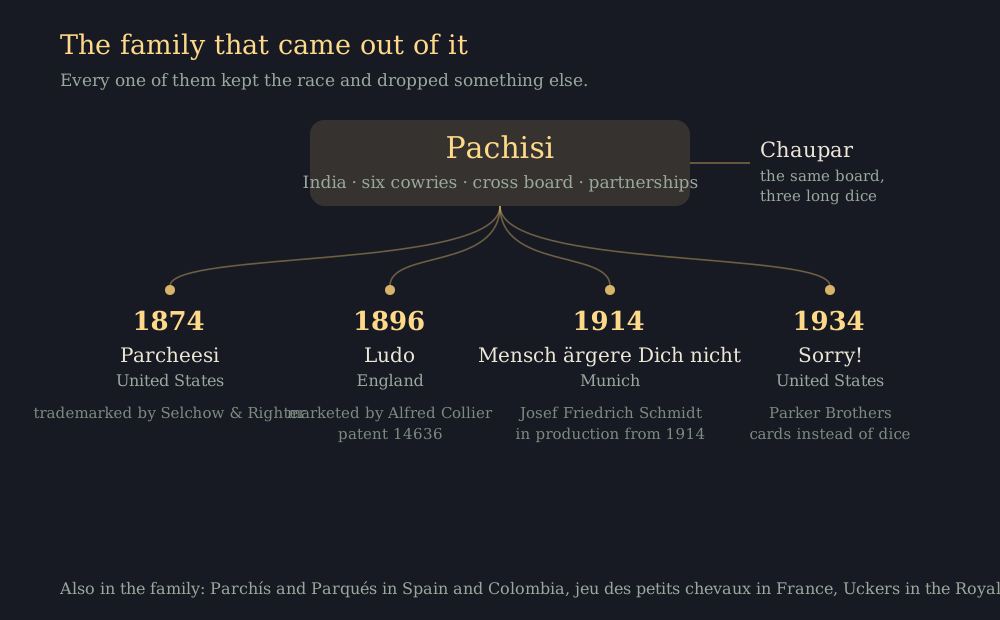
| Board | Randomiser | Closest to Pachisi | |
|---|---|---|---|
| Parcheesi (1874, US) | Cross, like Pachisi | Two dice, split between pieces | Yes — blockades and all |
| Ludo (1896, England) | Square, corner yards | One die | No — the big simplification |
| Mensch ärgere Dich nicht (1914, Munich) | Square | One die | No — Ludo in German |
| Sorry! (1934, US) | Square | A deck of cards | No |
| Trouble (1965, US) | Square | One die in a plastic dome | No |
Parcheesi was trademarked by Selchow & Righter twenty-two years before Ludo existed. It kept the cross-shaped board, and it rolls two dice whose values may be split between two different pieces — which brings back a real share of the counting that Ludo threw away. Two of your pieces on one square still form a blockade. If you have played Ludo and found it thin, Parcheesi is the step back up.
Sorry! keeps the race and replaces the randomiser a second time. You draw cards instead of rolling, so the possible moves are a fixed, known set rather than one to six — and the cards do things a die cannot, like moving an opponent backwards. It is the furthest any of them travelled from a dice race.
Trouble is Ludo with the die sealed under a Pop-O-Matic dome that you press instead of rolling. The change is physical, not mechanical: nothing about the game underneath it differs from Ludo in any way that matters. It exists because dice get lost under sofas.
Mensch ärgere Dich nicht is Ludo with a German name and a better one — it translates roughly as "don't get annoyed", which is the honest description of a game where a single throw sends you back to the start.
None of them restored what Ludo dropped. The partnerships, the cowries and the must-capture rule stayed in India. The full story of how the game left is in the history.
So which one should you play?
Ludo is a good children's game and an honest one: it is quick, it is entirely luck at the start, and a five-year-old can play it after one round.
Pachisi asks more and gives more back. You count instead of hoping, you play for a partner as well as yourself, and you cannot avoid the fight. A game takes around twenty minutes and the first one will feel like Ludo with strange numbers. By the third you will be counting nine-gaps without noticing.
If you know Ludo, the fastest way in is simply to play a game. The rules are all in Pachisi: Rules and Strategy, and if you want to know how much of the Akbar-and-the-marble-courtyard story is actually true, that is in the history.
Play Pachisi — free, in the browser, no download and no account. Against the computer, or with up to three friends: open a table, send them the link, and they take a seat as soon as they open it. Empty seats are played by the computer until people arrive, so nobody waits for a full house. Ludo is here too, if you want to feel the difference back to back.