
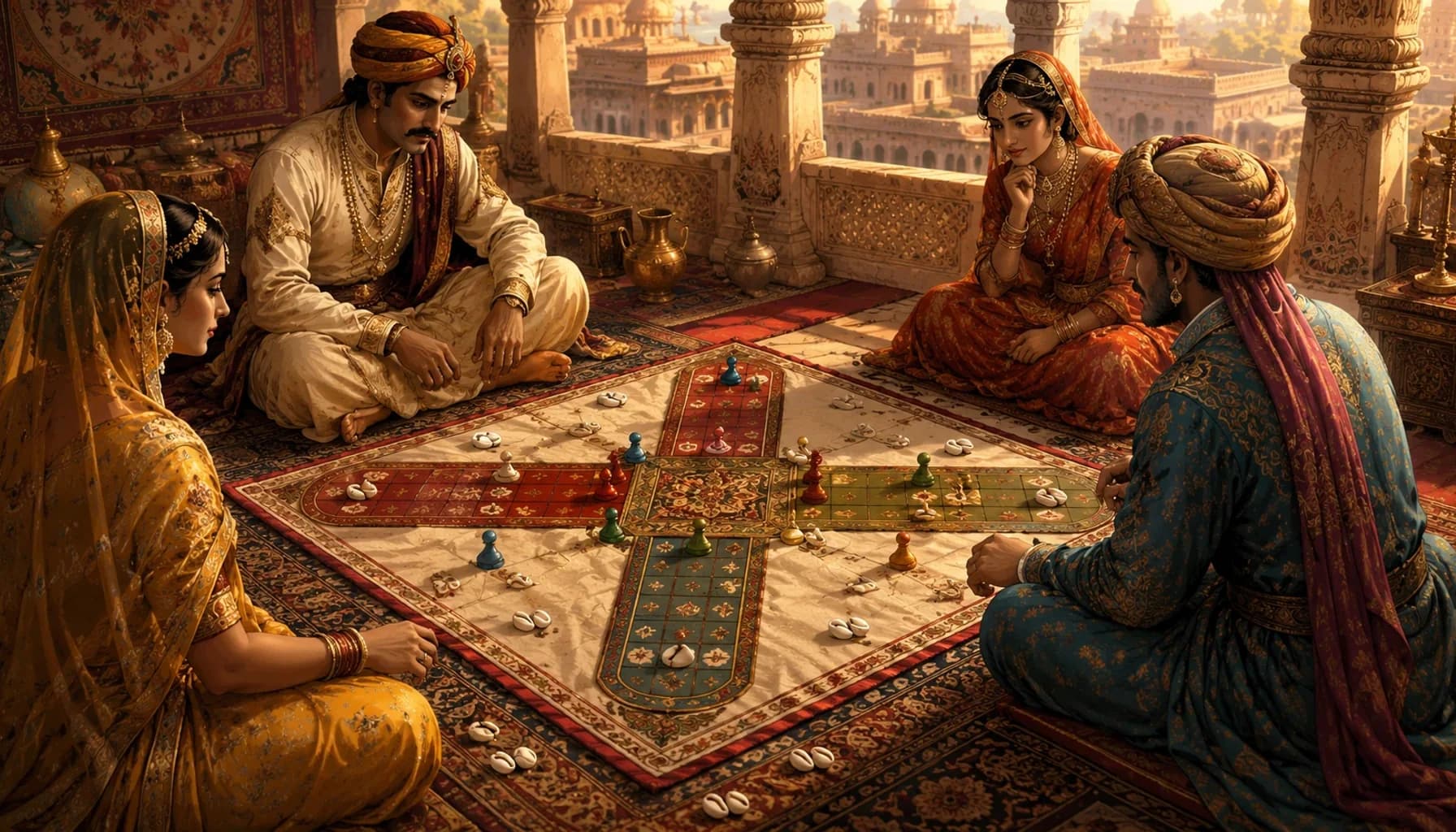
Pachisi has a problem that very old games often have: the story everybody tells is better than the story anybody can prove.
You will read that it was played five thousand years ago, that it appears in the Mahabharata, that the Emperor Akbar played it on a marble courtyard using women from his harem as living pieces. Those claims travel from article to article without anyone stopping to ask what they rest on. Some of them rest on very little.
What follows is the history with the evidence attached — and it is a better story for it. The real one has a gap of two thousand years in the middle, a nineteenth-century French traveller with a vivid pen, and a moment in the 1890s when a British patent turned a game of cowrie shells into a game of dice and sold it back to the world.
The name is the mechanism
Start with the word, because the word is the game.
Pachisi comes from the Hindi paccīs, twenty-five. Twenty-five is the highest throw of the six cowrie shells: when every shell lands mouth down, the throw counts 25 and you throw again. It is also, on a proper board, the distance from the centre to the safe square at the tip of the next arm.
A game named after its best throw tells you where its heart is. Not the board, not the pieces — the shells.
What the evidence actually shows
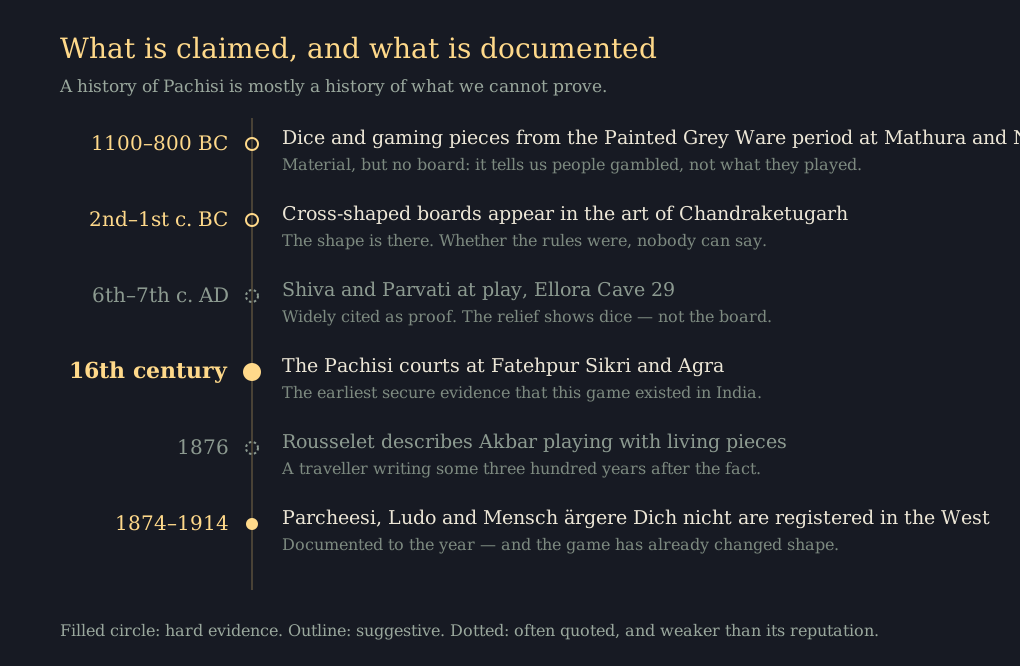
Iron Age, 1100–800 BC. Dice and gaming pieces turn up at Mathura and Noh, in the Painted Grey Ware layers. They are real objects and they are genuinely old. What they do not come with is a board. They tell us that people in northern India were gambling three thousand years ago, which nobody doubted, and nothing about what they were playing.
Second to first century BC. Cross-shaped boards appear in the art of Chandraketugarh in Bengal. Now the characteristic shape is on the record. Whether the rules played on it resembled Pachisi is unknowable from a picture.
The Mahabharata. The epic's famous gambling scene — Yudhishthira staking his kingdom, his brothers and finally Draupadi — is regularly presented as the first appearance of Pachisi. Irving Finkel, who curated the British Museum's board game collection and knows the Indian material as well as anyone, is blunt about it:
It is often assumed that the gambling game in the Mahabharata, the classical literary epic, is pachisi, but the descriptions do not tie in with the game, and this conclusion is perhaps erroneous.
The epic describes throws and stakes. It does not describe a board, a route, or pieces going round one. A dice game is not this game.
Ellora, sixth or seventh century. A relief in Cave 29 shows Shiva and Parvati at play, and it is cited everywhere as proof that Pachisi — or its sibling chaupar — was already old by then. Look at the relief: what it shows is dice. The distinctive cross board is not in it.
Ashtapada. Some writers derive Pachisi from the ancient eight-by-eight Indian board. It is plausible; it is also unsubstantiated. Two games can share a country and a millennium without one descending from the other.
So the honest summary of the first two and a half thousand years is this: the ingredients are demonstrably ancient in India — dice, cowries, cross-shaped boards, race games — and the specific combination we call Pachisi is not attested until much later.
The Mughal courts: the first firm ground
The oldest evidence that unmistakably shows this game is architectural, and you can still walk on it.
At Fatehpur Sikri, the capital Akbar built in the 1570s and abandoned within two decades, a courtyard in front of the Panch Mahal measures roughly 66 by 47 metres. Set into the paving, in the centre of its east side, is a symmetrical cross of square slabs, with a raised platform about a metre and a half across at its middle. A second such court survives at Agra. They are the size of a tennis court, and they are unmistakably Pachisi boards, laid in stone.
Finkel's verdict on them is the sentence that should anchor any history of this game: these grandiose boards still represent the earliest secure evidence for the existence of the game in India.
Not the epic. Not the cave. The courtyard.
The emperor and the living pieces
Now the famous story, and the reason to handle it with tongs.
The account everybody quotes comes from Louis Rousselet, a French traveller who published India and Its Native Princes in 1876. Describing Fatehpur Sikri, he wrote that the court itself, divided into red and white squares, was the board, and that sixteen young slaves from the harem, wearing the players' colours, represented the pieces.
It is a wonderful image. It is also written roughly three hundred years after Akbar's death, by a visitor looking at an empty courtyard, and no contemporary Mughal source is generally cited as describing that scene in that courtyard. Abu'l-Fazl's Ain-i-Akbari, the vast administrative record of Akbar's reign, establishes that the emperor was a keen player. The living pieces on that particular pavement are Rousselet's contribution, and later writers have been repeating them ever since — usually without his name attached.
None of which means it did not happen. Courts of that size were built for something, and moving human counters across them is the obvious use. But there is a difference between this is what the pavement is for and here is what a sixteenth-century chronicler saw, and the difference is worth keeping.
Chaupar, the sibling
Pachisi rarely travelled alone. Its close relative chaupar (also chaupad, chausar, chopat) uses the same cross-shaped cloth and the same idea of a race, but replaces the cowries with three long four-sided dice. Where Pachisi is the folk version played on a cloth with shells picked off a beach, chaupar is the version that turns up in courtly settings and in painting.
The two names have been used loosely for centuries, and a good deal of the confusion in Pachisi's history is really confusion between the two. When a source says a relief or a text shows "chaupar", it is often a claim about dice, not about the board.
Why shells
Six cowrie shells look like a primitive way to generate a number. They are anything but.
Each shell lands mouth up or mouth down, so six shells give a binomial distribution. Count the mouths up and the game assigns a value: two through five count themselves, six mouths up counts 6, one counts 10, and none counts 25. The result is a distribution with a hump in the middle and two spikes at the far end:
| Mouths up | Value | Chance |
|---|---|---|
| 0 | 25 | 1 in 64 |
| 1 | 10 | 6 in 64 |
| 2 | 2 | 15 in 64 |
| 3 | 3 | 20 in 64 |
| 4 | 4 | 15 in 64 |
| 5 | 5 | 6 in 64 |
| 6 | 6 | 1 in 64 |
The average throw is 4.23. Most turns creep. Then, once in eight, a shell pattern comes up that hurls a piece a quarter of the way round the board and grants another throw. A die cannot do that. A die is flat: every face equally likely, no rhythm, no rare event to hope for.
This is also where the game's strangest property comes from: there is no throw of 1, and none of 7, 8 or 9 either. Distances that cannot be thrown are what make the Pachisi endgame a counting problem rather than a stroll. It is all worked through in the companion piece on the rules and the strategy.
A shape that turns up everywhere
Cross-and-circle boards are not unique to India. Korea has yut, played with four throwing sticks. Mexico had patolli, which the Spanish chroniclers described and the Church suppressed. Various North American peoples played race games on circular tracks with marked staves.
The historian H. J. R. Murray grouped these together by shape, and the grouping is useful. What it is not is a family tree. Similar boards in distant places are at least as likely to be independent solutions to the same problem — how do you make a race visible on a flat surface, with a home and a way round — as they are to be evidence of contact. Anyone who tells you patolli descends from Pachisi is guessing.
The century when the game left India
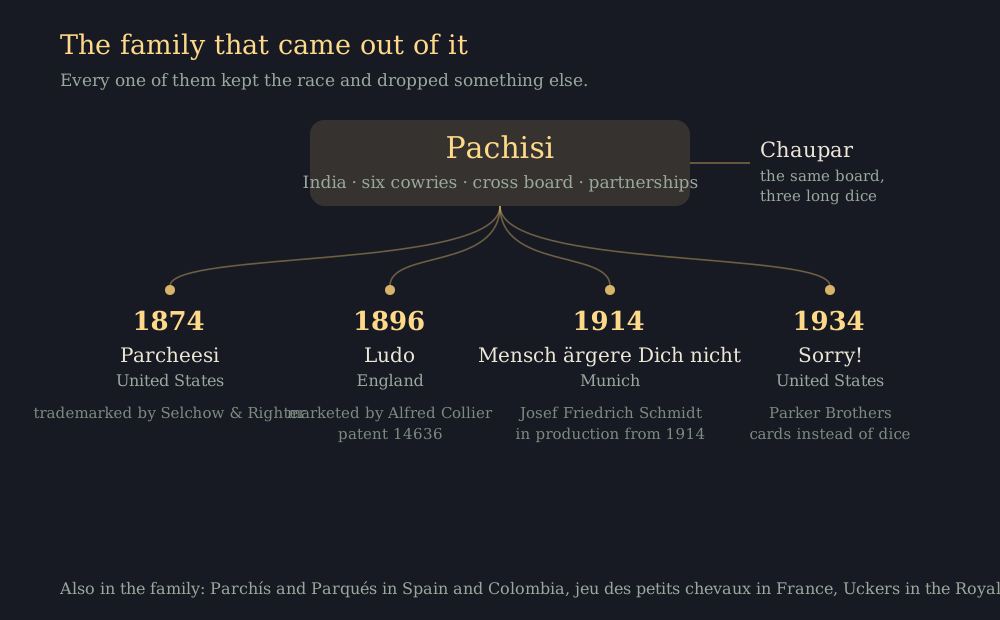
British officers and administrators met Pachisi in India in the nineteenth century, and the game went home with them — not as itself, but as a product.
1874, United States. Parcheesi is registered as a trademark by Selchow & Righter, who had acquired the rights a few years earlier. The name is a transliteration; the board keeps the cross.
1896, England. A version is marketed as Ludo — Latin for "I play" — by Alfred Collier, under patent number 14636. This is the decisive transformation. Ludo replaces the cowries with a single cubic die and the cloth cross with a square board.
1914, Munich. Josef Friedrich Schmidt's Mensch ärgere Dich nicht goes into series production, having been devised a few years earlier in Munich-Giesing after the English game. It becomes the German household game, sold in the millions, and it is Ludo's structure with a German title that translates roughly as "don't get annoyed".
1934, United States. Parker Brothers publishes Sorry!, which keeps the race and replaces the randomiser again — this time with a deck of cards.
Others followed the same pattern in other languages: Parchís in Spain, Parqués in Colombia, the French jeu des petits chevaux, and Uckers, the fiercely defended version played in the Royal Navy.
What was lost in translation
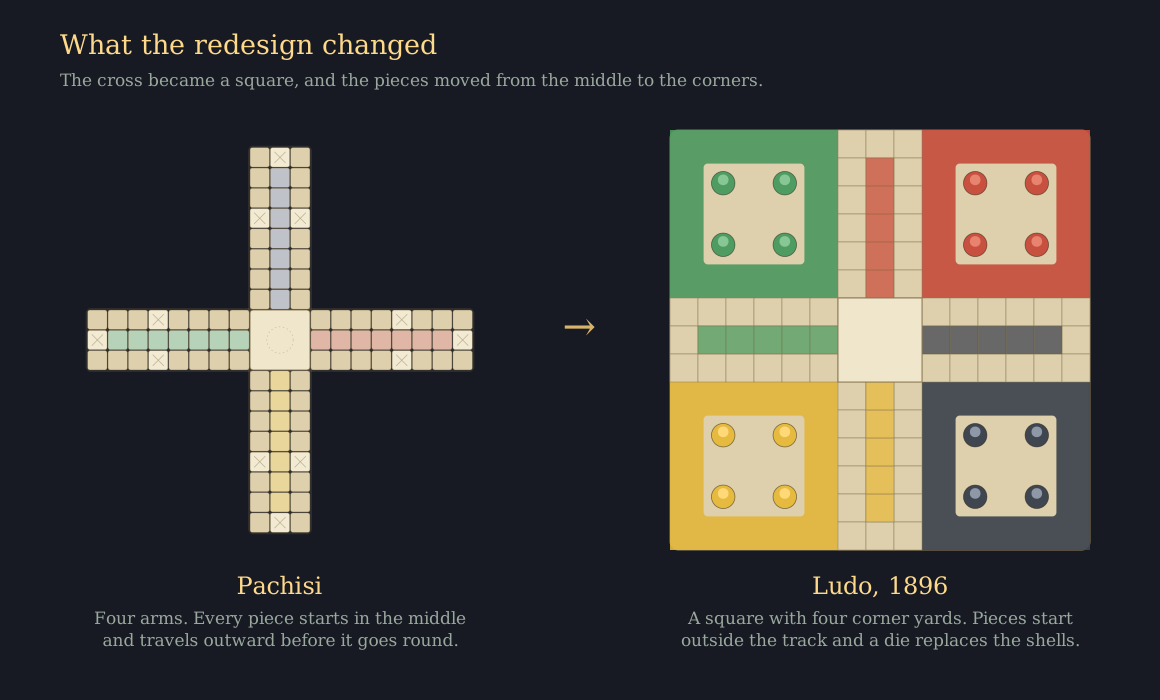
Look at the two boards together and the redesign is obvious. Four things went overboard.
The shape. Pachisi's board is a cross of four arms and nothing else; the space between the arms is table. Ludo's is a square, and the four spaces that Pachisi leaves empty became the players' yards.
The journey outward. In Pachisi every piece begins in the Charkoni, the big square in the middle, walks outward down its own arm, goes round, and comes back to the middle. The centre is both start and finish. In Ludo the pieces begin in the corners, outside the track, and the middle is only a destination.
The shells. One die, six faces, flat distribution. No graces, no extra throws, no 25 — and no unthrowable distances, which quietly removes the entire arithmetic of the Pachisi endgame.
The partnership. Pachisi is played by four in two sides, opposite players together, and a side wins when all eight of its pieces are home. Ludo is every player for themselves. That single change turns a game of alliances, blocking and sacrifice into a race.
There is one more rule that no descendant kept, and it is the sharpest of them all: in Pachisi no piece may come home until your side has captured an enemy piece. You cannot win by running away. Remove that, and you have removed the argument.
What survived
The game did not die when its children were exported. Pachisi and chaupar are still played across India, on cloth boards, with shells, by people who have never heard of a patent — and the courts at Fatehpur Sikri are still there, worn by five centuries of feet, being photographed by visitors who have mostly been told the story about the harem.
What the history rewards is a certain scepticism. The game is old, but not as old as the internet says. The emperor played, but the pageant is a Frenchman's. And the version most of the world knows is a Victorian redesign of something considerably better.
The good news is that the original is not lost, and it is not hard to find. It is one click away.
Where this comes from
- Pachisi — Wikipedia, including Irving Finkel's assessment of the Mahabharata claim and of the Mughal courts as the earliest secure evidence
- Chaupar — Wikipedia on the distinction between dice and cowries
- Ludo — Wikipedia on the 1896 marketing and patent 14636
- Pachisi Court, Fatehpur Sikri — Archnet for the measurements of the courtyard and its central platform
- Pachisi — MAP Academy on regional variants and material culture
- What is Pachisi? — The Print, an excerpt on Akbar and the game
Rousselet's account appears in India and Its Native Princes (1876) and is the source of the living-pieces description that later writers repeat.
Now that you know where it came from: play Pachisi — alone against the computer, or with up to three friends at the same table by sending them a link. Akbar needed a marble courtyard and a staff; you need a browser.
If you would rather read on: how it actually works, or Pachisi vs Ludo for what the simplification actually took away.