
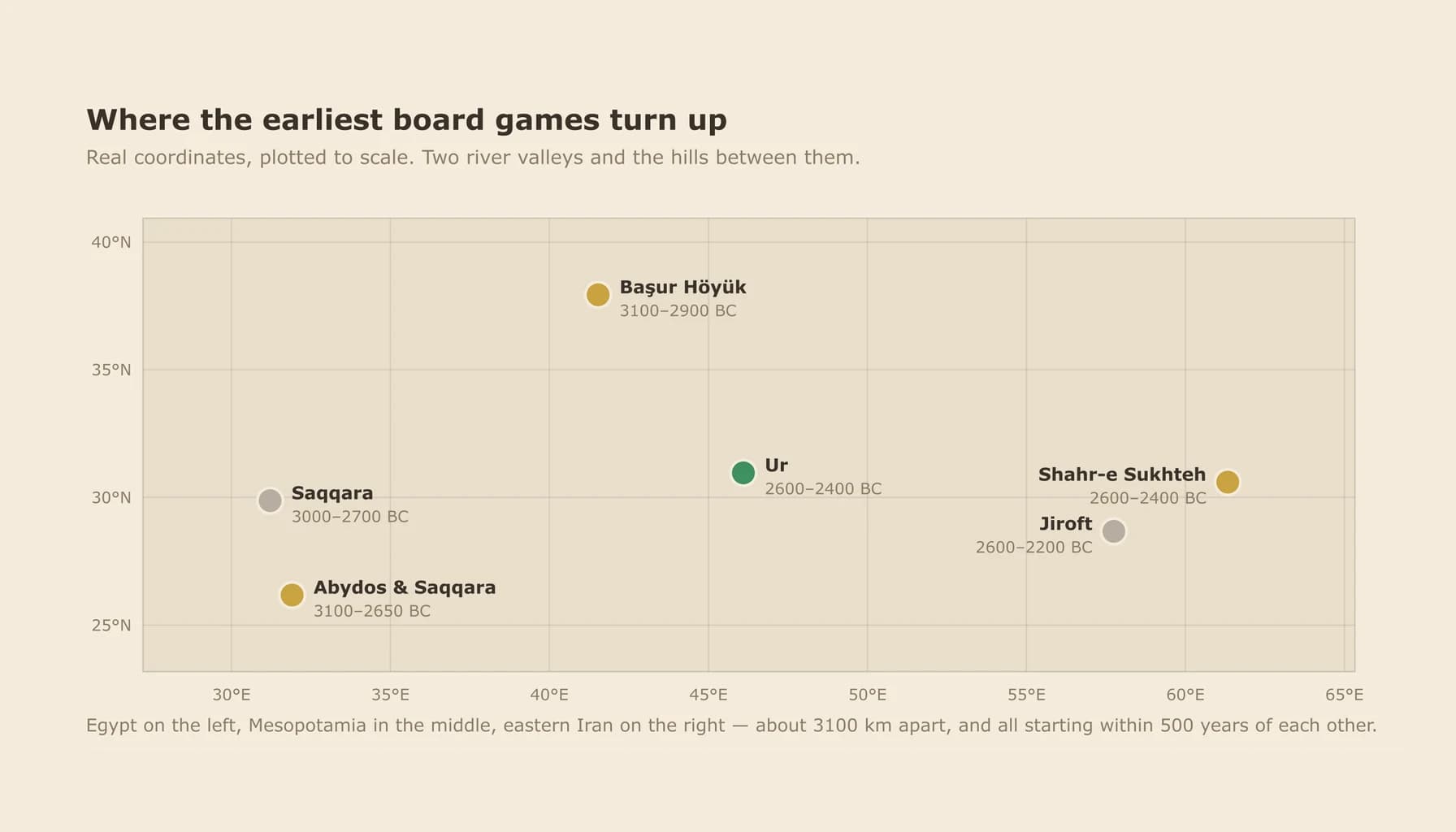
There is no answer to this question in the form people expect it — no year, no inventor, no first game. What there is instead is a window of about nine hundred years, from roughly 3100 to 2200 BC, in which board games appear in three separate river valleys, and a set of finds whose dating ranges overlap so thoroughly that nobody can put them in order.
That sounds like a dodge. It is not: the overlap is the finding, and it tells you something a single date never could.
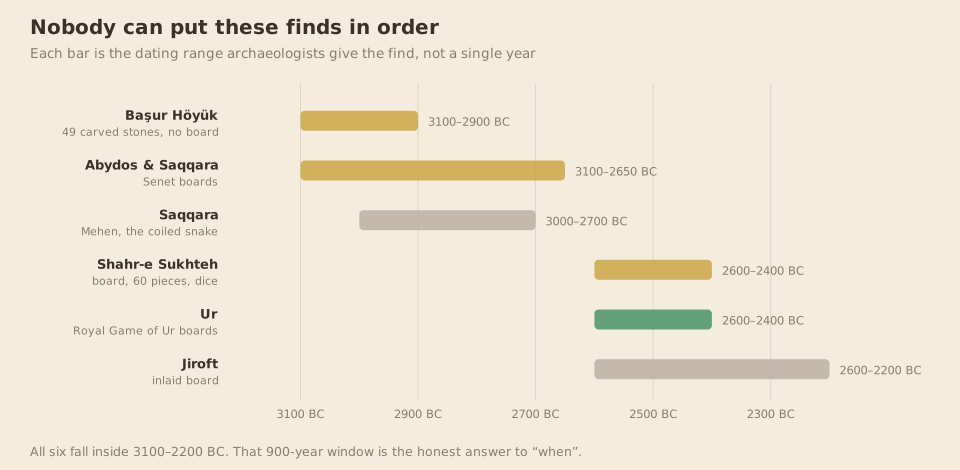
- 900 years — the window all the earliest finds fall inside
- 3,100 km between the westernmost and easternmost of them
- 500 years apart at most, where each site's evidence begins
- c. 3100 BC — the earliest defensible date of any of them
When was the first board game invented?
Somewhere in the fourth millennium BC, with the first hard evidence arriving around 3100 BC. Beyond that the honest answer is a range, for a reason that has nothing to do with scholarly caution and everything to do with how the evidence works.
Archaeological dates are not points. A board from a tomb is dated by the tomb, the tomb by its pottery, the pottery by its type — and each step adds a margin. So Başur Höyük is "3100–2900 BC" and the early Egyptian material is "3100–2650 BC", and those two ranges sit on top of one another.
Where were the first board games invented?
Three regions, and the distance between them is the surprise: about 3,100 km from the Egyptian sites to the eastern Iranian ones, with Mesopotamia in the middle. Every one of them starts within five hundred years of the others.
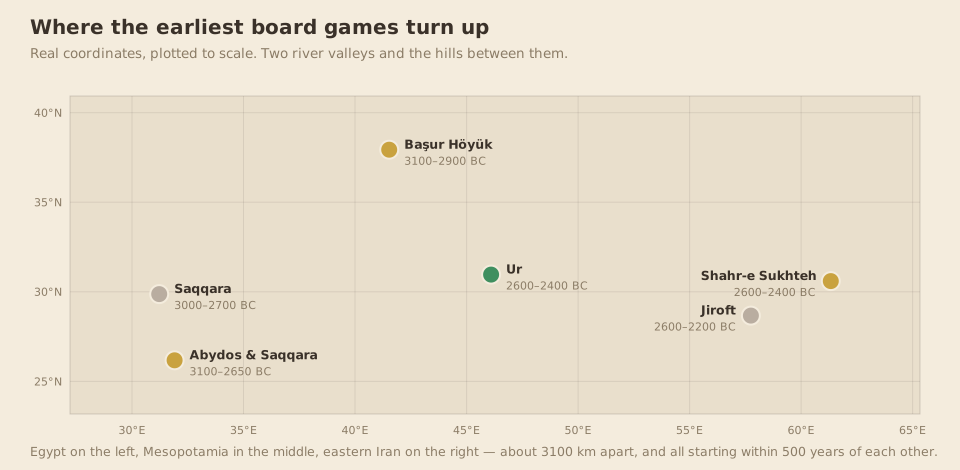
The three do not look like copies of each other, either. Egypt's games run on grids of squares in rows. Mesopotamia's twenty-square board is a distinct shape with rosettes on particular squares. Mehen is a coiled snake. If one place had taught the others, you would expect the boards to rhyme more than they do.
Which finds are the earliest candidates?
Six, and they are not equally good evidence. The difference between them is not age — it is how much of the game survived alongside the object.
| Find | Where | Range | What survived |
|---|---|---|---|
| Başur Höyük | Anatolia (Turkey) | 3100–2900 BC | 49 carved stones — but no board |
| Abydos & Saqqara | Egypt | 3100–2650 BC | Senet boards of thirty squares |
| Saqqara | Egypt | 3000–2700 BC | Mehen, the coiled snake; pieces uncertain |
| Shahr-e Sukhteh | Eastern Iran | 2600–2400 BC | Board, 60 pieces and dice together |
| Ur | Mesopotamia (Iraq) | 2600–2400 BC | Boards — and, much later, the rules |
| Jiroft | Eastern Iran | 2600–2200 BC | An inlaid board, function debated |
Başur Höyük is the awkward one. Those 49 stones are often reported as the oldest gaming pieces in the world, and they may well be — but there is no board with them, and a set of carved stones can be a game, a counting system or a ritual deposit. It is the strongest claim on the earliest date and the weakest claim on being a board game.
Ur is the opposite: not the oldest, but the only find here whose game we can actually play, because a Babylonian scribe wrote the rules on a clay tablet in 177 BC — 2,400 years after the boards were buried. You can play the Royal Game of Ur roughly as it really was.
Why there is no single first board game
Two problems stand between "we found something" and "this is a board game", and almost everything filters out.
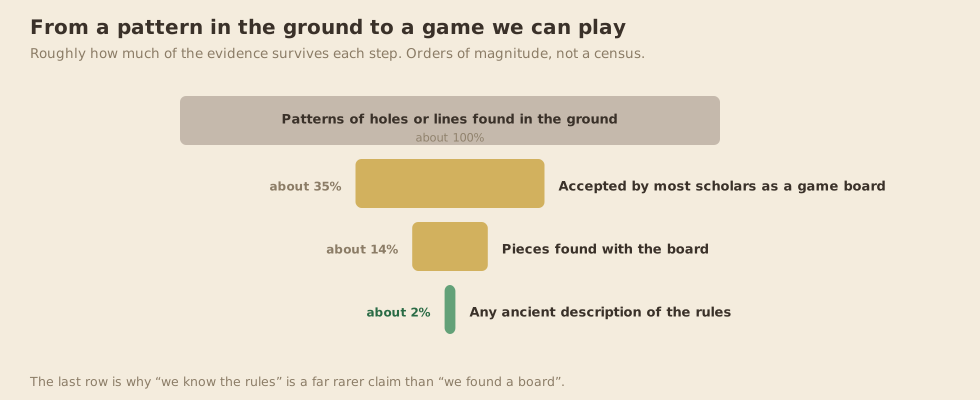
The first problem is that a grid is not necessarily a game. Rows of holes cut into rock have been read as game boards, counting devices, calendars and tally systems — sometimes all four, by different scholars looking at the same object. This is why mancala is quoted at anything from 5000 BC to AD 600 depending on who you read.
The second is that a scratch in an old stone is not an old scratch. Boards cut into temple floors and pavements are dated by the building, but somebody could have cut them at any point in the building's life. It is the single most common way an ancient game gets a date two thousand years too early.
What kind of game came first?
Look at the table again and something stands out that has nothing to do with dates. Wherever the boards are complete enough to read, they are race games — tracks that pieces travel along, with a randomiser deciding how far.
Senet is a track of thirty squares. Mehen is a coiled snake, which is a track wound into a spiral. The twenty-square board at Ur is a track with marked safe squares. Shahr-e Sukhteh's board came out of the ground with dice beside it. Not one of the earliest finds is a game of pure calculation.
That order is not obvious in advance, and it is worth sitting with. A race game needs a track, some counters and a way of generating numbers; the tension comes from luck and from what you do with what you are given. A strategy game needs players who accept that the loss was entirely their own doing. The first is apparently much easier to invent — and by the evidence, several societies invented it at once.
The one thing the early boards do share with modern games is capture. On the Ur board a piece landing on an occupied square sends the occupant back to the start, and Senet's reconstructions almost all include something similar. Racing plus interference is the oldest recorded shape of a board game, and it is still the shape of pachisi, Ludo and backgammon four and a half thousand years later.
How do you date a board game?
Rarely by the board itself. Wood, ivory and stone cannot be dated directly in a way that would help, so the date comes from context, and the quality of the answer depends entirely on which context is available:
- A sealed grave or destruction layer — the best case. The board is dated by everything buried with it, and the margin is a century or two. This is why the Ur and Başur Höyük material has usable dates.
- A dated building — much weaker. A board cut into a temple floor is dated by the temple, but somebody could have cut it at any point in the building's life. This single confusion is responsible for most of the wildly early dates in circulation.
- A written mention — the strongest evidence of play rather than of objects, and always later than the game itself. Go's date rests on this, which is why it is given as "by 500 BC" rather than "from 500 BC".
Did board games come before writing?
No — and the timing is close enough to be interesting. Proto-cuneiform appears at Uruk around 3200 BC; Egyptian writing appears at roughly the same time. The earliest board games turn up within a century or two of both.
That places games alongside the first cities, the first record-keeping and the first bureaucracies, not before them. Board games are not an ancient inheritance that cities picked up — they show up when cities do, in the same places, in the same centuries. A game with rules and pieces is itself a small system of abstract tokens obeying agreed conventions, which is not far from what the scribes at Uruk were doing.
Questions people actually ask
What was the first board game ever invented?
There is no defensible single answer. The strongest candidates are senet in Egypt and the carved stones from Başur Höyük in Anatolia, both around 3100 BC, and their dating ranges overlap — so neither can be shown to come first.
Where were the first board games invented?
In three regions at once: Egypt, Mesopotamia and eastern Iran, spread over about 3,100 km, with each region's earliest evidence beginning within five hundred years of the others.
How old is the oldest board game?
About 5,100 years, if you mean the oldest board that survives. If you mean the oldest game anybody still plays, the answer is roughly 2,500 years and the game is Go — those are two different questions, covered in oldest games still played today.
Who invented board games?
Nobody known, and probably not one person. The evidence points at several societies arriving at the idea independently within the same few centuries, which is what the overlapping dating ranges on this page are showing.
What is the oldest board game we can still play by its original rules?
The Royal Game of Ur, around 2600 BC. A clay tablet written in 177 BC by the scribe Itti-Marduk-balāṭu records how it was played — the only ancient rulebook that survives for any game of this age.
Are dice older than board games?
Roughly contemporary. The Shahr-e Sukhteh find of about 2600–2400 BC included dice with the board and its sixty pieces, which is one of the earliest sets where the randomiser and the board were buried together.
This page is about the beginning. For the argument over which game deserves the title of oldest, see what is the oldest board game in the world; for the games that survived the whole journey to the present, see oldest games still played today.