Oware is the sowing game of Ghana and one of the oldest board games still played seriously. Pick up the seeds from one of your pits, drop them one by one round the board, and take what you can from the far side. Two rows of six, forty-eight seeds, no dice and nothing hidden.
You may know it under another name. It is Awale in French-speaking West Africa, Awari in Suriname, Ayo among the Yoruba and Warri in the Caribbean — the same game with the same Abapa rules, which is what you get here.
The goal
Forty-eight seeds are in play. Capture 25 and you win — a majority that cannot be taken back. Twenty-four each is a draw.
The starting position
Twelve pits, four seeds in each. There are no store pits: what you capture is set aside beside the board, not sown into. That is the first thing that surprises anyone who learned on a Kalah set.
How a turn works
- Sow. Click one of your pits. All its seeds are picked up and dropped one by one into the following pits, counterclockwise, across both rows. A pit holding twelve or more goes all the way round and skips the pit it started from.
- Capture. If your last seed lands on your opponent's side and leaves that pit holding exactly two or three seeds, you take them.
- Keep taking. Look at the pit before it along the same sowing. If that one is also theirs with two or three, take it too, and carry on backwards until one is not.
Landing on your own side captures nothing, however tempting the pit looks.
Controls
| What you see | What it means |
|---|---|
| Glowing gold ring | A pit you can play right now — click it to sow its seeds. |
| Gold flash | A seed dropping in, as the sowing travels round the board. |
| Red flash | A capture: these pits are being emptied to your side. |
| Glowing board edge | It is your turn. |
| Seeds captured | The count beside the board — first to 25 wins. |
Below the board you choose your opponent — the computer or a friend online — set the difficulty, undo, toggle the sound and reopen the rules.
Four difficulty levels: Easy plays sensibly but forgives a lot, Medium is an even match for most people, Hard punishes a loose move, and Expert searches as deep as it can and shows no mercy. They differ in how much slack they allow themselves rather than how long they think.
Play 2 player Oware online with a friend
Oware is a game for two people sitting opposite each other, and it survives the internet better than most.
- Pick With a friend online below the board.
- Press Open a table. A four-character code appears.
- Send that code to your friend.
- They open the same page, pick the same option, type the code and press Join.
No account, no download, no app. Whoever opened the table moves first, and each of you sees your own row along the bottom — the board turns around for the second player, as it would if you were facing each other. A chat button sits in the turn card, with a red dot when a message arrives.
Two rules that decide games
You may not starve your opponent. If their side is empty, you must play a move that puts a seed back on it. If you cannot, the game stops and each player keeps what is on their own side. Deliberately emptying the far side to end the game early is therefore not a strategy — it is a rule the game closes off.
The grand slam captures nothing. A move that would take every seed your opponent has is legal, but no seeds change hands. Without that rule the game would end in a trick rather than a count.
Both belong to the Abapa rules, the version used in tournament play and on this board.
Three quick tips
- Count the far side, not yours. Every capture happens over there. Before you sow, look at which of their pits will end on two or three.
- A pit with one or two seeds is a target. Yours as much as theirs — one seed from them turns it into a capture. Empty those pits or fill them past three.
- Don't hand over your row. Seeds you sow across the board are seeds they can capture. Short moves that stay at home are usually worth more than they look.
Oware, Kalah and the rest
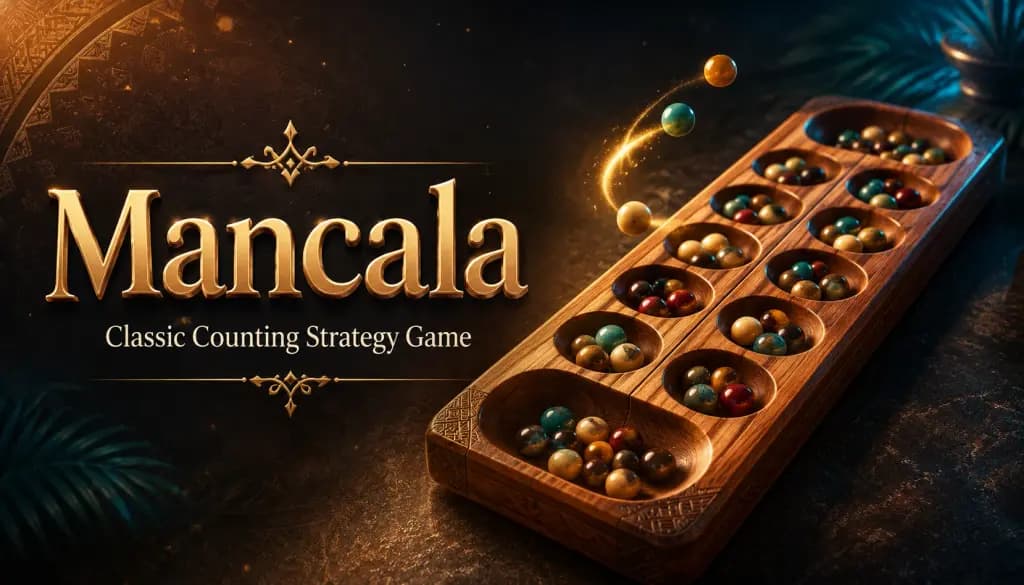
The set sold in Europe and North America as Mancala is almost always Kalah — the one with the two big stores. It is a modern commercial game. Oware is the older thing: played across West Africa and the Caribbean, known as Awale, Ayo, Awélé and a dozen other names, and still played competitively.
If you want the whole family — Bao, Congkak, Toguz kumalak and the rest — the Mancala rules and strategy guide works through it, and you can play Kalah here to feel the difference for yourself.
Play it away from the screen
An Oware board is two rows of six hollows and two stores, which is why the game travelled so well — a plank, an egg carton or twelve scooped holes in the sand all work. If you want a printed one, the printable mancala board draws an Oware layout alongside Kalah, Congkak and Toguz, with the right number of seeds listed for each. Forty-eight beans, pebbles or dried chickpeas finish the set.
About the game
Oware belongs to the oldest layer of board games. Sowing games have been played across Africa for over a thousand years, and boards have been found cut into rock. The name is Akan, from Ghana, where the game carries a story: two people who could not stop playing married so they could keep going without interruption — oware means "he/she marries".
The rules in full
Oware rules and strategy covers the sowing, the capture rule, the obligation to feed your opponent, and the endgame patterns that decide most games.