
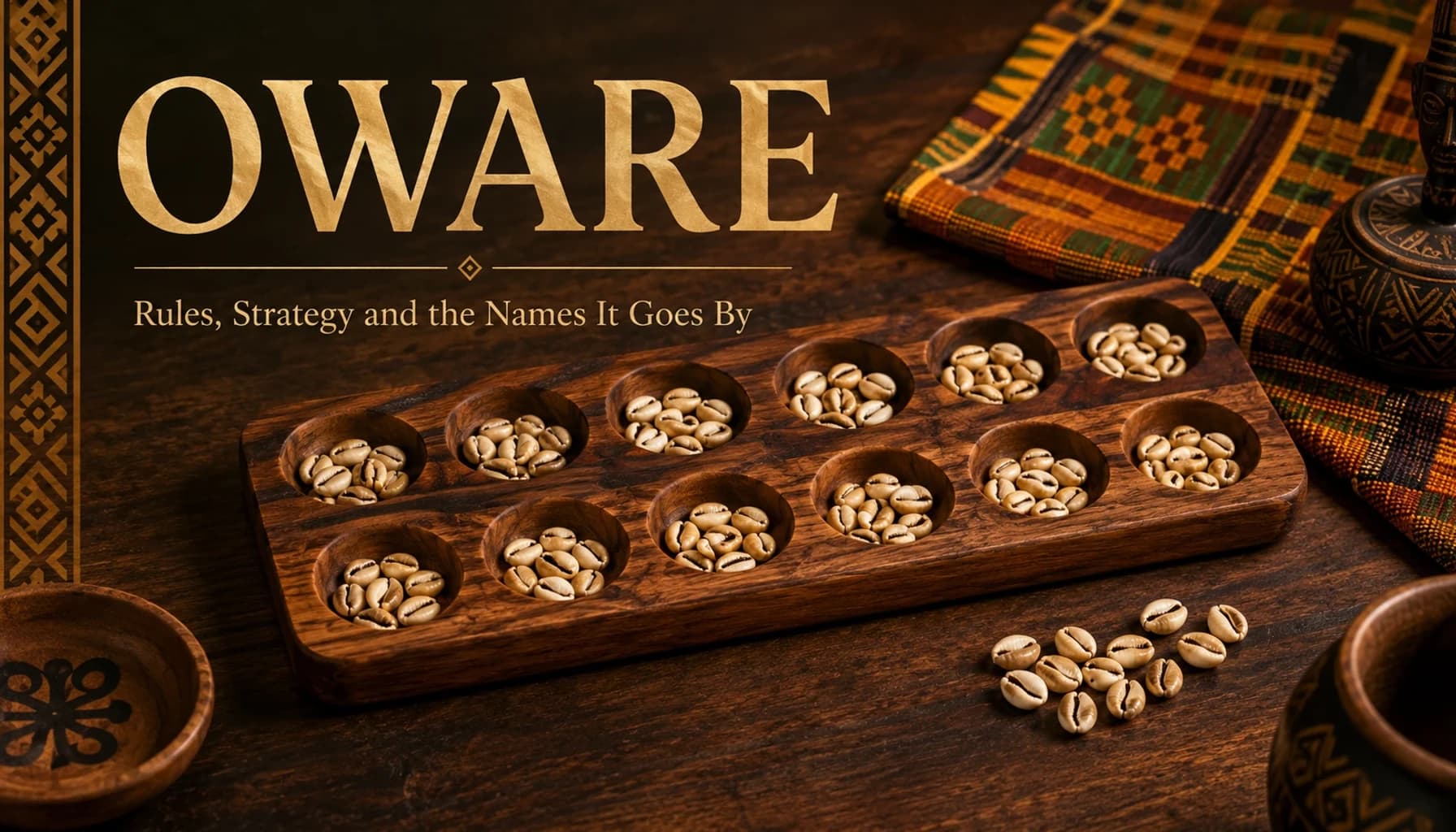
Oware is the sowing game of Ghana, and it is very good. Two rows of six holes, forty-eight seeds, no dice and nothing hidden — and a capture rule that turns the obvious move into the wrong one more often than any other classic I know.
It also has a problem that costs it players: nobody agrees what it is called.
One game, a dozen names
| Name | Where it is used |
|---|---|
| Oware | Ghana — the Akan name, and the one used internationally |
| Awale, Awélé | Côte d'Ivoire, Senegal, francophone West Africa |
| Ayò, Ayoayo | Nigeria — the Yoruba game, a close relative |
| Warri, Wari | Antigua, Barbados and the wider Caribbean |
| Ouril | Cape Verde, and the Cape Verdean communities of New England |
| Adji-boto | Suriname |
| Awari | the name computer scientists use |
Warri travelled the Atlantic in the slave ships and stayed; Ouril went with Cape Verdean sailors to Massachusetts. The game did not spread as a curiosity — it went where people went.
The names are not quite interchangeable. Ayoayo differs in a few details, and some regional versions change how the last seeds are settled. But if someone teaches you Awale in Abidjan and someone else teaches you Warri in Antigua, you will recognise the second game immediately.
None of them is Mancala. That is the family name — the shelf, not the book — and the box sold under it in Europe and North America almost always contains Kalah, a modern game with different rules. More on that below.
The board and the goal
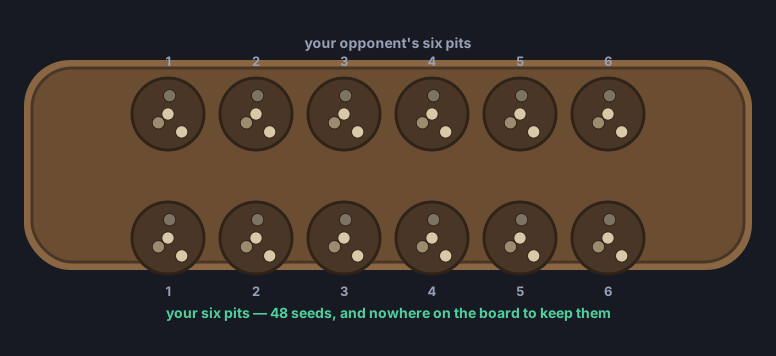
Twelve pits, four seeds in each. There are no store pits. What you capture leaves the board and sits beside you, which is why a real Oware board is a plain plank and not the tray-with-two-ends you may be picturing.
Forty-eight seeds are in play, so 25 wins — a majority that cannot be taken back. Twenty-four each is a draw.
Sowing
Pick up everything in one of your six pits and drop the seeds one at a time into the following pits, counterclockwise, around both rows. Your own row, then theirs, then back to yours.
One special case: if a pit holds twelve or more seeds, the sowing goes right round the board, and it skips the pit it started from. You never drop a seed back into the hole you just emptied.
Capturing happens on the far side
This is the rule that catches out everyone who learned on a Kalah set.
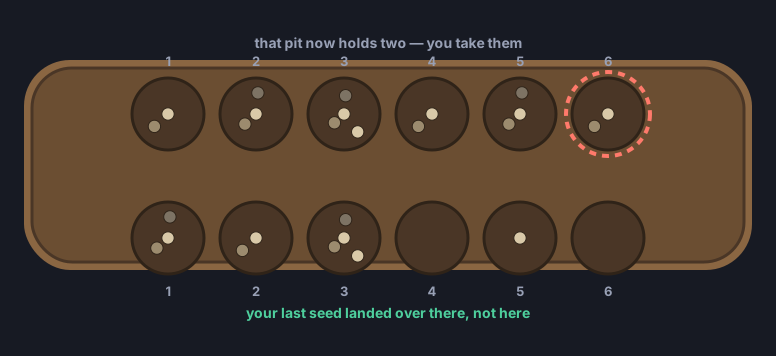
If your last seed lands in a pit on your opponent's side, and that pit then holds exactly two or three seeds, you capture them.
Not on your own side. Ever. A pit of your own left on two or three is not a capture, it is a target — and it is your opponent who will collect it.
The chain runs backwards
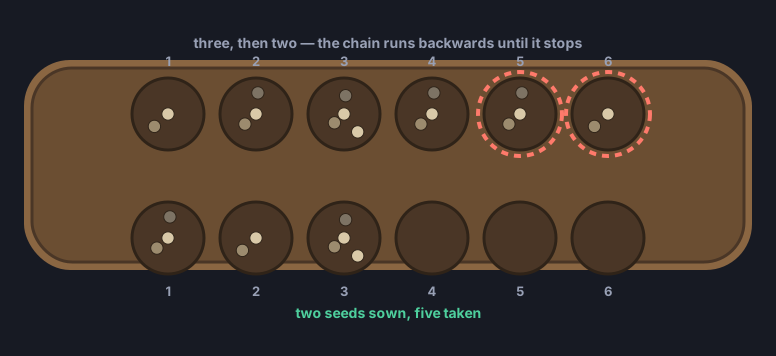
Having captured, look at the pit before it along the same sowing. If that one is also on their side and also holds two or three, take it too — and keep walking backwards until a pit fails the test.
Two seeds sown can take five. Five sown can take a dozen. This is where Oware games are won, and it is why counting the far side matters more than counting your own.
The two rules that make it a good game
Both exist to stop you winning by strangulation rather than by play. They belong to the Abapa rules, the version used in tournaments.
You may not starve your opponent. If their side is empty, you must play a move that puts at least one seed back on it. If you have no such move, the game ends there and each player keeps the seeds lying on their own side.
A grand slam captures nothing.
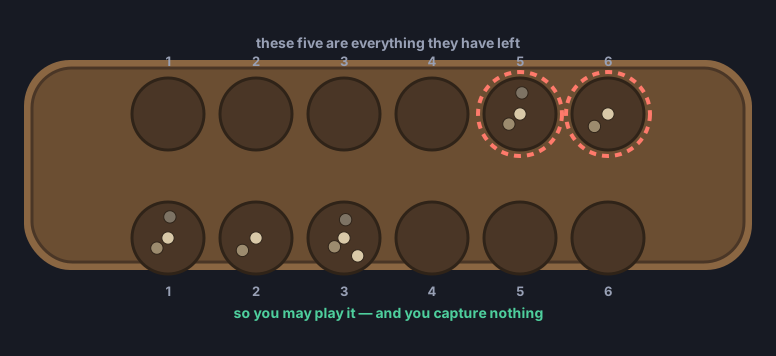
A move that would capture every seed your opponent has is allowed, but no seeds change hands. Without that rule the game would end with a trick instead of a count.
How a game ends
Three ways, and only the first is common.
- Someone reaches 25 seeds. It is over; nothing can overturn it.
- A player cannot move and cannot be fed. Each side keeps what is on it.
- The game loops — a few seeds circling with nothing being captured. It is stopped by agreement, and again each side keeps what is on it.
Strategy
- Count their pits, not yours. Every capture happens over there. Before you sow, work out which of their pits your last seed will land in and what it will hold afterwards.
- A pit with one or two seeds is a loaded gun. Yours as much as theirs. One seed from them turns your two into a three, and a three is a capture. Empty those pits or push them past three.
- Don't feed the far side. Seeds you sow across become their material. A short move that stays at home is often worth more than a big one that spills eight seeds over the table.
- Build a big pit late. A pit holding twelve or more sows all the way round, which lets you reach and disturb pits you otherwise cannot touch. Loading one is slow and telegraphed, but in the endgame it is often decisive.
- Watch the count, not the board. At 20 captured seeds each, a five-seed chain ends the game. Positions that look comfortable are not, once someone is five short of 25.
The computer verdict: a draw
Here is where Oware separates itself from the game in the shops.
In 2002 John Romein and Henri Bal solved Awari — the same game, under the name computer science uses — by computing every one of its roughly 889 billion positions on a cluster of 144 processors. The result: with perfect play by both sides, the game is a draw.
Two caveats worth stating. The ruleset they solved differs from tournament Abapa in the handling of the grand slam and the very end of the game, so the result applies to their variant exactly and to ours approximately. And "solved" means perfect play, which nobody has.
Our own engine is not a solver, but you can see the same shape in it. Set it against itself from the starting position and the first player wins 13 of 16 games at full strength, by an average of 25.1 seeds to 19.9. One notch down, at Medium, it is 7 wins to 8 with one draw — a coin toss.
Compare that with Kalah, the Mancala from the shop, which was solved as a first-player win and which our engine converts in 20 games out of 20, by 35.5 to 12.6. Same family, same gesture, entirely different game:
| Kalah (the shop Mancala) | Oware | |
|---|---|---|
| Store pits | Two, one per player | None |
| Extra turn | Yes, for landing in your store | No |
| Captures | On your own side | On your opponent's side |
| Starving your opponent | Allowed | Forbidden — you must feed them |
| Solved result | First player wins | Draw |
| Our engine, first player | wins 100 % | wins 81 % |
That is the case for Oware in one table. It is the older game, the balanced one, and the one still played competitively.
Common questions
Is Oware the same as Mancala? No — mancala is the family, not a game. Oware is one member of it; the set sold as "Mancala" is usually Kalah, a different one.
What is the difference between Oware and Awale? Nothing but the language. Awale is the French-influenced West African spelling of the same game. Ayoayo, Warri and Ouril are the Yoruba, Caribbean and Cape Verdean names.
Can I capture on my own side? Never. Landing your last seed in your own pit does nothing at all, whatever it holds.
What if I take all my opponent's seeds? The move is legal and captures nothing. That is the grand slam rule, and it exists so they always have something to play.
How many seeds do I need to win? Twenty-five of the forty-eight. Twenty-four each is a draw.
How long is a game? Ten to twenty minutes. Longer than Kalah, because seeds keep circulating instead of collecting in a store.
Is Oware solved? The Awari variant is, and it is a draw. Bao — the other great mancala — is not, and may never be.
Ready to play? Play Oware here against four levels of computer opponent, or open a table and play a friend online with a chat window beside the board. If you want the whole family — Kalah, Bao, Congkak, Toguz kumalak — the Mancala rules and strategy guide works through it, and there is a printable board with an Oware layout if you would rather play away from a screen.