
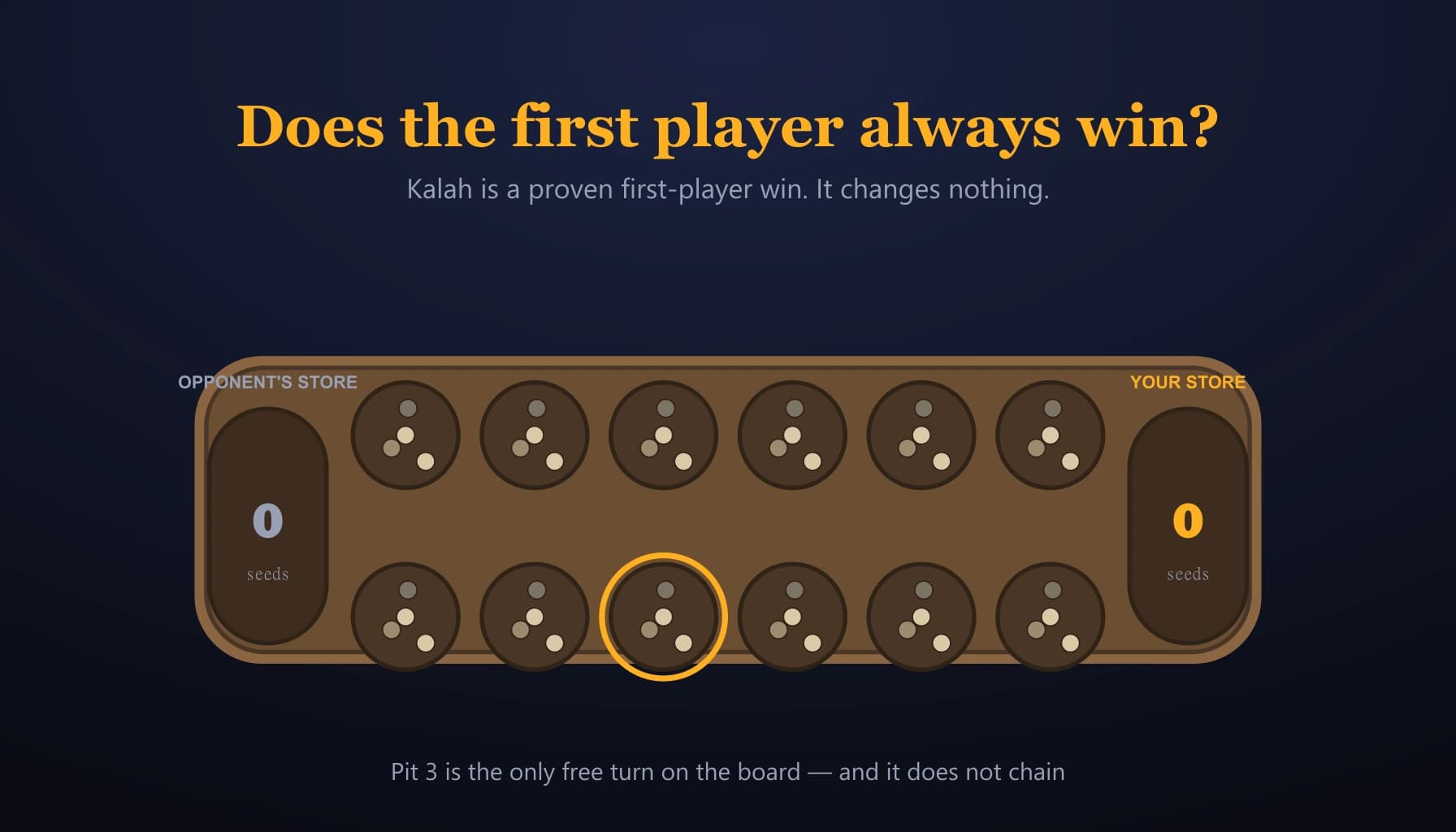
The short answer
Yes, with perfect play — and no, in any game you are likely to play.
Standard Mancala, the Kalah set sold in shops with six pits a side and four seeds in each, was solved by computer in 2000: with flawless play from both sides the first player wins. That is a proven fact about the game.
It is also almost entirely irrelevant to you, and the rest of this page is about why.
What "solved" actually means
A solved game is one where the whole tree has been walked. Kalah with six pits and four seeds was cracked by Geoffrey Irving, Jeroen Donkers and Jos Uiterwijk using a retrograde search — not by a clever insight, but by a computer looking at enough positions.
The result says: if neither player ever errs, the player who moves first wins. It says nothing at all about a game between two people who each miscount once or twice, which is every game between two people.
What it is worth against a machine
Our own computer opponent is not a solver, but at full strength it plays the opening out to the end. Set it against itself from the starting position, twenty games, and the first player wins every one of them, banking 35.5 seeds on average against 12.6.
That is a rout. Now turn the strength down one notch:
| Both sides play | First player wins | Average score |
|---|---|---|
| Perfect | 100 % | 35.5 : 12.6 |
| Hard | 40 % | 23.4 : 24.6 |
| Medium | 35 % | 22.7 : 25.3 |
| Easy | 55 % | 23.9 : 24.1 |
Twenty games per row, both sides played by the same setting. Below perfect the first-player advantage does not shrink — it disappears into the noise. The numbers wobble around fifty per cent because the games are decided by whoever miscounts last, not by who started.
That is the honest answer to the question. The advantage is real, provable, and worth nothing to a human being.
The one thing the first move does give you
There is exactly one concrete opening advantage, and it is worth understanding even though it is small.
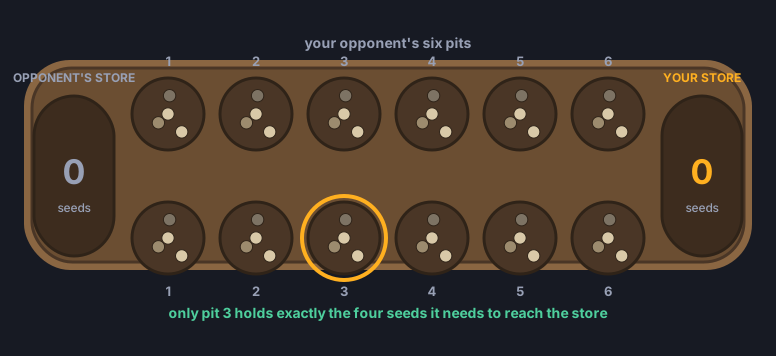
The pit next to your store needs one seed to reach it, the next needs two, and so on. In the starting position every pit holds four, so only the third pit reaches the store exactly — play it and you go again.
Every guide tells you to open there, and every guide is right. What almost none of them tell you is what happens next.
The chain that isn't
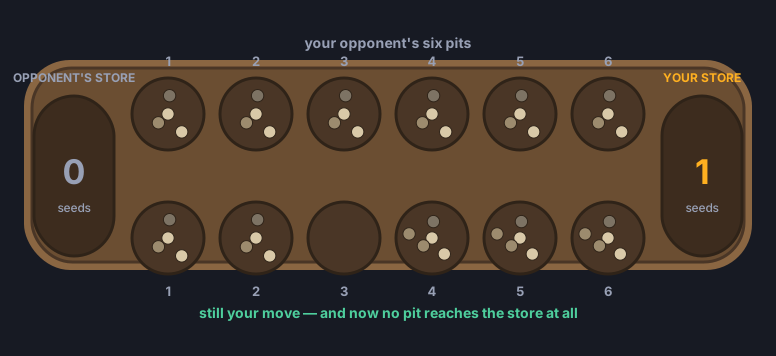
After that first free turn your row reads 4, 4, 0, 5, 5, 5. Pit 1 would need six seeds and has four. Pit 2 needs five and has four. Pit 4 needs three and has five. Pit 5 needs two, pit 6 needs one; both have five.
Not one pit reaches the store. The famous opening chain is a single link long. You bank one seed, take your second move as an ordinary move, and the advantage you have gained is one seed and a slightly better shape.
The position everyone describes
Strategy pages love this arrangement:
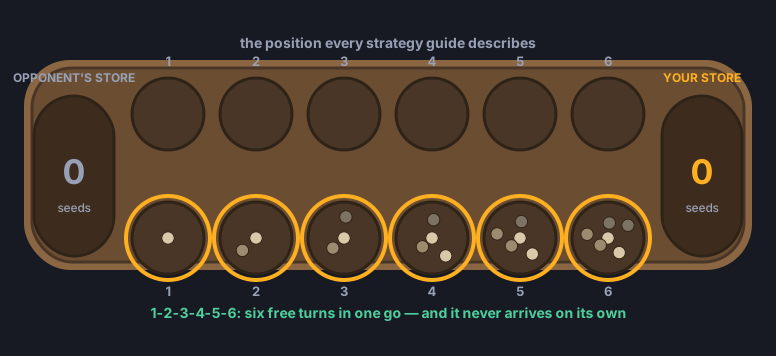
Read from the store outwards, each pit holds exactly the number of seeds it needs to land there: six moves, six free turns, one enormous turn. It is a real thing and it is worth steering towards.
It is also not something that happens to you. It has to be built over a dozen moves while your opponent is doing everything they can to disturb it, and half a chain — two or three links — is what real games actually produce. That is where the game is won.
What to do about it
If you want the advantage gone, you have three honest options.
- Play two games and swap who starts. This is what tournaments do, and it costs nothing. Add the scores.
- Change the seed count. Our engine at full strength converts four seeds a pit every single time. At three seeds the same engine drew 12 of 20 games against itself; at six seeds it split them evenly. Deeper games are harder to search, so this is evidence rather than proof — but if you want a start that feels balanced, moving off four is the simplest lever you have. The board here lets you pick 3, 4, 5 or 6.
- Play a different mancala. Oware has no store pits and no extra turn at all, so the whole mechanism that creates Kalah's first-move advantage is simply absent — and the version of it that has been solved comes out a draw.
What is not worth doing is worrying about it. Unless your opponent is a computer set to Perfect, the person who wins is the one who counted the last ten moves properly.
Common questions
Is Mancala solved? Kalah with six pits and four seeds is, along with several other small Kalah settings. So is Awari, the Oware variant used in computer science — solved in 2002, and it comes out a draw rather than a first-player win. Bao, the four-row East African game, is not solved and may never be.
Does the first player always win in real games? No. Measured over twenty games at each of our three human-scale difficulty settings, the first player won between 35 and 55 per cent of the time. That is a coin toss.
Which pit should I open with? Pit 3, counting from the left of your row — the one four steps from your store. It is the only opening move that earns a free turn.
Can I chain free turns from the start? Only one. After pit 3 no pit on your side reaches the store, so the second move is an ordinary move.
Is going second a disadvantage worth compensating? Only against a perfect opponent. Between people, swap sides over two games and the question answers itself.
Try it yourself: play Mancala here and set the computer to Perfect with yourself moving second — you will not win. Then set it to Medium and it becomes a game again. The rules and strategy guide covers the counting that actually decides matches, and Oware is next door if you want the older game without stores.