Hnefatafl is the board game of the Viking age, and you can play it here free in your browser — against three levels of computer opponent, or against a friend at a shared table. No download, no account.
It is not chess with different pieces. A king sits in the middle of an eleven-by-eleven board with twelve guards. Around the edge stand twenty-four attackers, twice as many. The king is trying to reach a corner; the attackers are trying to close the ring before he does. The two players are not playing the same game, and that is the whole point.
What is hnefatafl?
Hnefatafl means roughly "the king's table" — from hnefi, the king piece, and tafl, simply the Old Norse word for a board game. It was played across Scandinavia, the British Isles and as far east as Ukraine for around four centuries, until chess arrived from the south and replaced it by about 1200.
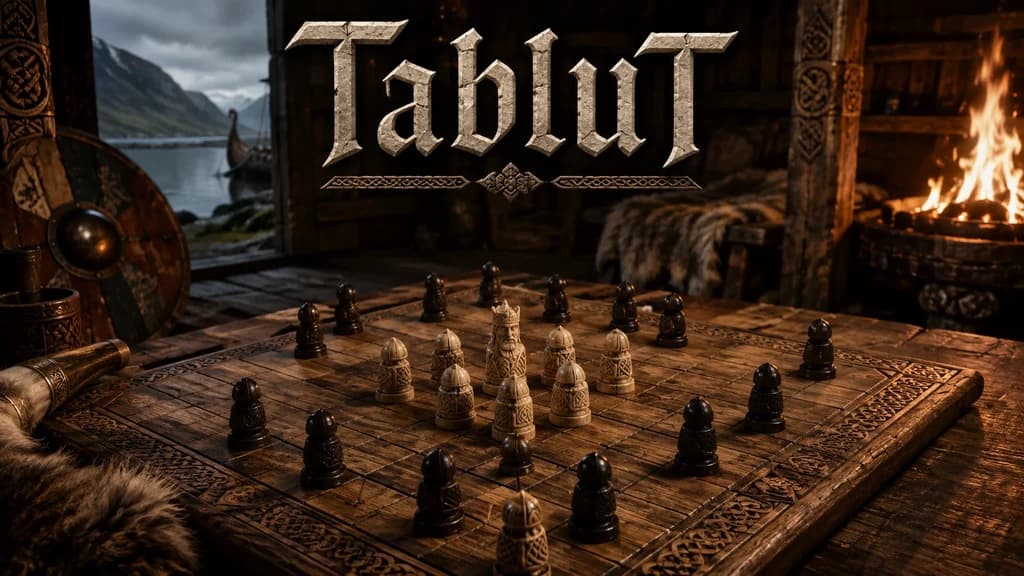
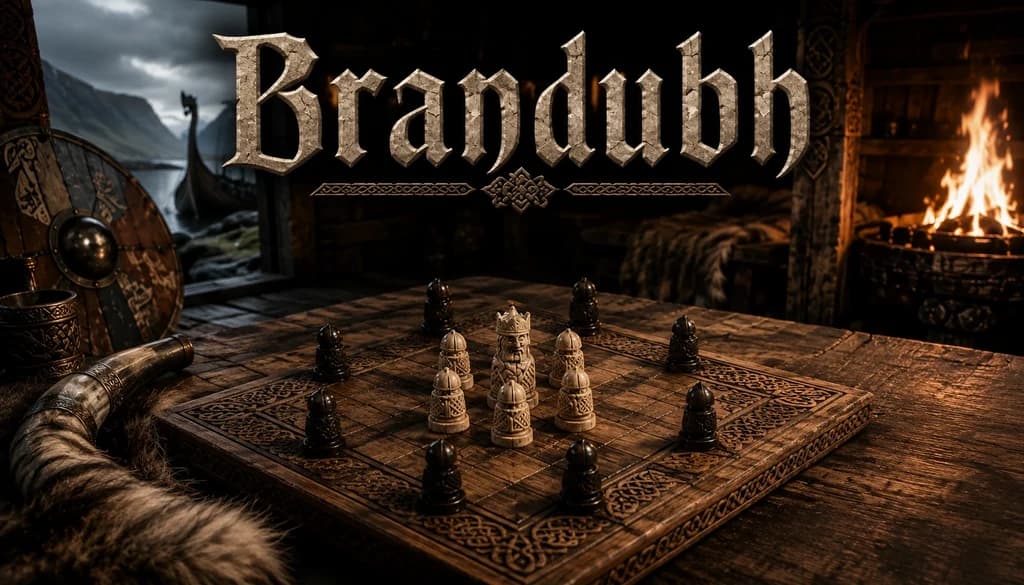
It is the best known member of the tafl family, and its name is now used for the whole group. Smaller boards in the same family are Tablut at 9×9 and Brandubh at 7×7.
One warning before you buy anything: "Viking chess" means two different games. In English and especially in German (Wikingerschach) that name most often refers to Kubb, the lawn game where you throw wooden batons at blocks. Hnefatafl is the board game. This page is the board game.
How to set up a hnefatafl board
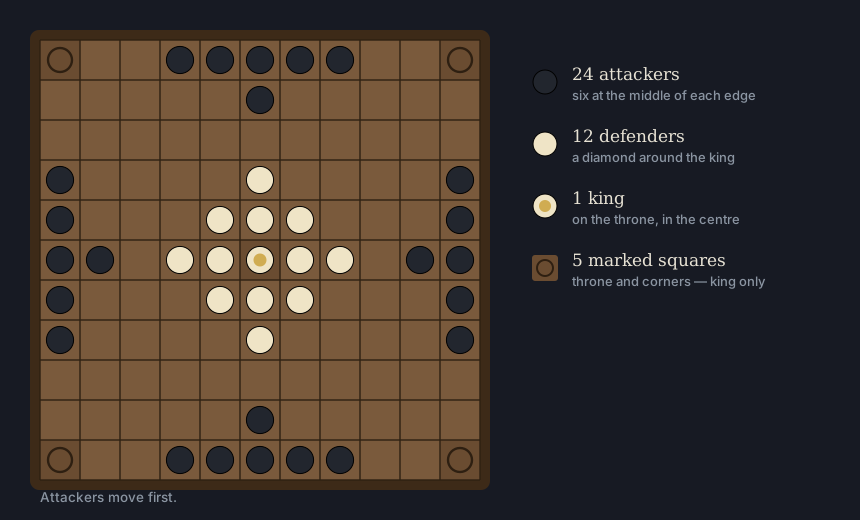
- The king goes on the throne, the marked square in the exact centre.
- The twelve defenders form a diamond around him — one at each point of the cross, filling out to a rough lozenge.
- The twenty-four attackers stand in four blocks of six: five in a row at the middle of each edge, plus one stepped inward from the centre of that row.
- The four corners are marked. Together with the throne that makes five squares that only the king may occupy.
The attackers move first.
How to play hnefatafl
Moving
Every piece moves like a rook in chess: any distance along a row or column, never diagonally, never jumping over another piece. There is one movement rule and it applies to everything on the board, king included.
To move here: click a piece, then click one of the green dots.
How pieces are captured
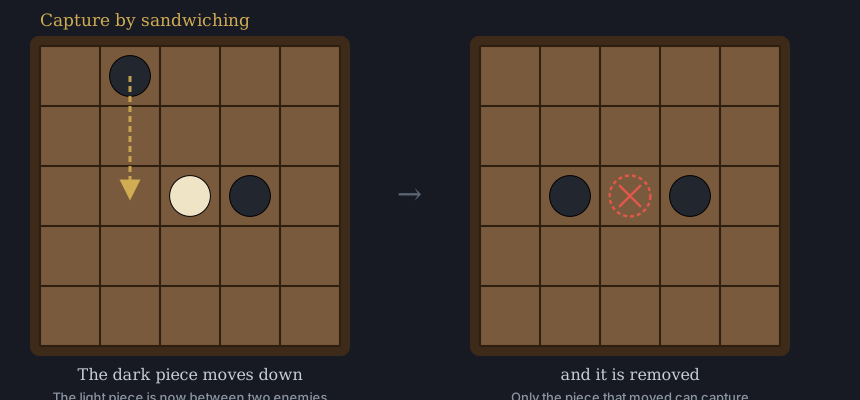
You capture by sandwiching: move a piece so that an enemy is caught between it and another of your own pieces, straight along a row or column.
Three things follow from this, and the second one catches every new player:
- One move can capture on several sides at once if the shape is right.
- Only the piece that moved captures. Moving your own piece into the gap between two enemies is completely safe. Nothing happens.
- There is no chain capture and no forced capture. You take what your move takes, and nothing more.
What the marked squares do
The throne and the four corners are not decoration:
- They take only the king. Ordinary pieces may pass over the empty throne, but not stop on it, and may never enter a corner at all.
- They are hostile to both sides. An empty throne or a corner counts as an enemy piece when somebody is being sandwiched — so a lone attacker beside a corner can capture a defender against it.
How to win
- Defenders win when the king reaches any corner.
- Attackers win when they capture the king.
- A side with no legal move at all loses. Being shut in is exactly what the attackers want, so it is a defeat and not a draw.
- Threefold repetition, or fifty moves with no capture, is a draw.
Controls on this board
| What you see | What it means |
|---|---|
| Gold dashed ring | A piece that can move. Click to select, click again to deselect. |
| Green dot | A square your selected piece can move to. |
| Large gold dot | A corner — moving the king here wins on the spot. |
| Red pulsing ring | An enemy piece that this move would capture. |
| White circle | Where the last move ended. |
| Crown | The king. |
Hnefatafl strategy
How to win as the attackers
Twenty-four men sounds like plenty. It is not, because you defend four things at once and only need to fail once.
- The four corner lines are the game. Top row, bottom row, left column, right column. Every corner sits on two of them. A king who reaches one with a clear run has already won.
- Build a wall, do not chase. The king moves like a rook and takes two pieces to capture. Every move spent following him is a move not spent closing a line.
- Trade freely. You start two to one up. Even exchanges thin the defence and leave the king with fewer shields.
How to win as the defenders
- Break one section, not the middle. Twelve guards cannot beat twenty-four in a fight. Pick the thinnest part of the wall and trade there — you want a hole, not an advantage.
- Make two threats at once. A king who can step onto two open lines cannot be stopped: the attacker blocks one, you take the other. Every plan should end in that shape.
- Leaving the throne is a commitment. The empty throne turns hostile the moment he steps off it, and it will help capture your own men.
The mistake that loses most games
For the attackers, it is this: a man in the middle of a line only blocks half of it. An attacker sitting between the king and one corner does nothing at all about the corner on the other side of him. Count both directions before you decide a line is closed.
Play 2 player hnefatafl online with a friend
Pick With a friend online, press Open a table and you get a four-character code. Send it to whoever you want to play — they open this same page, type the code and press Join. No account, no download, and a chat window in the corner.
An hour-long asymmetric game is exactly the kind that is better against a person, and swapping seats between games is the fastest way to understand it. Whoever opens the table plays the attackers and moves first, and the host's King setting applies to both sides.
Which hnefatafl rules does this use?
Corner escape, hostile empty throne, hostile corners, capture by sandwiching, and only the moving piece captures. Those are common to essentially every modern reconstruction.
Where reconstructions differ is the king. Tournament play between strong humans uses the four-sided king — he must be surrounded on all four sides. Here the default is the two-sided king, and that was measured rather than chosen. Twelve games per setting with the strong computer on both sides, as attacker wins : defender wins : draws:
| Rule | Result |
|---|---|
| Armed king, two sides | 6 : 6 : 0 |
| Armed king, four sides (tournament) | 0 : 9 : 3 |
| Unarmed king, two sides | 3 : 8 : 1 |
That is a statement about this opponent, not about the tournament rule. Closing a ring around a rook-moving king is a plan across many moves, and on 121 squares this computer searches three half-moves in the second it is given. Strong human attackers do make the four-sided ring work, which is why tournaments use it. Ours cannot, so it would only hand you an easy win from the king's side.
Both settings are in the panel under King. Playing a friend at a table? Take the four-sided rule — two humans are exactly the case it was designed for.
Hnefatafl vs chess: what is the difference?
Both are war games for two players and they are built on opposite principles. Chess is symmetric: same pieces, same powers, same goal, and the contest is pure execution. Hnefatafl is asymmetric: unequal forces, different goals, and you cannot read the position by counting material.
Three habits a chess player has to unlearn here: moving next to an enemy is safe, no piece has a value, and being a man up means nothing on its own. The full comparison — including how chess actually displaced this game around 1200 — is in hnefatafl vs chess.
Which board size should you play?
All three sizes use the same rules and play like genuinely different games:
| Board | Size | Pieces | A game takes | Play it if |
|---|---|---|---|---|
| Brandubh | 7×7 | 8 v 4 + king | ~10 min | You have never played tafl. Everything the family does is visible, and you can lose three games and understand why inside half an hour. |
| Tablut | 9×9 | 16 v 8 + king | ~20 min | You want the historical original. This is the board Linnaeus watched in 1732 — every other version is reconstructed from it. |
| Hnefatafl (this page) | 11×11 | 24 v 12 + king | ~1 hour | You want the real thing: a slow siege about walls and lines rather than a sprint. |
The short version: learn on Brandubh, settle on Hnefatafl.
Where hnefatafl comes from
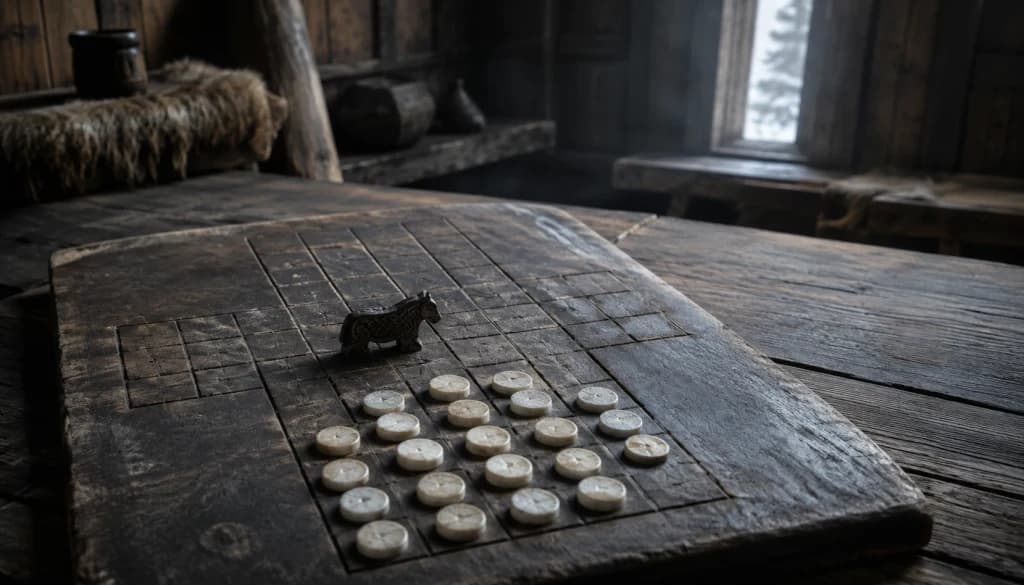
Nobody knows the original rules, and anyone selling you "the authentic Viking rules" is guessing. Not one line of rules survives from the period the game was played in. What survives is equipment: a 13×13 board fragment from the Gokstad ship burial, a 7×7 board in yew from an Irish lake dwelling, glass pieces showing one king against a crowd, and a complete gaming set laid on the lap of a warrior buried at Birka.
The only usable description of any tafl game is Carl Linnaeus's, written in Latin in 1732 after watching Sámi hosts play the 9×9 game — and its 1811 English translation contains a one-word error that tilted the game towards the defenders for a century and a half.
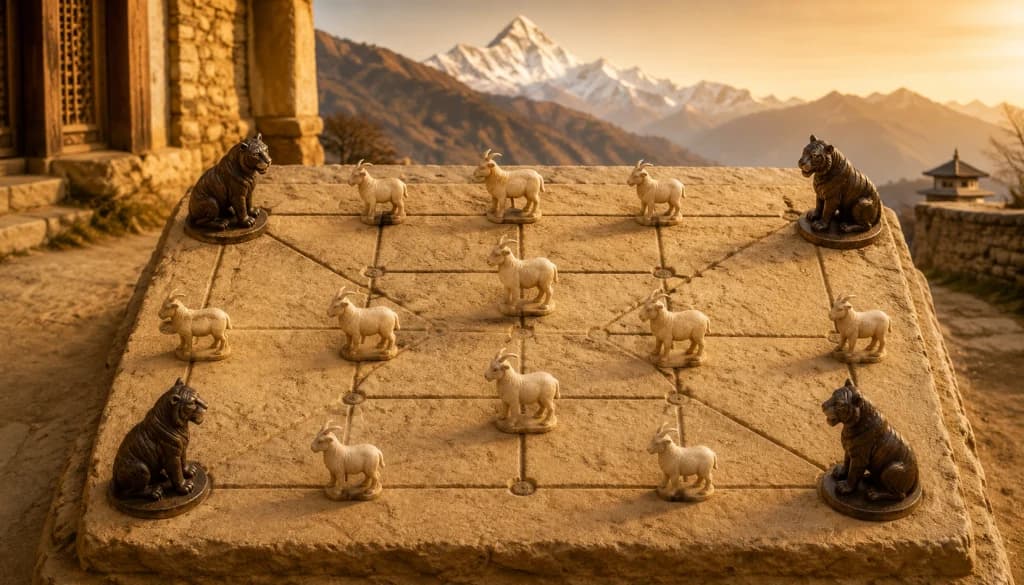
The whole story is in the history of hnefatafl, the six known variants are sorted by evidence in the tafl variants compared, and if the asymmetry is what interests you, hunt games puts this game next to the tiger games of Nepal and the fox of medieval England.