
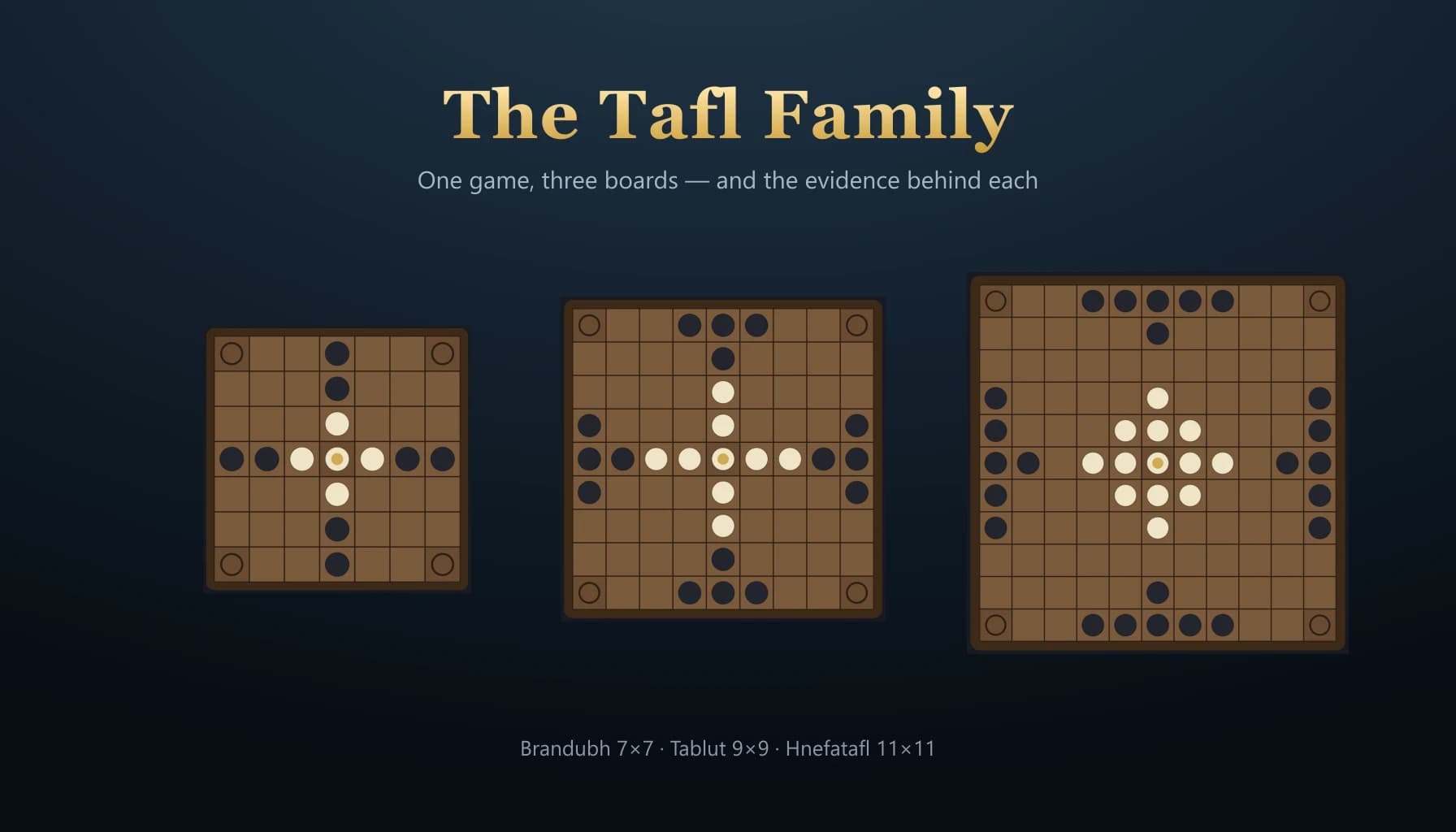
There is a board game the Vikings played for four hundred years, across an area running from Ireland to Ukraine, and nobody wrote down how it worked.
That is the whole problem with tafl. The boards survive. The pieces survive — glass, amber, bone, walrus ivory, sometimes still sitting in a grave in the arrangement they were buried in. What does not survive is a single line of rules from anyone who actually played it. Everything you can buy today is a reconstruction, and the versions differ enormously in how much they are reconstructing from.
So here is the family sorted by evidence rather than by popularity.
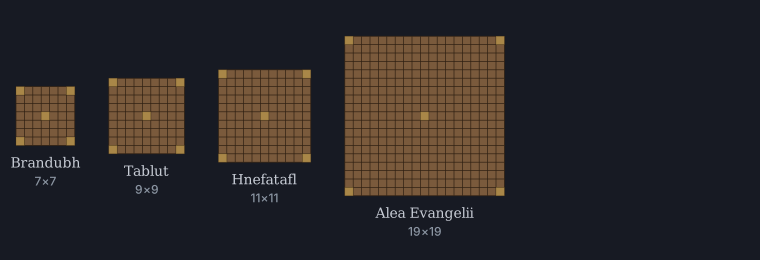
What all of them are
Tafl is simply the Old Norse and Old English word for board game, the way chess now stands for one particular game that was once one of many. Every member of the family shares one design, and it is a design nothing else in the classical canon uses:
- The two sides are not equal and do not want the same thing. A king sits in the centre with a small guard. An attacking force, always exactly twice as large, surrounds him on the edges.
- The king is trying to leave. The attackers are trying to close the ring.
- Everything moves like a rook — any distance along a row or column, no diagonals, no jumping.
- You capture by sandwiching, and only with the piece that moved. Stepping into a gap between two enemies is safe. That single rule is what stops the game collapsing into mutual destruction.
The attackers move first, everywhere. What changes between variants is the size of the board, the number of pieces, and how the king is caught.
Brandubh — 7×7, Ireland
The evidence: unusually good for a tafl game, and it comes from poetry. Acallam na Senórach describes a game of thirteen pieces, five against eight. The poem Abair riom a Éire ógh adds that one of the five is a branán — a chief, a raven — and that the five noble squares belong to him. Five against eight, with five squares reserved for the king: that is a 7×7 board with a throne and four corners, described in verse centuries before anyone drew it.
And it was drawn. A wooden board pulled out of a crannog at Ballinderry in 1932 — tenth century, a decorative border, two carved heads as handles — has seven rows of seven peg holes. Pegs rather than flat counters, which suggests a set built to travel.
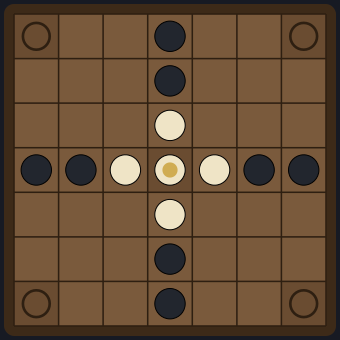
What the poems do not say is how anything moves. That part is borrowed from Tablut, like everything else in modern tafl.
You can play Brandubh here — against the computer, or against a friend at a shared table.
Tablut — 9×9, Sámi
The evidence: this is the one. Everything else in this article ultimately leans on it.
In 1732 the young Carl Linnaeus — later the botanist who named every species we know, at the time a twenty-five-year-old on a field trip through Lapland — watched Sámi hosts play a game he called Tablut, and wrote it down in his Latin travel diary. He did not speak the language. He worked out the rules by watching, and sketched the board.
That account is the only eyewitness description of a tafl game by anybody, ever. Every reconstruction of Hnefatafl, Brandubh, Tawlbwrdd and the rest is extrapolated from those few paragraphs.
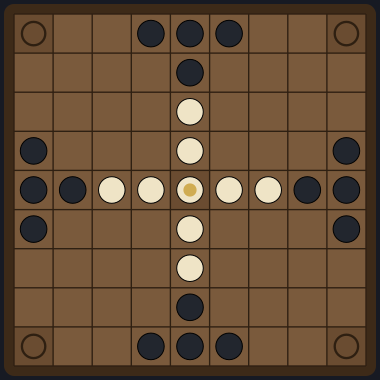
Tablut is playable here on the 9×9 board, with corner escape rather than the edge escape Linnaeus described — for reasons that become obvious in the next paragraph.
And then it was mistranslated. The 1811 English edition rendered a phrase about the king as "except the king" where the Latin says something closer to "likewise the king" — one word, and it turned the king into a piece that could not be captured the ordinary way. That reading made the defenders far too strong, and it shaped nearly every tafl rule set published for the next hundred and fifty years. If you have ever played a tafl game where the king's side wins almost every time, you have met the ghost of a translator's slip.
Hnefatafl — 11×11, Scandinavia
The evidence: the name is genuine and appears in the sagas. The board size is supported by archaeology. The rules are pure reconstruction.
Hnefatafl means roughly the king's table — hnefi, the fist or the chief piece. It is both a specific game and, confusingly, the word most people now use for the whole family. This is the version that gets played competitively, at 11×11 with twenty-four attackers against twelve defenders and a king.
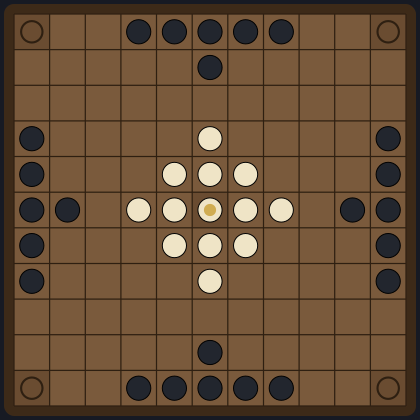
The modern tournament sets — Copenhagen and Fetlar — exist precisely because of the translation problem above. They are the result of people playing thousands of games and adjusting until neither side dominated: corner escape rather than edge escape, an armed king, capture on four sides, and extra rules for the shapes that turned out to be unbeatable. The result is roughly even, with a mild edge to the defence.
Play Hnefatafl here on the full 11×11 board. Set aside an hour.
That balancing does not transfer downward. On the small Irish board the four-sided king is hopeless for the attackers — the ring needs almost the entire attacking force, and the king is out of a corner long before it forms. Every board size needs its own answer, which is the main reason there are so many "official" rule sets.
Tawlbwrdd — 11×11, Wales
The evidence: better than most people assume. Robert ap Ifan wrote a manuscript in 1587 that describes the Welsh game and includes a diagram — twelve defenders and a king against twenty-four attackers, the same shape as Hnefatafl.
That makes Tawlbwrdd the second-best-attested tafl game after Tablut, and the only one where a period source actually drew the board. It is a late source — by 1587 the game had been dying for three hundred years — but it is a source, which puts it far ahead of most of what is sold as historical.
Alea Evangelii — 19×19, Anglo-Saxon
The evidence: a manuscript drawing that was never meant as a rule sheet.
An Anglo-Saxon manuscript preserves a large grid described as alea evangelii, the game of the gospels, said to have come from the court of King Æthelstan. The text around it is a religious allegory: the points of the board are matched to passages of the four gospels, and the whole thing is an exercise in harmonising them. The game is the vehicle, not the subject.
So we have a tafl board of enormous size — 19×19, with something like seventy-three pieces — and a document that explains what it symbolises rather than how it is played. It is a wonderful object and a poor game: at that size a king takes forever to get anywhere, and the attackers have men to spare.
We have not drawn a setup for it here. The arrangement in the manuscript is irregular, and a tidy diagram would present as settled something that is not.
Ard Rí — 7×7, Scotland, probably not
The evidence: none.
Ard Rí, "high king", is sold everywhere as the Scottish tafl: 7×7, sixteen attackers against eight defenders and a king. It appears in shops, in rule compendia, on laser-cut boards, and in a great many blog posts written by people copying each other.
It appears in no historical source at all. And the archaeology cuts against it: the 7×7 boards that have been dug up point to thirteen pieces — the Brandubh number, straight out of the Irish poems — not to twenty-five. The consensus among people who have actually gone looking is that Ard Rí is a twentieth-century invention, assembled from boards found elsewhere and given a Gaelic name.
None of which makes it a bad game. It makes it a modern game, and that is worth knowing before you pay for something described as a thousand years old.
Which one should you actually play?
- Never played a tafl game: Brandubh. Seven squares across, thirteen pieces, ten minutes. Everything the family does is visible on a board that small, and you can lose three games and understand why before you have spent half an hour.
- Want the real thing: Hnefatafl at 11×11 with the Copenhagen rules. It is a different game in practice — a slow siege about blockades and lines rather than a sprint — and it is the version with decades of balancing behind it.
- Interested in the history: Tablut. Whatever you play, you are playing Linnaeus's notes with the corners changed.
And whichever you pick, remember that you are playing somebody's reconstruction. The honest sets say so. The ones that tell you these are "the authentic Viking rules" are selling you a translator's guess from 1811.
If you want the story rather than the catalogue, the history of hnefatafl follows the evidence from a Danish bog to an Irish lake to a grave at Birka — and hunt games shows that northern Europe was not the only place to invent a game where the two sides are not equal.
Not Kubb
One last thing, because it costs people money. Viking chess — in German Wikingerschach — is attached to two entirely unrelated games. One is this board game. The other is Kubb, the lawn game where you throw wooden batons at blocks across a garden. If you are shopping from a description rather than a picture, check which one you are buying.