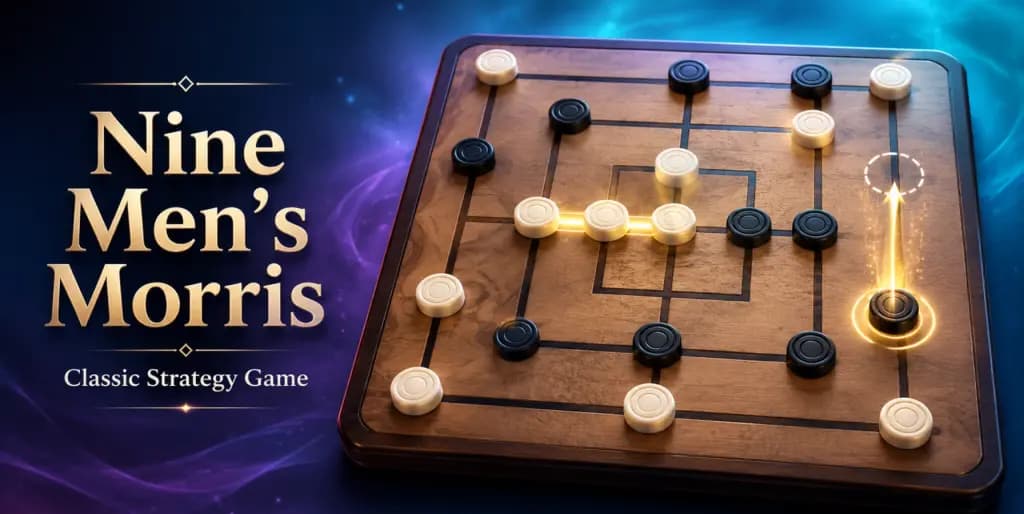
Brandubh is the small Irish member of the tafl family — the Viking hunt games — and you can play it here free in your browser, against three levels of computer opponent or against a friend at a shared table. No download, no account.
Two sides, two completely different jobs. A king sits in the middle of a seven-by-seven board with four guards. Around the edges wait eight attackers, twice as many. The king wants to reach any corner; the attackers want to catch him first. Nothing else in the classical board game canon is built like this.
At 49 squares it is the quickest way into the whole family: a game takes about ten minutes, and everything the big boards do is visible on this one.
What is Brandubh?
Brandub is Old Irish for black raven. It is the Irish version of hnefatafl, played on the smallest board the family uses — 7×7, with eight attackers against four defenders and a king.
Unusually for a tafl game, two early Irish texts describe it. Acallam na Senórach has it played with thirteen pieces, five against eight. The poem Abair riom a Éire ógh adds that one of the five is a branán, a chief, and that the five noble squares belong to him. Five against eight, with five squares reserved for the king: that is exactly the board below.
How to set up a Brandubh board
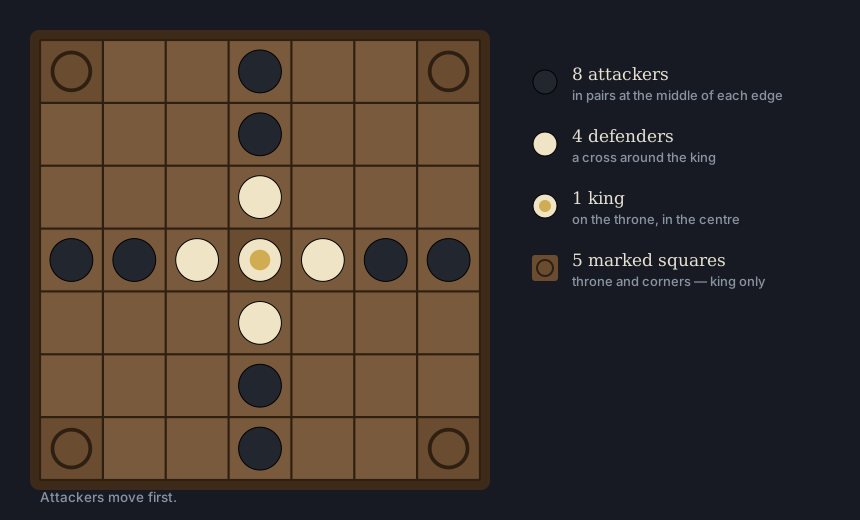
- The king goes on the throne, the marked square in the exact centre.
- The four defenders sit beside him, one in each direction — a cross.
- The eight attackers stand in pairs at the middle of each edge: one on the edge itself, one stepped inward.
- The four corners are marked. With the throne that makes five squares only the king may occupy.
The attackers move first.
How to play Brandubh
Moving
Every piece moves like a rook in chess: any distance along a row or column, never diagonally, never jumping over anything. One movement rule for everything on the board, king included.
To move here: click a piece, then click one of the green dots.
How pieces are captured
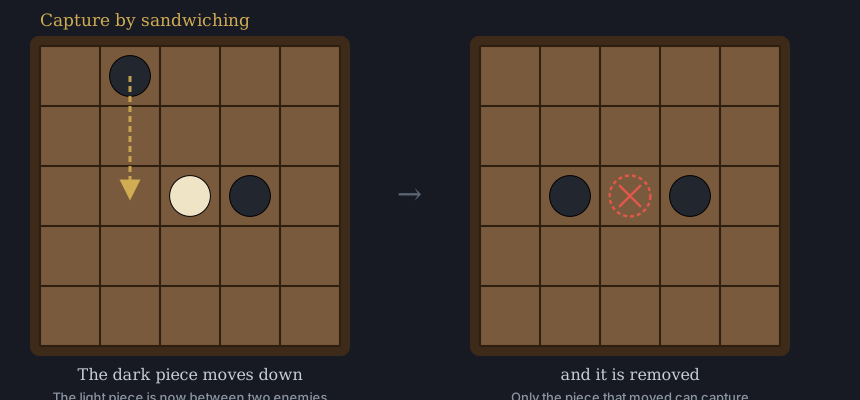
You capture by sandwiching: move a piece so an enemy is caught between it and another of your own, straight along a row or column.
- One move can capture on several sides at once.
- Only the piece that moved captures. Walking your own piece into the gap between two enemies is completely safe — and on a board this small you will do it constantly.
- There is no chain capture and no forced capture.
What the marked squares do
- They take only the king. Ordinary pieces may pass over the empty throne but not stop on it, and may never enter a corner.
- They are hostile to both sides: an empty throne or a corner counts as an enemy piece when somebody is being sandwiched.
How to win
- Defenders win when the king reaches any corner.
- Attackers win when they capture the king.
- A side with no legal move at all loses — being shut in is what the attackers are trying to achieve, so it is a defeat, not a draw.
- Threefold repetition, or fifty moves with no capture, is a draw.
Controls on this board
| What you see | What it means |
|---|---|
| Gold dashed ring | A piece that can move. Click to select, click again to deselect. |
| Green dot | A square your selected piece can move to. |
| Large gold dot | A corner — moving the king here wins the game on the spot. |
| Red pulsing ring | An enemy piece that this move would capture. |
| White circle | Where the last move ended. |
| Crown | The king. Watch which lines he can see down. |
Brandubh strategy
How to win as the attackers
You have eight pieces and it still is not enough, because you are defending four things at once.
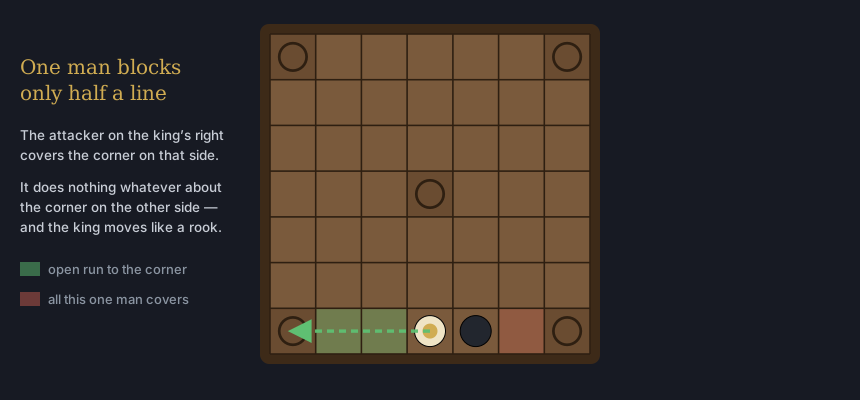
- Count the four lines. Top row, bottom row, left column, right column. Every corner sits on two of them. If the king reaches one with nothing between him and the corner, the game is over — there is no catching up.
- A man in the middle of a line only blocks half of it, as above. Check both directions before you decide a line is closed.
- Do not chase. The king moves like a rook and you need two pieces to take him. Close lines instead of following him.
- Trades are good for you. You start with twice the material. Every even exchange leaves the king with fewer shields.
How to win as the defenders
- Open a line, then walk it. Your first job is not to run — it is to get the king out of the centre with a route the attackers have thinned.
- Threaten two corners at once. A king who can reach two open lines in one move cannot be stopped: the attacker blocks one, you take the other.
- Your guards are shields, not soldiers. Four pieces cannot fight eight. Use them to open the king's road and to occupy squares the attackers need.
- The throne is a trap once you leave it. An empty throne turns hostile and will help capture your own men, and the king himself.
Play 2 player Brandubh online with a friend
Pick With a friend online, press Open a table and you get a four-character code. Send it to whoever you want to play — they open this same page, type the code and press Join. No account, no download, and a chat window in the corner.
This is the game on the site that gains most from a human opponent, because the two sides are not playing the same game. Swap seats between rounds and the board you thought you understood turns inside out: the lines you were guarding become the lines you are running down.
Whoever opens the table plays the attackers and moves first. The King setting belongs to the host, and it is named in the table line under the board so nobody is guessing.
Which Brandubh rules does this use?
Nobody knows the original rules, and any page that tells you otherwise is guessing. No rule text survives from the period tafl was played in. Here the king escapes to a corner, he is armed, and he is captured on two sides like any other piece.
The last two were measured rather than picked from a book — twenty games per setting with the strong computer on both sides, as attacker wins : defender wins : draws:
| Rule | Result |
|---|---|
| Armed king, two sides | 5 : 12 : 3 |
| Armed king, four sides | 0 : 18 : 2 |
| Unarmed king, two sides | 6 : 9 : 5 |
On 49 squares the four-sided king does not work at all: the ring needs almost the entire attacking force, and the king is through a corner long before it forms. Both settings are switchable under King in the panel — the four-sided king makes an excellent handicap when you are teaching somebody the attackers' side.
Hnefatafl, Brandubh, Tablut — what is the difference?
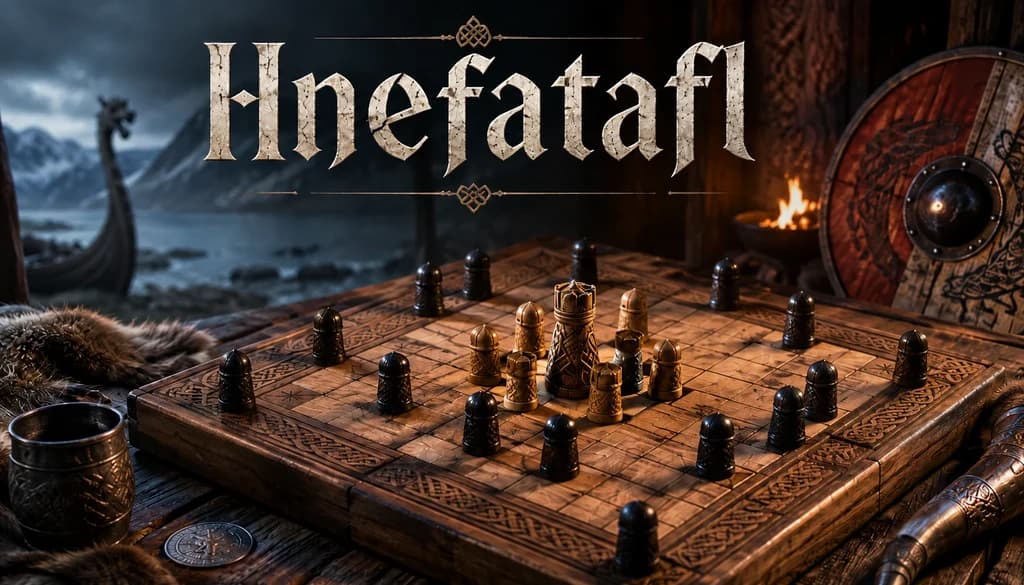
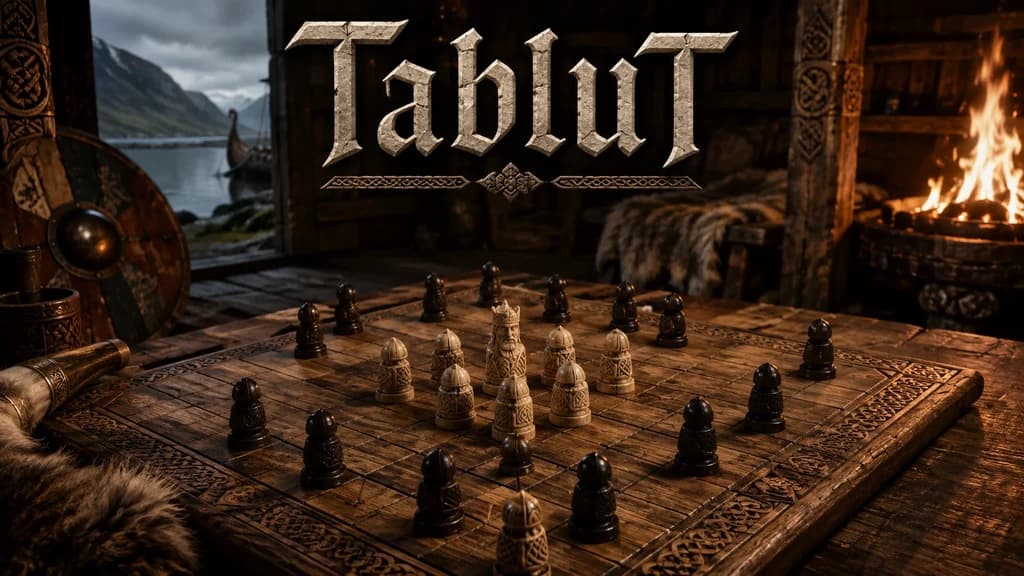
They are the same game at different sizes. Tafl is simply the Old Norse and Old English word for board game, and the family shares one design: a king and a small guard in the middle, an attacking force twice as large around the edge, rook moves, capture by sandwiching. What changes is the board, the piece count, and how well the rules are attested.
| Variant | Board | Setup | Where | Rules known from |
|---|---|---|---|---|
| Hnefatafl | 11×11 | 12 + king vs 24 | Scandinavia | Reconstructed from Tablut; the name doubles as the family term |
| Tablut | 9×9 | 8 + king vs 16 | Sámi, Lapland | Linnaeus watched a game in 1732 — the only eyewitness account there is |
| Brandubh (this page) | 7×7 | 4 + king vs 8 | Ireland | Two Old Irish poems, plus the Ballinderry board |
| Tawlbwrdd | 11×11 | 12 + king vs 24 | Wales | Robert ap Ifan's manuscript of 1587, with a diagram |
| Alea Evangelii | 19×19 | 24 + king vs 48 | Anglo-Saxon | A manuscript diagram — drawn as religious allegory, not as rules |
| Ard Rí | 7×7 | 8 + king vs 16 | Scotland | No historical source at all; very probably a modern invention |
Brandubh is the smallest and the quickest to learn, which is why it is a good place to start. The full 11×11 Hnefatafl board is a different animal — an hour rather than ten minutes, a game about blockades rather than sprints — and Tablut sits in between, on the one board anybody actually described from watching it played.
Not the same as Kubb
If you came here looking for Viking chess, check which game you mean. The name is attached to two unrelated things: this board game, and Kubb, the lawn game where you throw batons at wooden blocks. In German the confusion is almost total, where Wikingerschach nearly always means Kubb. This page is the board game.
Where Brandubh comes from
The name is in early Irish literature, and unusually for a tafl game, two texts say something concrete: thirteen pieces, five against eight, one of them a branán to whom the five noble squares belong.
The physical evidence matches. A wooden board dug out of a crannog at Ballinderry in 1932 — tenth century, a decorative border, two carved heads as handles — has seven rows of seven peg holes. Pegs, not flat counters, which suggests a set made to be carried and played on a journey.
So the shape of the game is well attested and the rules are not. That gap is the whole story of tafl: three pieces go deeper than this page can — the history of hnefatafl follows the evidence from a Danish bog to a grave at Birka; the tafl variants compared sorts all six by how much we actually know; and hnefatafl vs chess covers the game that replaced this one, and what a chess player has to unlearn.