
For something like eight hundred years, from the late Roman Iron Age to the twelfth century, people across northern Europe played a board game in which one side had a king and the other had twice as many men. We can say that with confidence, because they kept burying the boards.
What nobody did was write down how it worked.
That is the peculiar situation of hnefatafl. We have the equipment. We have poems about it, riddles about it, a saga scene where two men talk in code over a board. We have a set laid on the lap of someone important enough to be buried with two horses. What we do not have is a single line of rules from anybody who ever played it.
What comes out of the ground
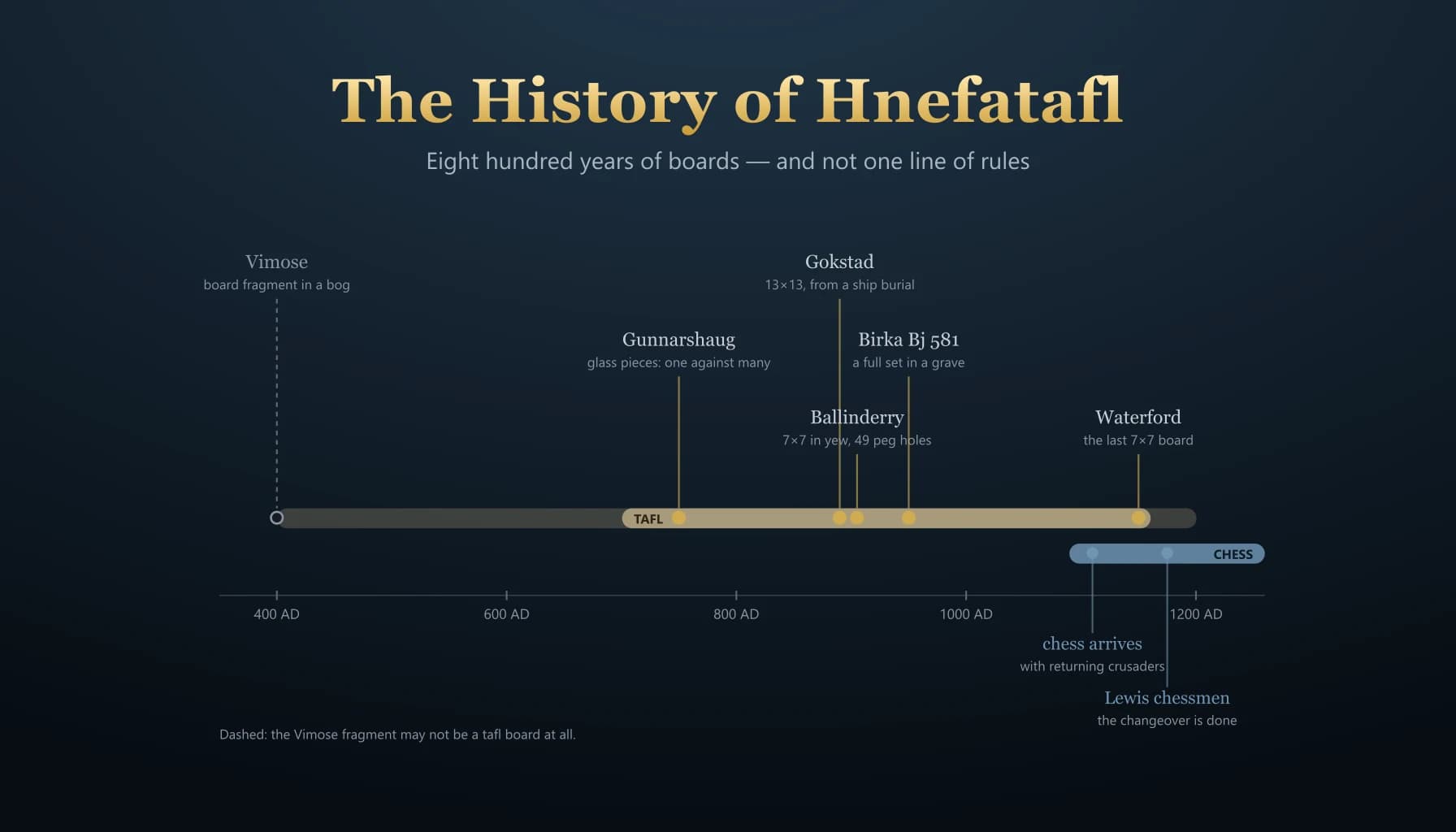
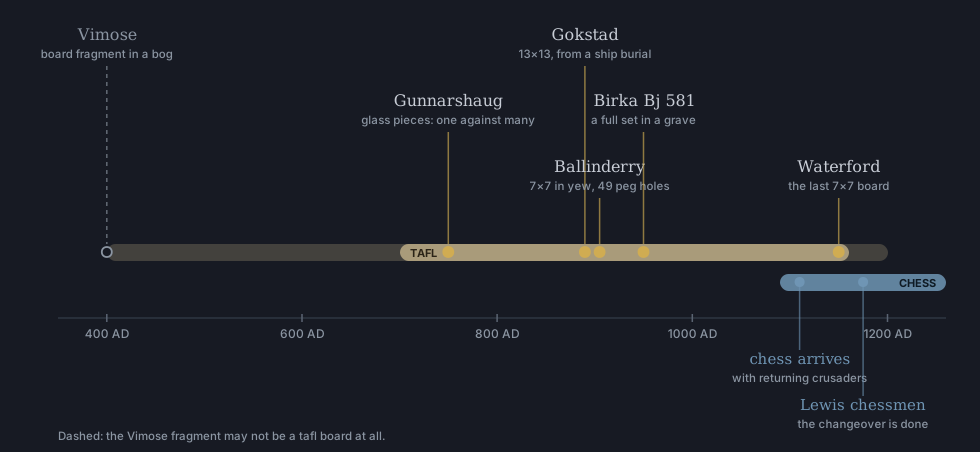
Vimose, Denmark, around AD 400. A fragment of a gaming board, thrown into a bog as part of a war-booty offering. It is the oldest object anyone puts on this list, and it is also the shakiest: it may have come from Romanised Germans and may not be a tafl board at all, but a board for ludus latrunculorum, the Roman "game of little soldiers". Start the story here and you are already guessing.
Gunnarshaug, Norway, eighth century. Glass gaming pieces that read as one king piece and a small force set against a large one. This is the first find where the shape of the game — the asymmetry, the thing that makes tafl tafl — is visible in the equipment itself rather than inferred.
Gokstad, Norway, ninth century. A board fragment from the famous ship burial, ruled into thirteen rows of thirteen. That size matches no other known game of the period, which is a useful kind of evidence: it tells us the family had more than one board size long before anyone tried to standardise it.
Ballinderry, Ireland, excavated 1932. The best-preserved board there is, pulled out of a crannog — a lake dwelling — in County Westmeath. Yew wood, about 26 by 17 centimetres, seven rows of seven peg holes, carved heads at the edges that served as handles, and panels of interlace around the border. Late ninth or early tenth century. It is in the National Museum of Ireland, and it is worth knowing that it takes pegs, not flat counters: this was a set built to be carried and played somewhere that moves.
Birka, Sweden, tenth century. More on this one below.
Waterford, Ireland, around 1150, and Buckquoy on Orkney. Two oak fragments of another 7×7 peg board from Waterford, plainer than Ballinderry. On Orkney, three boards scratched into stone — 7×7 grids with the centre point circled. The stone ones matter for a different reason than the fine ones: somebody without a craftsman's set still wanted to play, and marked out a board where they sat.
What the sagas say
The literature is thinner than the archaeology but sharper, because it occasionally lets slip a detail nobody would bother inventing.
In Hervarar saga, King Heiðrekr is challenged to a riddle contest by a stranger called Gestumblindi, who is the god Óðinn in disguise. One of the riddles runs, in translation:
Who are those maids, who fight weaponless around their lord? The darker protect during all the days, but the fairer go forth to attack.
The king solves it: it is a game of tafl. The riddle is doing exactly what riddles do — describing the thing without naming it — and in the process it records the two facts that define the game. The pieces around the lord defend. The others attack. Neither side is doing what the other is doing.
Friðþjófs saga goes further and is more useful. In it, two men hold a conversation over a board while appearing to discuss the game, and what leaks out of the scene is that the king's men are red, the attackers white, and that the word hnefi really does mean the king piece. That is a colour scheme and a piece name, recovered from a story that was not trying to teach anybody anything.
Note what is still missing. Nobody says how far a piece moves. Nobody says how a capture works. Nobody says where the king is trying to get to.
The set on her lap
Grave Bj 581 at Birka, excavated in 1878, is one of the richest warrior burials of the Viking age: a chamber grave with weapons, two horses, and — laid across the lap of the person buried there — a complete gaming set. Twenty- eight pieces including a king piece, three dice, and the iron frame of a board.
Two things about this grave are worth separating carefully, because they are usually run together.
The first is settled. Osteological analysis in 2014 and a DNA study in 2017 established that the person in Bj 581 was biologically female, overturning a century of assuming otherwise.
The second is not settled. The reading that she was a commander — that a gaming board in a grave signals someone who made tactical decisions rather than someone who followed them — is an interpretation, and a contested one. A reassessment published in Antiquity pushed back on how much can be read from grave goods at all. That argument is still live.
What is not in dispute is the object. Somebody thought a hnefatafl set belonged with this person, alongside the weapons and the horses, and that tells you something about where the game sat in that culture. It was not a distraction. It was equipment.
How it ended, and reasonably quickly
Chess reached Scandinavia in the eleventh and twelfth centuries. One specific route is documented: crusaders returning to Norway around 1107–1110 brought it back with them, along with everything else they brought back.
The Norse called it skáktafl — "chess-tafl". The old word simply attached itself to the new game, which is the linguistic fingerprint of a replacement rather than an addition. The Lewis chessmen, carved in the mid-twelfth century and found on the Isle of Lewis, are Norse work depicting the new game; they mark the changeover about as neatly as an object can. By around 1200, hnefatafl had been almost completely displaced.
Why is a harder question, and the honest answer is that we are reasoning from circumstance. The usual argument is that chess and tafl were too alike to coexist — both are war games, both occupy the same slot in a culture, and there was not room for two. Chess also arrived attached to the prestige of Christian Europe, at exactly the moment Scandinavia was joining it. And chess had something tafl never got: a written tradition. Rules, problems, a literature. When fashion turned, chess had a way to survive being unfashionable and tafl did not.
What was actually lost
This is the part that matters for anyone who wants to play it now.
The equipment survived. The rules did not. The entire modern reconstruction of every tafl game rests on one source: Carl Linnaeus, who in 1732 travelled through Lapland, watched Sámi hosts play a related game called Tablut, and wrote down what he could work out — in Latin, without speaking the language, from observation.
And then it got worse. The 1811 English translation of his diary rendered a phrase about the king as "except the king" where the original reads closer to "likewise the king". One word. It made the king uncapturable in the ordinary way, handed the defenders an enormous advantage, and shaped published tafl rules for the next century and a half.
So when you see a set sold with "the authentic Viking rules", what is in the box is a reconstruction from a botanist's holiday notes, filtered through a translator's slip. That is not a reason not to play it. It is a reason to be suspicious of anyone who tells you their version is the real one — including us, which is why every rule we chose is named and measured rather than asserted.
Play the game
All three surviving board sizes are here, and they are the same rules with different amounts of room:
- Hnefatafl, 11×11 — the full Viking board. About an hour.
- Tablut, 9×9 — the one Linnaeus actually watched.
- Brandubh, 7×7 — the Irish board, the one from Ballinderry. Ten minutes, and the fastest way to understand the family.
If you want to know how the six known variants compare and which of them have any evidence behind them at all, that is a separate piece: the tafl variants compared.