Tablut is the one tafl game anybody ever wrote down from watching it played, and you can play it here free in your browser — against three levels of computer opponent, or against a friend at a shared table. No download, no account.
In the summer of 1732 a twenty-five-year-old Swedish naturalist walked through Lapland collecting plants. In the evenings his Sámi hosts played a board game, and because he wrote down everything he saw, Carl Linnaeus wrote that down too — in Latin, in a travel diary, without speaking the language, working out the rules by watching.
That page is the only eyewitness description of a tafl game in existence. Every reconstruction of the Viking board game, on every board size, traces back to it. This is that game.
What is Tablut?
Tablut is the 9×9 member of the tafl family: sixteen attackers around the edge against eight defenders and a king in the centre. The two sides do not want the same thing. The attackers want the king; the king wants a corner.
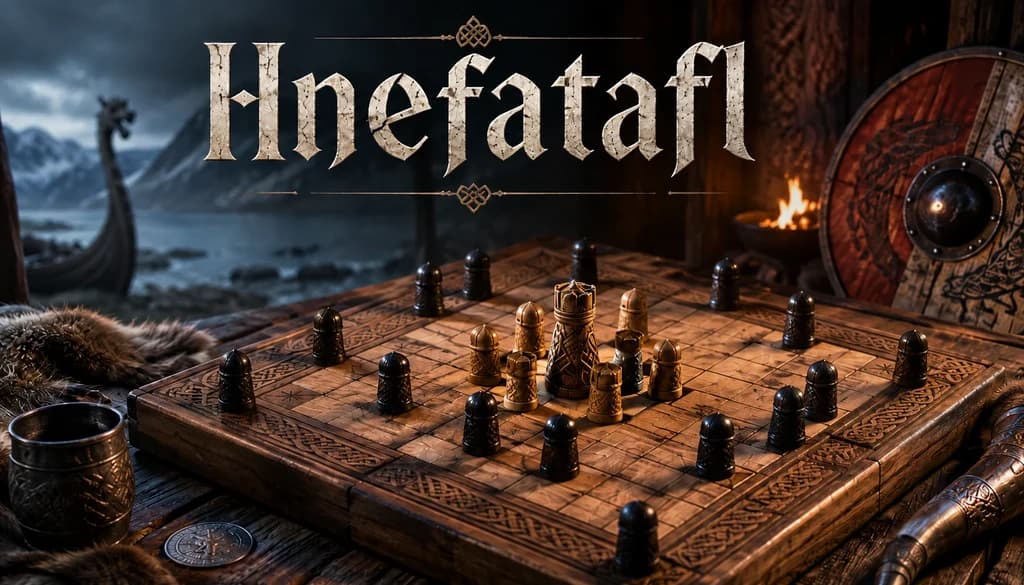
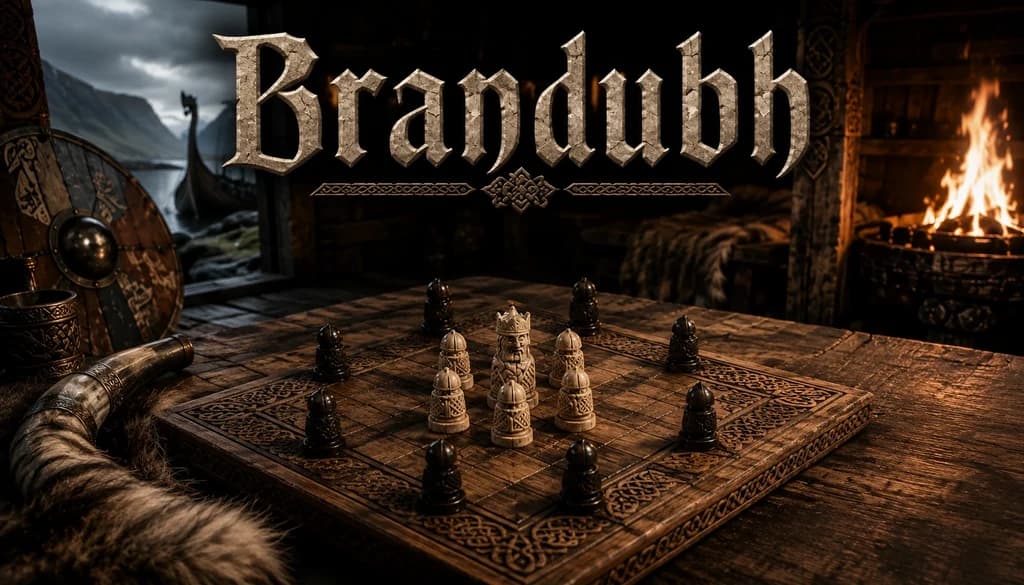
It sits between the small Irish board, Brandubh at 7×7, and the full Hnefatafl board at 11×11. Historically it is the source of both — they are Linnaeus's description with the board resized.
How to set up a Tablut board
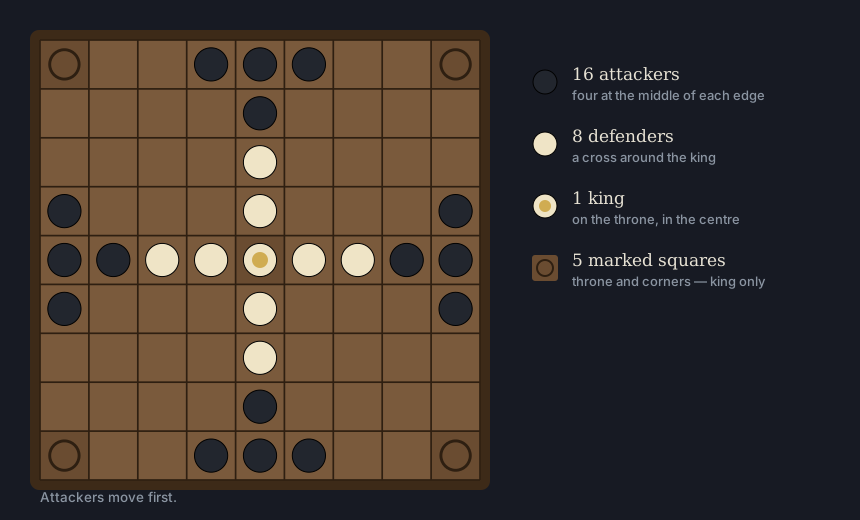
- The king goes on the throne, the marked square in the exact centre.
- The eight defenders form a cross around him, two in each direction.
- The sixteen attackers stand in four blocks of four: three in a row at the middle of each edge, plus one stepped inward.
- The four corners are marked. With the throne that makes five squares only the king may occupy.
The attackers move first.
How to play Tablut
Moving
Every piece moves like a rook in chess: any distance along a row or column, never diagonally, never jumping. One movement rule for everything on the board.
To move here: click a piece, then click one of the green dots.
How pieces are captured
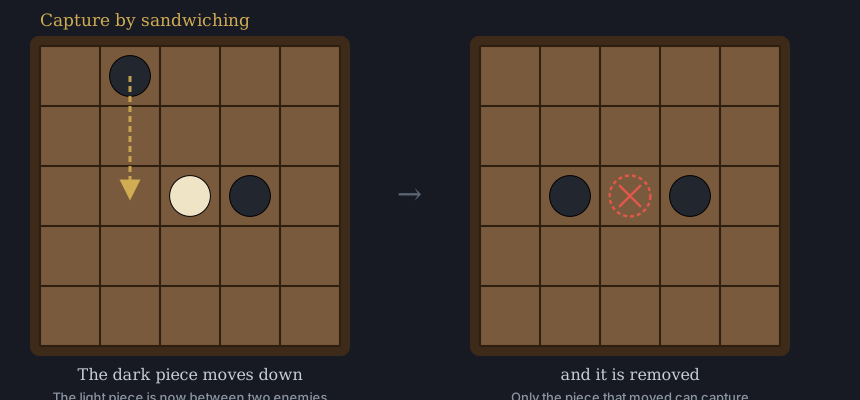
You capture by sandwiching: move a piece so an enemy is caught between it and another of your own, straight along a row or column.
- One move can capture on several sides at once.
- Only the piece that moved captures. Moving into the gap between two enemies is completely safe.
- There is no chain capture and no forced capture.
What the marked squares do
- They take only the king. Ordinary pieces may pass over the empty throne but not stop on it, and may never enter a corner.
- They are hostile to both sides: an empty throne or a corner counts as an enemy piece when somebody is being sandwiched.
How to win
- Defenders win when the king reaches any corner.
- Attackers win when they capture the king.
- A side with no legal move at all loses.
- Threefold repetition, or fifty moves with no capture, is a draw.
Controls on this board
| What you see | What it means |
|---|---|
| Gold dashed ring | A piece that can move. Click to select, click again to deselect. |
| Green dot | A square your selected piece can move to. |
| Large gold dot | A corner — moving the king here wins on the spot. |
| Red pulsing ring | An enemy piece that this move would capture. |
| White circle | Where the last move ended. |
| Crown | The king. |
Tablut strategy
Nine squares across changes the game from the small Irish board in one specific way: the king has room, and the attackers have men to spare.
How to win as the attackers
- Two rings, not one. With sixteen pieces you can hold the four corner lines and keep a second layer behind them. Losing the outer wall is survivable; losing both at the same point is not.
- A man in the middle of a line only blocks half of it. He covers the corner on his side of the king and nothing at all on the other. Count both directions before you call a line closed.
- Never chase. The king moves like a rook and you need two pieces to take him. Close lines instead of following him around.
How to win as the defenders
- Break one section, not the middle. Your eight guards cannot fight sixteen. Pick the thinnest part of the wall and trade there — the aim is a hole, not an advantage.
- Count before you run. A king one square from an open line is worth more than a king already on one and blocked. Set up two threats before stepping out.
- Leaving the throne is a commitment. It turns hostile the moment he steps off, and it will help capture your own men.
Play 2 player Tablut online with a friend
Pick With a friend online, press Open a table and you get a four-character code. Send it to whoever you want to play — they open this same page, type the code and press Join. No account, no download, chat included.
Whoever opens the table plays the attackers and moves first, and the host's King setting applies to both sides.
Which Tablut rules does this use?
Two things here differ from what Linnaeus wrote, and both are deliberate.
Corner escape, not edge escape
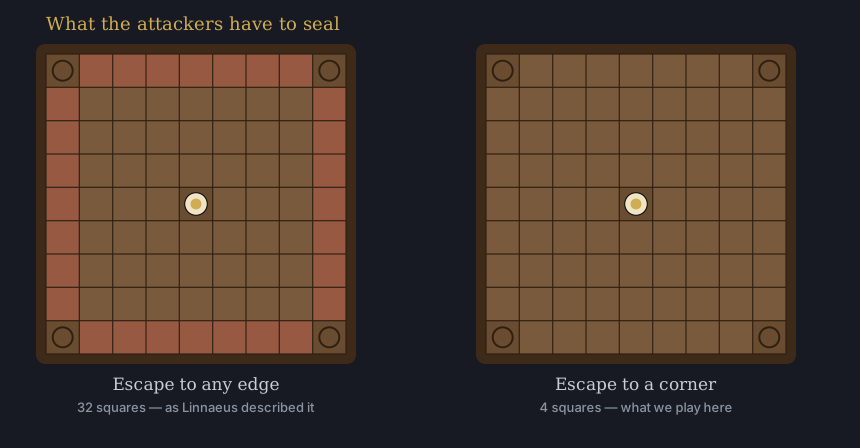
Linnaeus described escape to any edge square. We use corner escape, because edge escape does not produce a game: the attackers would have to seal thirty-two squares instead of four, and the king's side wins almost every time. It is also the rule the famous mistranslation below reinforced. Corner escape is what modern play settled on, for exactly this reason.
The king is armed and falls on two sides
That was measured on this board, with the strong computer playing both sides — attacker wins : defender wins : draws:
| Rule | Result |
|---|---|
| Armed king, two sides | 7 : 5 : 2 |
| Armed king, four sides | 0 : 7 : 7 |
| Unarmed king, two sides | 10 : 2 : 2 |
Nine squares is not room enough for this computer to close a ring around a king on all four sides — and neither, it turns out, is eleven: the full-size board measured 0 : 9 : 3 under the same rule. Strong human attackers do make it work, which is why tournaments use it. Ours cannot, so it is not the default here. Both settings are switchable under King, and for two people at a table the four-sided king is the better game.
The mistranslation that broke tafl for a century
Linnaeus wrote his account in Latin. When it was translated into English in 1811, a phrase about the king came out as "except the king" where the original reads closer to "likewise the king". One word, and the king stopped being capturable the ordinary way.
Rule sets built on that reading gave the defenders an enormous edge, and because Linnaeus was the only source, the error propagated into essentially every published version of hnefatafl for the next hundred and fifty years. The modern tournament rules — and the settings on this page — exist because people eventually played enough games to notice that one side kept winning.
It is a good reminder of how thin the evidence is: a single traveller, a language he did not speak, and a translator's slip.
Which board size should you play?
All three sizes use the same rules and play like genuinely different games:
| Board | Size | Pieces | A game takes | Play it if |
|---|---|---|---|---|
| Brandubh | 7×7 | 8 v 4 + king | ~10 min | You have never played tafl. Everything the family does is visible on it. |
| Tablut (this page) | 9×9 | 16 v 8 + king | ~20 min | You want the historical original — the board Linnaeus actually watched. |
| Hnefatafl | 11×11 | 24 v 12 + king | ~1 hour | You want the full siege: walls and lines rather than a sprint. |
Where Tablut comes from
Tablut is the tafl game of the Sámi, recorded in Lapland in 1732 and published in Linnaeus's travel diary. Everything else in this family is that account with the board resized — which is why a game played by Sámi hosts in the eighteenth century is the reason anybody can play a Viking board game at all.
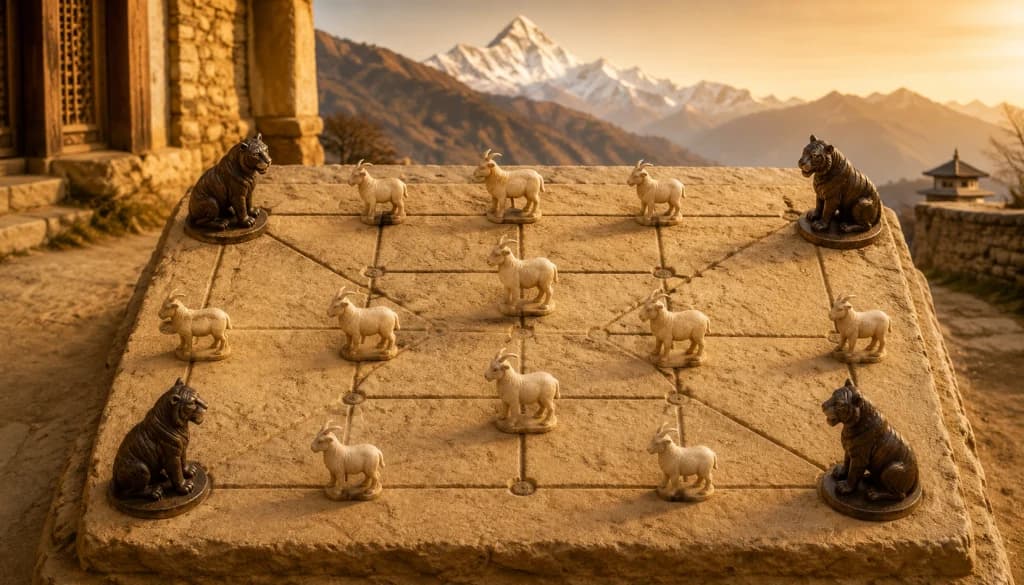
For the wider story: the history of hnefatafl covers what came out of the ground and what the sagas let slip; the tafl variants compared sorts all six by how much evidence there is behind each; and hunt games puts the whole family next to the tiger games of Nepal and the fox of medieval England.