
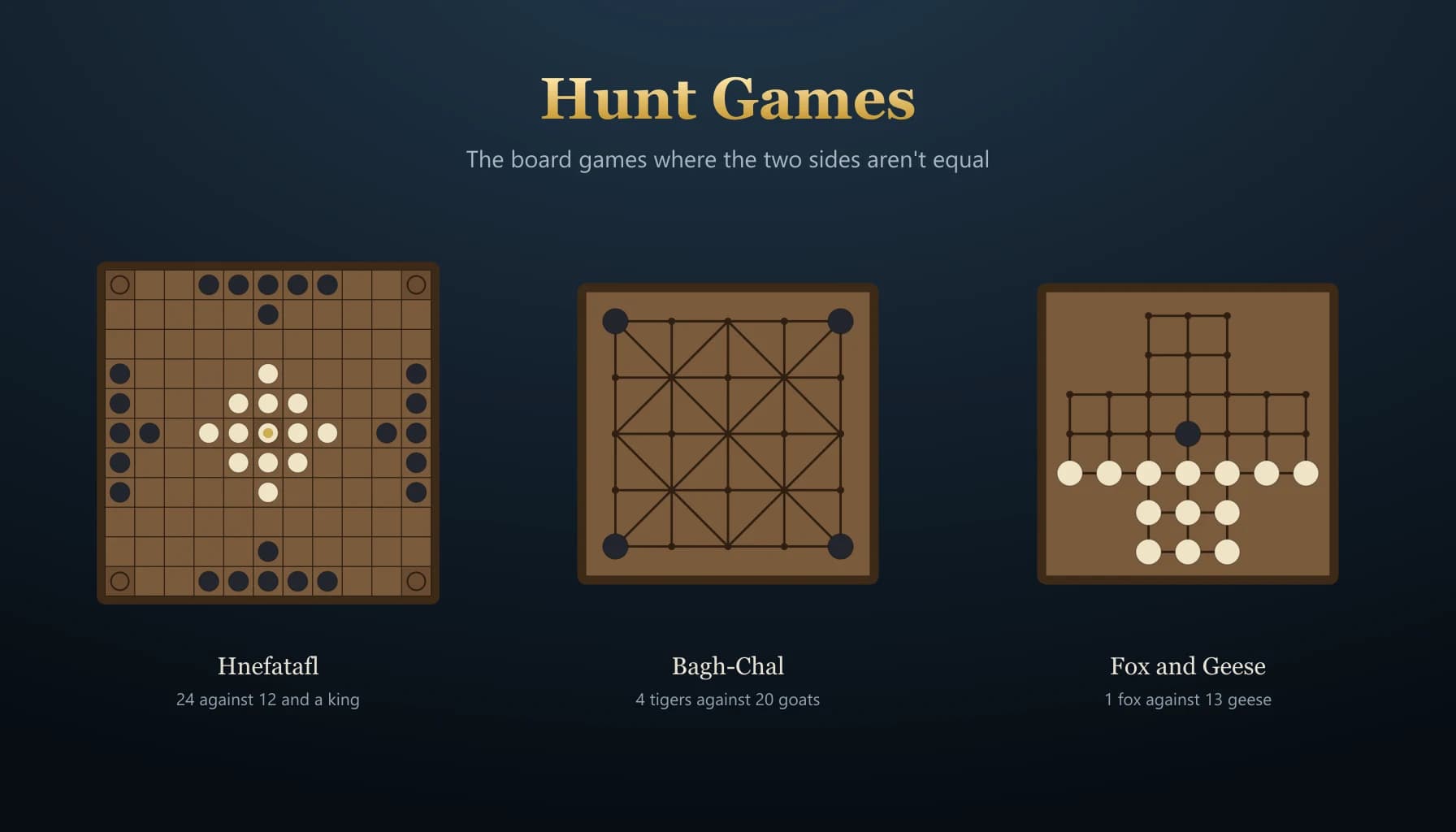
Almost every board game you know starts with mirror images. Chess, draughts, backgammon, go: same pieces, same powers, same objective, and the only thing separating the players is what they do next.
Then there is a whole family that does the opposite. One player gets a few strong pieces, the other gets many weak ones, and they are not even trying to achieve the same thing. Nepal has one. Medieval England had one. The Vikings had one. Malaysia, South India, nineteenth-century Germany — all of them, and mostly invented independently.
These are the hunt games, and they are the most under-appreciated corner of traditional board gaming.
What makes a hunt game
Three things, and all three are unusual:
- The forces are unequal in number, usually by a factor of two or more.
- The two sides win differently. The few must capture or escape; the many must trap, smother or block.
- Capture is often asymmetric too. In many of them the strong pieces take by jumping while the weak ones cannot capture at all — they win by sheer weight.
The result is a game where "who is winning" cannot be answered by counting pieces, which is precisely what makes them hard to learn and interesting to return to.
Bagh-Chal — Nepal
Bagh-Chal means "moving tigers", and it is playable here. Four tigers start on the corners of a 5×5 grid of lines; twenty goats come onto the board one per turn, and only after all twenty are placed may the goats start moving. Tigers capture by jumping a goat into an empty point beyond, exactly as in draughts. The goats never capture anything at all — they win by crowding the tigers until none of them can move.
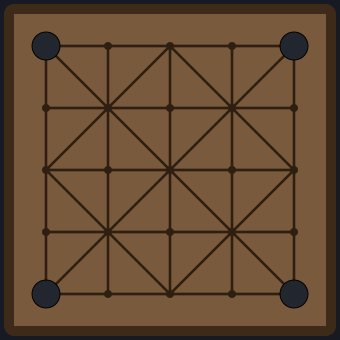
The lines are worth noticing. They are the same pattern as the Alquerque board — orthogonals everywhere, diagonals only at alternate points. That grid is one of the oldest in the world and turns up under half a dozen different games.
Rimau-rimau in Malaysia is the same idea with two tigers against twenty-two or twenty-four men, and one memorable wrinkle: a tiger may jump an odd number of men in a straight line — one, three, five — provided there are no gaps. The tigers win by capturing fourteen.
Aadu Puli Aatam in southern India is another cousin in the same tiger-hunt tradition, played on a triangular board rather than a square one.
Fox and Geese — northern Europe
The European branch — playable here — runs on the cross-shaped board most people now know as the peg solitaire board: 33 points. One fox starts in the middle. The geese fill one arm and advance. The fox jumps geese to remove them; the geese cannot capture at all, and win by penning the fox so he has nowhere to jump.
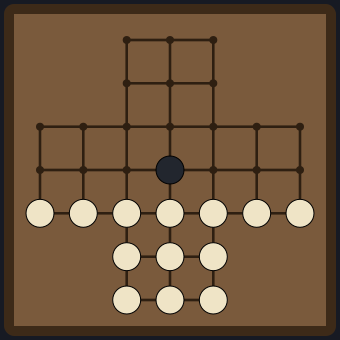
The earliest firm record is a royal account book. Edward IV of England (reigned 1461–1470 and 1471–1483) bought "two foxes and 26 geese" — almost certainly two sets of the game. Where it came from before that is less certain, but the Old Norse name halatafl, glossed as "fox game", puts something very like it in the same northern world as hnefatafl, several centuries earlier.
By the nineteenth century the idea had been re-skinned as Asalto — also sold as German Tactics or Officers and Sepoys — where the few become officers defending a fortress and the many become attackers storming it. Same skeleton, new uniform, and a distinctly imperial one.
The problem every one of them had to solve
Here is what makes this family genuinely interesting rather than merely quaint.
Asymmetric games do not balance themselves. In chess, the starting position is fair by construction: whatever one player has, the other has. A hunt game has no such guarantee. Somebody has to decide how many geese, how many tigers, what each side may do — and get it right, with no mathematics and no way to test beyond playing.
They all solved it the same way: by tuning the counts, over generations.
And it works — we can now show that rather than assert it. Bagh-Chal is playable here, so we put our own program on both sides at equal strength and ran twenty games at each of three levels:
| Both sides playing at | Tigers win |
|---|---|
| our weakest level | 90.0% |
| our middle level | 52.5% |
| our strongest level | 50.0% — all twenty drawn |
Four against twenty is badly lopsided between beginners and close to even between players who know the board. The tuning that generations of players did by feel produces a game that balances itself as the players improve — which is a stranger and better property than being fair from the first game.
The usual caveat applies: two programs of the same design measure themselves as much as they measure the game.
Fox and Geese is the clearest case. The earliest form is one fox against thirteen geese. Later forms raise it to fifteen, then seventeen — and at the same time restrict how the geese may move, precisely to offset the extra numbers. That is a balance patch, applied by nobody in particular, over a few hundred years of people noticing that one side kept winning.
Rimau-rimau does it with a threshold instead: the tigers do not need to eliminate the hunters, only to take fourteen of them. Bagh-Chal does it with the drop phase, which forces the goat player to feed pieces onto a board where tigers are already circling.
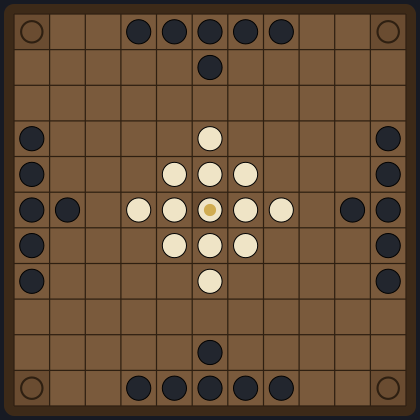
And the tafl games did it with board size and capture rules — which is a live argument to this day, because tafl's tuning was interrupted. The game died out around 1200 and was reconstructed from scratch in the twentieth century, so its balancing had to be redone from nothing. We measured all three board sizes rather than inheriting an answer, and got a different result on each one.
Why play an unfair game
The obvious objection to asymmetry is that it sounds unfair. In practice it does three things a symmetric game cannot.
You play both sides. Swap seats after a game and it is a different game with the same equipment. The lines you spent twenty minutes guarding are the lines you are now running down. Nothing in chess does this, because in chess both seats are the same seat.
It is a good handicap system. Give the beginner the side with more pieces and the simpler job. No piece odds, no clock handicap — the game has a built-in gradient.
It resists memorisation. There is no opening theory to learn, partly because almost nobody has written any, and partly because the two sides are answering different questions. You are working it out at the board.
Play them here
- Bagh-Chal — four tigers against twenty goats on the Alquerque grid. The clearest of the lot: one side jumps, the other cannot capture at all, and the goat player is making twenty decisions before the game proper begins.
- Fox and Geese — one fox against thirteen geese on the cross board, in the earliest recorded count. We had to settle the one rule this game has always fudged — when the fox has won — so we computed it: the cheapest cage on that board takes four geese, and below that the geese cannot win however they stand.
The tafl branch of the family is playable on this site at all three historical board sizes:
- Hnefatafl, 11×11 — twenty-four against twelve and a king, about an hour.
- Tablut, 9×9 — sixteen against eight and a king.
- Brandubh, 7×7 — eight against four and a king, ten minutes. The quickest way to feel what asymmetry does.
And Alquerque is worth a look for a different reason: it is the symmetric game played on the same grid as Bagh-Chal, and the jump-capture that the hunt games use is the one it handed on to draughts.
If you want the tafl side of this in more depth, there is the history of hnefatafl and the six known variants sorted by evidence.